




.webp)
.avif)
.avif)
If you’re a D2C founder, your acquisition is probably working. You’re driving traffic, getting first orders, and growing top-line revenue. The problem starts after that.
In 2025, e-commerce churn remained above 70%, meaning 7 out of 10 customers never returned after their first purchase. For most Shopify brands, this created a cycle where growth depended on constant acquisition while lifetime value stayed flat and margins kept shrinking.
This isn’t a traffic problem; it’s a progression problem. Most brands treat loyalty as a one-time initiative instead of a structured journey. But customers don’t become loyal randomly. They move through clear stages, from first purchase to preference to long-term advocacy.
The biggest drop-off happens between the first and second purchase, where most brands lose momentum.
In this guide, we’ll break down the three stages of brand loyalty, how customers behave at each stage, and how to move them forward using structured triggers like rewards, referrals, and post-purchase engagement, without adding complexity to your team.
Key Takeaways
- Most D2C brands lose momentum after the first purchase, with 70%+ churn; the real gap is in customer progression, not acquisition.
- Brand loyalty develops in stages: awareness → preference → loyalty, and each stage requires different strategies.
- The biggest drop-off happens between the first and second purchase, making early post-purchase engagement critical.
- Discounts drive repeat purchases, but true loyalty comes from trust, consistent experience, and engagement beyond transactions.
- Sustainable growth comes from building a structured system (rewards, referrals, reviews) that moves customers forward across stages, not one-off campaigns.
What Is Brand Loyalty?
Brand loyalty refers to a customer’s consistent preference for one brand over others, driven by positive experiences, trust, and perceived value over time.
For D2C founders and retention leads running Shopify brands, this distinction shows up clearly in your metrics. You might see repeat purchases during campaigns, but that doesn’t always translate into long-term customer value.
In e-commerce, loyalty goes beyond repeat purchases. Loyal customers don’t just come back, they choose your brand even when alternatives are available, often at a lower price.
It’s important to understand that brand loyalty has two dimensions:
- Behavioral loyalty: when customers repeatedly purchase from your brand
- Attitudinal loyalty: when customers feel a strong preference or emotional connection toward your brand
Many e-commerce brands achieve behavioral loyalty through discounts or convenience. But attitudinal loyalty is what creates long-term value, customers who trust your brand, recommend it to others, and continue buying without needing constant incentives.
This is why loyalty is often misunderstood. A customer who buys twice during a sale is not necessarily loyal. But a customer who consistently chooses your brand, engages with it, and advocates for it, that’s true brand loyalty.
Why Understanding Brand Loyalty Stages Matters
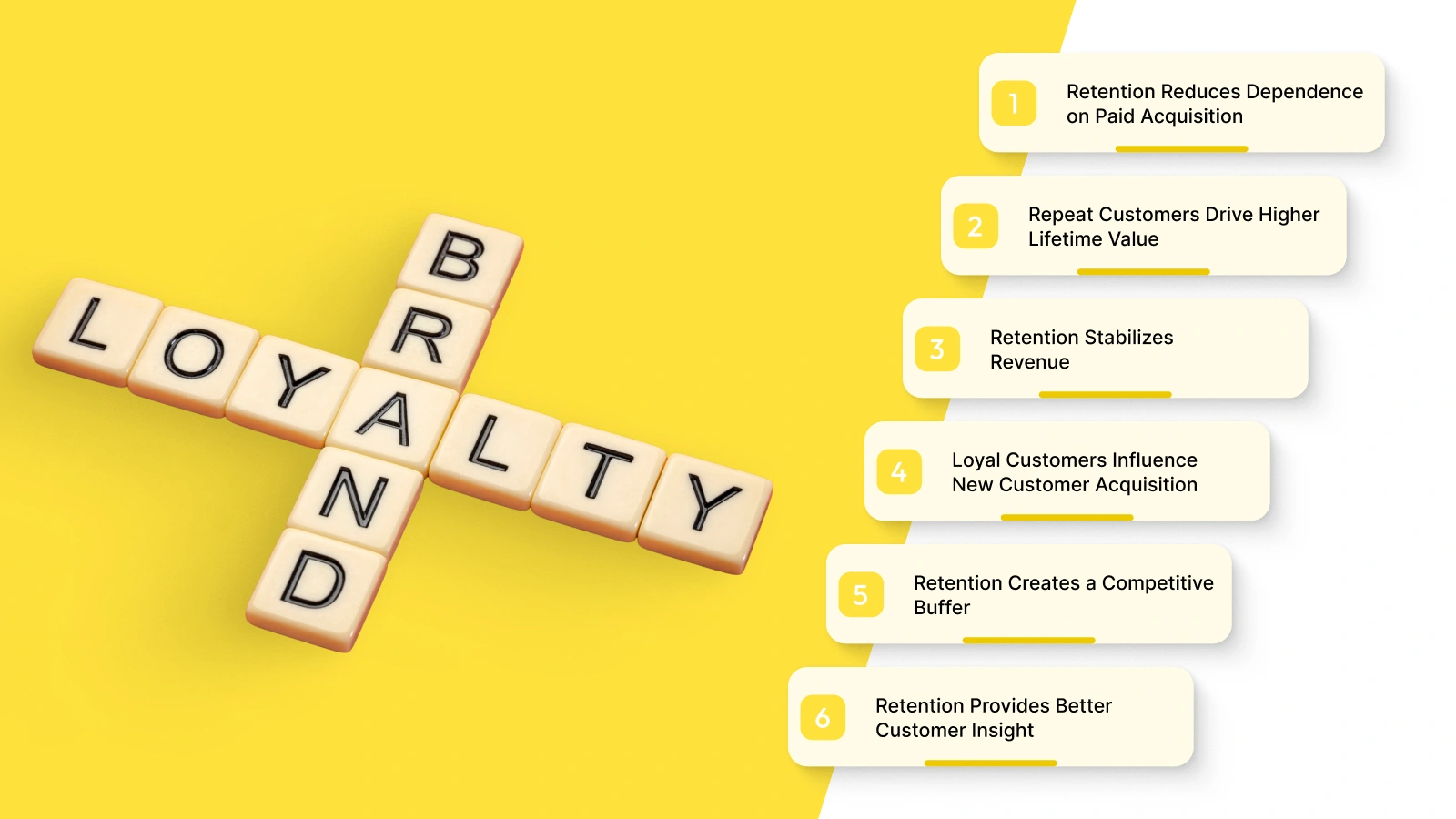
Most e-commerce brands try to build loyalty without understanding how it actually develops.
They offer discounts to first-time buyers, run the same campaigns for all customers, and expect repeat purchases to translate into long-term loyalty. But without recognizing where a customer is in their journey, these efforts often fall short. Here’s why it’s important:
1. Retention Reduces Dependence on Paid Acquisition
For most e-commerce brands, acquisition is the biggest cost center. Paid ads, influencer campaigns, and discounts can drive traffic, but they don’t guarantee long-term revenue.
Retention changes that dynamic.
When customers return on their own, you reduce the need to continuously spend on acquiring new buyers. Over time, this lowers your overall cost of growth and improves marketing efficiency.
2. Repeat Customers Drive Higher Lifetime Value
First-time purchases rarely generate significant profit. Margins are often offset by acquisition costs.
Repeat customers behave differently:
- They purchase more frequently
- They explore more products
- They require less persuasion
As a result, they contribute more revenue over time, increasing customer lifetime value without proportional increases in marketing spend.
For example, with Nector, fashion brand XYXX saw 38% higher AOV from customers earning/redeeming loyalty points on expanded carts, plus 74.4% referral completion rates as buyers shared links post-reward, proving repeats don't just return, they explore more products and spend more through structured incentives.
3. Retention Stabilizes Revenue
E-commerce revenue can be unpredictable when it depends entirely on new customer acquisition. Retention introduces consistency.
When a portion of your customer base continues to return, you build a more reliable revenue stream. This makes it easier to forecast demand, plan inventory, and make long-term decisions.
4. Loyal Customers Influence New Customer Acquisition
Retention doesn’t just impact existing customers; it also affects how new customers discover your brand.
Satisfied customers:
- Leave reviews
- Recommend products
- Share experiences with others
This creates organic acquisition channels that are often more trusted than paid marketing.
5. Retention Creates a Competitive Buffer
In highly competitive markets, customers have multiple alternatives. If your relationship with customers is purely transactional, switching becomes easy.
But when customers are engaged, recognized, and rewarded over time, they are less likely to move to competitors, even when prices or offers change.
6. Retention Provides Better Customer Insight
Your most valuable insights don’t come from first-time buyers; they come from repeat customers.
Their behavior helps you understand:
- What drives repeat purchases
- Which products perform best over time
- What experiences matter most
This allows you to refine your strategy based on real customer behavior, not assumptions.
If you’re seeing repeat purchases fluctuate or relying heavily on discounts to bring customers back, the gap is usually in how your loyalty system is structured.
With Nector, you can map rewards, referrals, and review triggers to each stage of the customer journey, so customers don’t just return, they progress toward higher engagement and advocacy, without adding manual work to your team.
Book a demo and see how a structured loyalty system impacts your repeat purchase rate and LTV.
The Three Stages of Brand Loyalty That Turn First-Time Buyers Into Repeat Customers
.webp)
Brand loyalty is often described using different frameworks, but most of them follow the same underlying progression. Customers don’t become loyal instantly; they move through stages as their relationship with your brand strengthens over time.
For e-commerce brands, this journey can be simplified into three core stages: awareness, preference, and loyalty.
Stage 1: Awareness and Initial Trust
At this stage, customers are aware of your brand and may have interacted with it once.
They might have:
- Discovered your brand through ads or social media
- Visited your website
- Made a first purchase
However, there is little to no attachment.
Customer behavior at this stage:
- Highly price-sensitive
- Willing to explore alternatives
- Low trust and brand recall
In e-commerce, this often looks like a customer purchasing during a sale and not returning.
What this means for your strategy:
Your focus here should be on building trust and reducing friction. A smooth first experience, clear product information, easy checkout, and reliable delivery play a critical role in moving customers forward.
Stage 2: Preference and Engagement
At this stage, customers begin to prefer your brand over others based on positive experiences. They are no longer just trying your brand; they are considering it as a reliable option.
Customer behavior at this stage:
- Repeat purchases (second or third order)
- Active comparison with competitors
- Influenced by experience, not just price
In e-commerce, this is when customers return because they trust your product or service, not just because of discounts.
What this means for your strategy:
Your goal here is to reinforce that preference and make the experience more engaging.
This includes:
- Consistent product and delivery experience
- Personalized communication
- Early-stage rewards or incentives
This stage is critical. Without consistent engagement, customers can easily switch to competitors.
Stage 3: Loyalty and Commitment
This is the stage where true brand loyalty is established. Customers don’t just prefer your brand, they consistently choose it and are less influenced by competitors.
Customer behavior at this stage:
- Repeat purchases without relying on discounts
- Strong trust in your brand
- Higher spending and engagement
These customers are more likely to:
- Recommend your brand
- Leave reviews
- Engage beyond transactions
In e-commerce, these are your most valuable customers. They contribute not only through repeat purchases but also by influencing others.
What this means for your strategy:
At this stage, the focus shifts from conversion to relationship-building.
This includes:
- Rewarding loyalty consistently
- Recognizing high-value customers
- Creating opportunities for deeper engagement
These customers are not just buyers; they are long-term contributors to your brand’s growth.
If you’re trying to move customers across these stages without adding more tools or manual work, Nector lets you map rewards, referrals, and review triggers to each stage of the journey. Book a demo to see how your customers can keep progressing instead of dropping off after their first purchase.
How Customers Move Between Loyalty Stages
Customers don’t move from awareness to loyalty automatically. Progression happens when each interaction reinforces trust and reduces friction.
The journey typically looks like this:
- A customer discovers your brand and makes a first purchase
- A positive experience builds initial trust
- Consistent engagement encourages a second and third purchase
- Over time, trust turns into preference and then commitment
The biggest drop-offs usually happen between the first and second purchase. This is where most e-commerce brands lose momentum.
To move customers forward, each stage needs a clear trigger:
- Awareness → Preference: strong first experience + post-purchase follow-up
- Preference → Loyalty: consistent experience + incentives + engagement
Without these triggers, customers stall or churn instead of progressing.
Common Mistakes E-commerce Brands Make
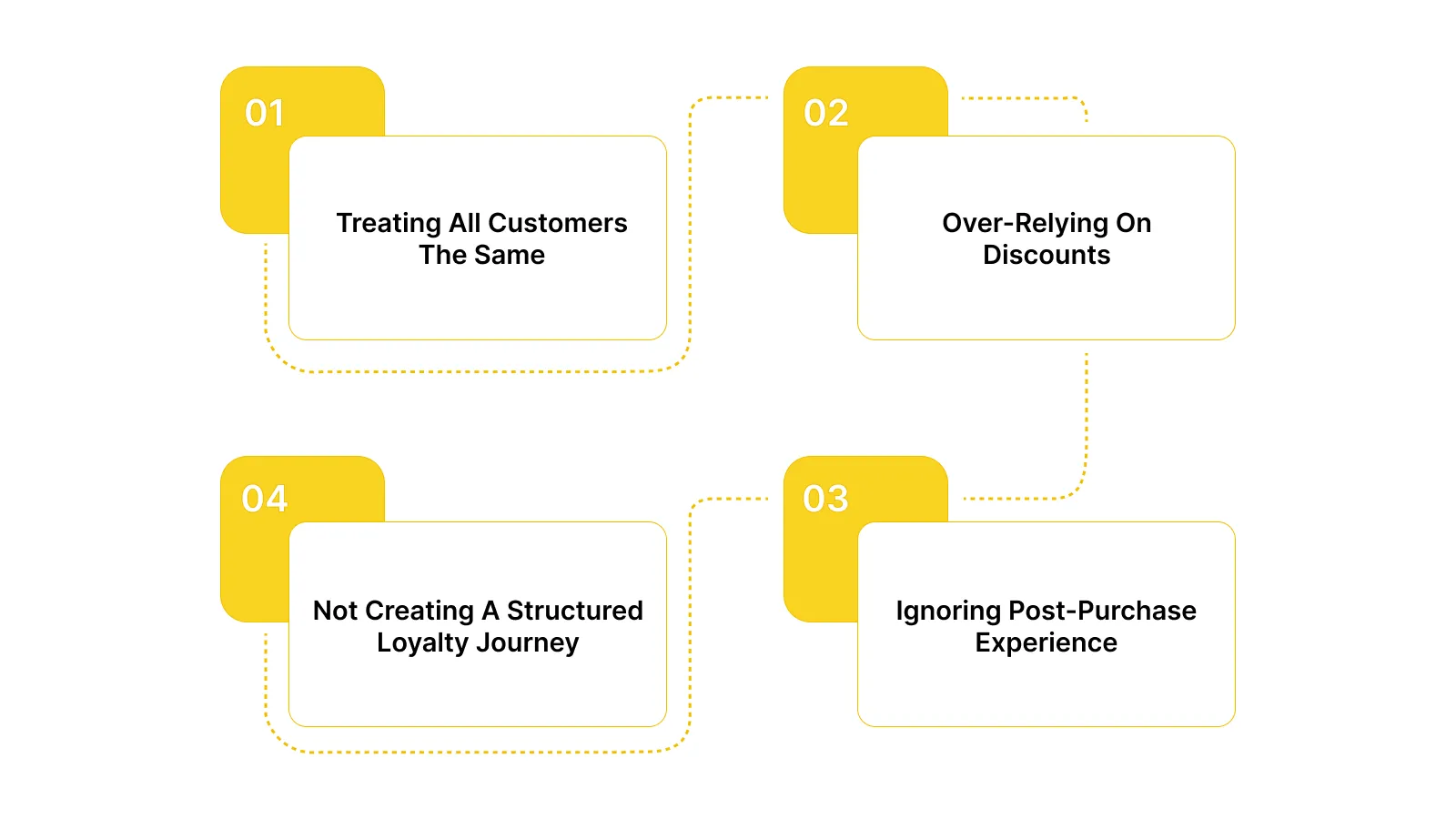
Many brands struggle with loyalty not because they lack effort, but because they apply the wrong strategy at the wrong stage.
1. Treating All Customers the Same
A first-time buyer and a repeat customer often receive the same messaging and offers. This leads to irrelevant communication and missed opportunities to deepen relationships.
2. Over-Relying on Discounts
Discounts can drive repeat purchases, but they rarely build true loyalty. Customers trained to wait for offers are more likely to switch when a better deal appears.
3. Ignoring Post-Purchase Experience
Many brands focus heavily on acquisition and conversion but neglect what happens after checkout. Without post-purchase engagement, customers have no reason to return.
4. Not Creating a Structured Loyalty Journey
Loyalty is often treated as a campaign instead of a system. Without a structured approach, engagement becomes inconsistent and difficult to scale.
Strategies to Move Customers Across Loyalty Stages
Each stage requires a different approach. What works for acquisition won’t work for long-term loyalty. For D2C founders and retention leads managing Shopify brands, this is where most gaps show up. You might be driving strong first orders, but without a structured system, customers don’t progress beyond that.
1. Moving From Awareness to Preference
At this stage, the goal is to build trust and drive the second purchase. For small teams, this is the most critical drop-off point, where most customers are lost.
Focus on:
- A smooth onboarding and first purchase experience
- Clear product value and communication
- Post-purchase follow-ups (email, WhatsApp, SMS)
- Early incentives for repeat purchases
The second purchase is the most important milestone here. If customers don’t return quickly, they are unlikely to come back at all.
2. Moving From Preference to Loyalty
Once customers start returning, the focus shifts to strengthening the relationship.
For growing Shopify brands, this is where you move from campaign-driven retention to building a system.
Focus on:
- Consistent product and delivery experience
- Personalized communication based on behavior
- Rewards for repeat purchases
- Engagement beyond transactions
This is where structured loyalty programs start to make a measurable impact on repeat purchase rate and LTV.
3. Strengthening Loyalty and Encouraging Advocacy
At this stage, customers already trust your brand. The goal is to deepen that relationship and turn them into growth drivers.
For retention-focused teams and agencies, this is where loyalty compounds into referrals and organic acquisition.
Focus on:
- Exclusive rewards and perks
- Referral incentives
- Recognition for loyal customers
- Opportunities to engage with the brand
These customers don’t just buy. They refer, review, and influence new customers, making them your highest-value segment.
Build Loyalty Across All Stages Without Adding Complexity
.webp)
For D2C founders and retention leads, the challenge isn’t understanding loyalty. It’s executing it consistently without adding more tools, workflows, or team bandwidth.
Most Shopify brands know they need rewards, referrals, and post-purchase engagement. But running all of this manually or across separate tools makes it difficult to maintain consistency across the customer journey.
Nector solves this by turning loyalty into a structured system that runs across all stages, from first purchase to advocacy.
Loyalty Programs That Encourage Progression
Nector enables brands to reward customers at every stage:
- first purchase incentives to drive second orders
- points-based rewards that customers can track in real time, with clear visibility into how close they are to their next reward
- tiered programs to recognize long-term customers
This helps move customers from awareness to preference and eventually to loyalty.
Referral Programs That Drive Advocacy
Once customers reach the loyalty stage, referrals become a natural next step.
Nector allows customers to:
- share referral links through WhatsApp, email, and other channels
- earn rewards for successful referrals
This turns loyal customers into acquisition channels.
Review Programs That Build Trust Early
Reviews play a critical role in the early stages of loyalty.
Nector helps brands:
- automate review collection
- reward customers for feedback
- build social proof
This strengthens trust for new customers and supports progression through the loyalty stages.
Final Thoughts
Brand loyalty is not a one-time outcome. It’s a journey. Customers move from discovering your brand to trusting it, and eventually to choosing it consistently. Each stage requires a different approach, and missing even one step can slow down that progression.
For e-commerce brands, the opportunity lies in building systems that support this journey at scale.
When you align your strategy with how loyalty actually develops, you don’t just increase repeat purchases; you build long-term customer relationships that drive sustainable growth.
If you’re trying to move customers from first purchase to long-term loyalty without increasing operational complexity, Nector helps you do it through structured loyalty, referral, and review programs.
Instead of managing multiple tools, you can create a unified system that keeps customers engaged across every stage of their journey. Book a demo and see how you can build loyalty at scale.
Frequently asked questions
What are the three stages of brand loyalty?
The three stages are awareness, preference, and loyalty. Customers move from recognizing a brand to preferring it and eventually committing to it.
What is the difference between brand preference and brand loyalty?
Brand preference means customers favor your brand but may still switch. Brand loyalty means they consistently choose your brand and are less influenced by competitors.
How do you move customers from awareness to loyalty?
By delivering a strong first experience, maintaining consistent engagement, and introducing incentives that encourage repeat purchases.
Why is brand loyalty important for e-commerce?
Loyal customers drive repeat purchases, higher lifetime value, and referrals, making them critical for long-term growth.
Can repeat customers be non-loyal?
Yes. Customers may return due to discounts or convenience without having a strong preference for your brand.


.webp)