




.webp)
.avif)
.avif)
Most e-commerce stores celebrate every sale, yet only 30% of buyers return for another purchase. Watching customers vanish despite your efforts can feel discouraging and unfair.
Low customer loyalty silently drains revenue, but it doesn’t have to be this way. By addressing the gaps that push buyers away, you can turn one-time shoppers into repeat customers who fuel sustainable growth.
This guide uncovers why buyers disappear, the hidden loyalty gaps hurting your business, and the strategies that actually keep customers coming back.
Key Takeaways
- Low customer loyalty causes one-time buyers to vanish, increasing marketing costs and limiting revenue growth.
- Customers leave when they don’t feel rewarded, remembered, or valued after their first purchase.
- Personalized engagement, loyalty programs, referrals, and tiered rewards significantly improve repeat purchases.
- Tracking metrics like repeat purchase rate, customer lifetime value, and retention rate shows the impact of loyalty efforts.
- Platforms like Nector simplify loyalty management, helping brands turn one-time buyers into consistent repeat customers.
What is Low Customer Loyalty?
Low customer loyalty happens when buyers purchase once but do not return or engage with your brand. It signals that your marketing spend is not generating long-term value and your customers are not becoming repeat buyers.
Key impacts of low customer loyalty include
- Higher marketing costs to replace lost customers.
- Lower lifetime value because most buyers purchase only once.
- Reduced marketing efficiency by targeting new rather than returning customers.
- Unpredictable revenue that depends on continuous acquisition.
- Weak competitive position compared to brands with loyal customers.
Addressing low customer loyalty is essential to increasing repeat purchases, improving customer lifetime value, and driving sustainable business growth.
Why Customers Leave After the First Purchase (And What Brands Miss)
Most e-commerce brands don’t lose customers due to product failures. They lose them because something in the ownership or repurchase journey makes customers feel there’s no upside in returning. These are the five most common root causes.
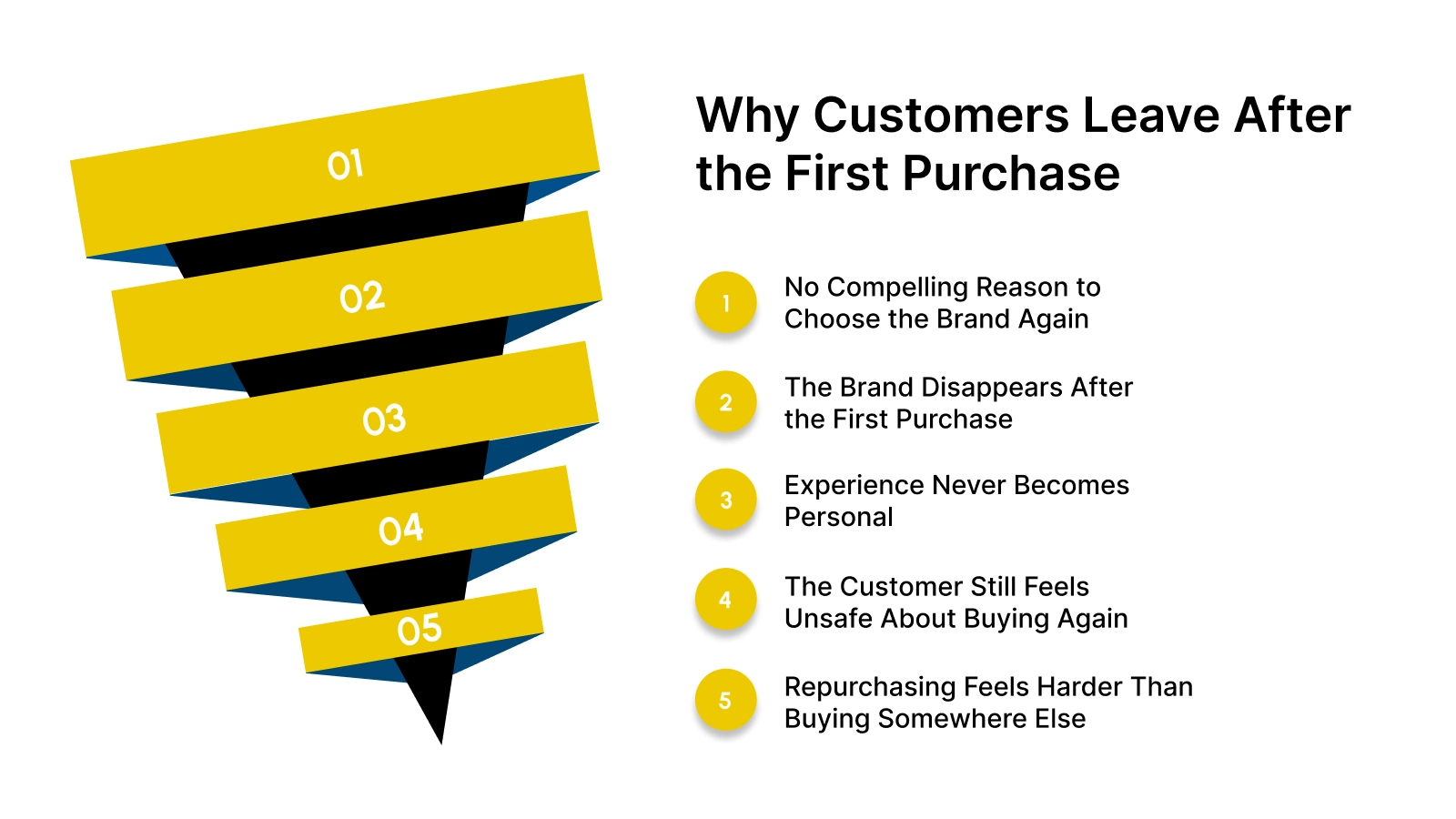
1. No Compelling Reason to Choose the Brand Again
If customers can get the same benefits elsewhere, loyalty will never form. Discounts, variety, or convenience become the deciding factor, not the brand relationship. Customers return when staying loyal creates clear value, points, perks, exclusives, recognition, or savings tied to buying again.
2. The Brand Disappears After the First Purchase
Many brands put all their effort into sales and none into the time between purchases. If the brand isn’t present when the need returns, customers default to whoever shows up in front of them at that moment.
3. Experience Never Becomes Personal
A customer’s second purchase decision is emotional, not logical. If every message, recommendation, and offer feels generic, the customer sees no progression in the relationship. Relevant communication signals, “We know you.” Generic communication signals, “You’re just a transaction.”
4. The Customer Still Feels Unsafe About Buying Again
After purchasing one, customers still seek reassurance that the decision was right, especially in categories where fit, results, sizing, durability, or expectations matter. If reviews, UGC, before-and-afters, or testimonials aren’t continually visible, doubt quietly erodes repeat-purchase confidence.
5. Repurchasing Feels Harder Than Buying Somewhere Else
A slow site, unclear returns, missing payment options, slow responses, or complicated checkout don’t stop the first sale; the customer is motivated then. But the memory of that friction becomes the reason to try a competitor next time, where they expect a smoother experience.
None of these issues is a deal-breaker on its own, but together they determine whether a customer comes back or quietly moves on. To overcome this, you need to intentionally design loyalty into every stage of the customer journey, giving buyers clear reasons to return, engage, and choose your brand again.
Also Read: How to Increase Repeat Customer Visits Using Loyalty Platforms

11 Strategies to Build Stronger, Long-Term Customer Loyalty
These strategies are proven approaches that successful brands use to transform one-time buyers into repeat customers, driving sustainable revenue growth.
1. Give Customers a Reason to Come Back
A strong loyalty program works because it creates momentum. The more customers engage, the harder it feels to walk away.
What an effective program includes
- Points earned on every purchase with simple, transparent conversion rates.
- Additional ways to earn through reviews, referrals, birthdays, and social engagement.
- Flexible redemption options such as discounts, free products, or early access.
- Tiered levels (bronze, silver, gold) that unlock increasingly valuable benefits.
- Clear visibility of point balances and available rewards at all times.
- Thoughtful point expiration that encourages activity without feeling punitive.
2. Turn Customers Into Your Best Acquisition Channel
Referrals work because they’re rooted in trust. Customers are far more likely to buy when a friend recommends you.
How to encourage sharing
- Reward both sides so referrals feel fair and generous.
- Make sharing effortless with one-click links via email, SMS, WhatsApp, and social.
- Show referral progress clearly so customers know when rewards are earned.
- Offer incentives meaningful enough to motivate action (typically 10–20%).
- Surface referral prompts in post-purchase emails and account dashboards.
- Acknowledge and reward your top referrers with exclusive perks.
To make this even easier, you can use a platform like Nector to automate referral tracking and reward distribution, turning satisfied customers into a steady acquisition engine without added operational effort.
3. Use Reviews to Build Trust and Commitment
Reviews deepen existing customers’ attachment to your brand.
How to collect and leverage reviews
- Ask for reviews 7–14 days after delivery, once customers have had a real experience.
- Incentivize text, photo, or video reviews with loyalty points.
- Use frictionless, one-click review links that pre-fill key details.
- Feature fresh reviews prominently on product and category pages.
- Respond publicly to every review to show accountability and appreciation.
- Reuse customer photos and quotes across email, ads, and social content.
4. Personalize Instead of Broadcasting
Customers tune out generic messaging. Relevance is what keeps them engaged.
Ways to personalize at scale
- Segment customers by purchase frequency, categories, and lifetime value.
- Tailor product recommendations and incentives to each segment.
- Dynamically change homepage content based on browsing or purchase history.
- Send replenishment reminders aligned with product usage cycles.
- Automatically adjust email content based on customer behavior.
- Use different incentives for VIPs, first-time buyers, and win-back audiences.
5. Use Status and Progress to Increase Spend
People are motivated by progress. Tiered programs turn spending into a goal-driven experience.
Designing tiers that motivate
- Limit tiers to 3–4 levels based on annual spend or points earned.
- Increase value at each tier with higher earn rates, free shipping, or early access.
- Show progress visually so customers know how close they are to the next level.
- Celebrate tier upgrades with personalized messages and surprise rewards.
- Trigger bonuses at key spending milestones, even outside tier upgrades.
- Offer exclusive events or experiences to top-tier members.
6. Let Automation Do the Heavy Lifting
Retention shouldn’t depend on manual follow-ups. Automation ensures consistency.
High-impact workflows to automate
- Thank-you emails, onboarding tips, review requests, and replenishment reminders.
- Re-engagement campaigns for customers who have been inactive for 60, 90, or 120 days.
- Abandoned cart reminders with escalating urgency.
- Notifications when points are ready to redeem or nearing expiration.
- Birthday and anniversary messages with small rewards.
- Triggers based on browsing behavior or interest in specific categories.
7. Remove Friction Wherever It Appears
Even loyal customers will leave if buying becomes inconvenient.
Where to simplify
- Reduce checkout steps, enable guest checkout, and offer multiple payment options.
- Optimize mobile speed, navigation, and tap targets.
- Make returns and refunds straightforward and clearly explained.
- Provide instant support via chatbots and explicit response-time guarantees.
- Improve site search, menus, and filtering.
- Allow one-click reorders from the customer account dashboard.
8. Make the Post-Purchase Experience Count
What happens after checkout determines whether customers come back.
Post-purchase moments that matter
- Share usage tips, setup guides, or care instructions.
- Offer multiple support channels with fast response times.
- Proactively check in before minor issues turn into frustration.
- Send real-time shipping updates and delivery confirmations.
- Follow up 1–2 weeks after delivery to confirm satisfaction.
- Maintain a strong library of FAQs, tutorials, and troubleshooting content.
9. Create a Smooth Experience Everywhere
Customers don’t think in channels; they expect continuity.
How to stay consistent
- Sync loyalty points across online, mobile, and in-store experiences.
- Let carts and wishlists carry over between devices.
- Centralize customer data into a single profile.
- Keep branding, tone, and promotions consistent.
- Allow support conversations to continue across channels.
- Enable flexible fulfillment options, such as BOPIS and cross-channel returns.
10. Build a Brand People Want to Belong To
The strongest loyalty comes from identity, not incentives.
Ways to nurture your community
- Create private spaces like Facebook groups, Discord servers, or forums.
- Host virtual or in-person events, workshops, or meetups.
- Highlight customer stories and transformations.
- Encourage experienced customers to help newcomers.
- Use insider language that signals membership.
- Take authentic stands on issues your audience cares about.
11. Reward Engagement and Not Just Spending
Emotional loyalty grows when customers feel seen and appreciated.
Beyond transactional rewards
- Incentivize engagement like social follows, surveys, and content sharing.
- Celebrate birthdays, anniversaries, and long-term milestones.
- Introduce challenges, badges, or achievement levels.
- Surprise loyal customers with unexpected rewards.
- Allow points to be donated or gifted.
- Invite customers to vote on products, test betas, or shape future launches.
You don’t need to implement everything at once. Start where friction or disengagement is highest, measure impact, and layer in additional strategies over time.
Also Read: 10 Best Customer Loyalty Software Platforms in 2026
How to Tell If Your Loyalty Strategy Is Actually Working?
Building loyalty strategies is half the challenge. Proving they work is the other half. You need concrete metrics showing whether your efforts are increasing repeat purchases and driving profitable growth.
Key Metrics for Assessing Customer Loyal
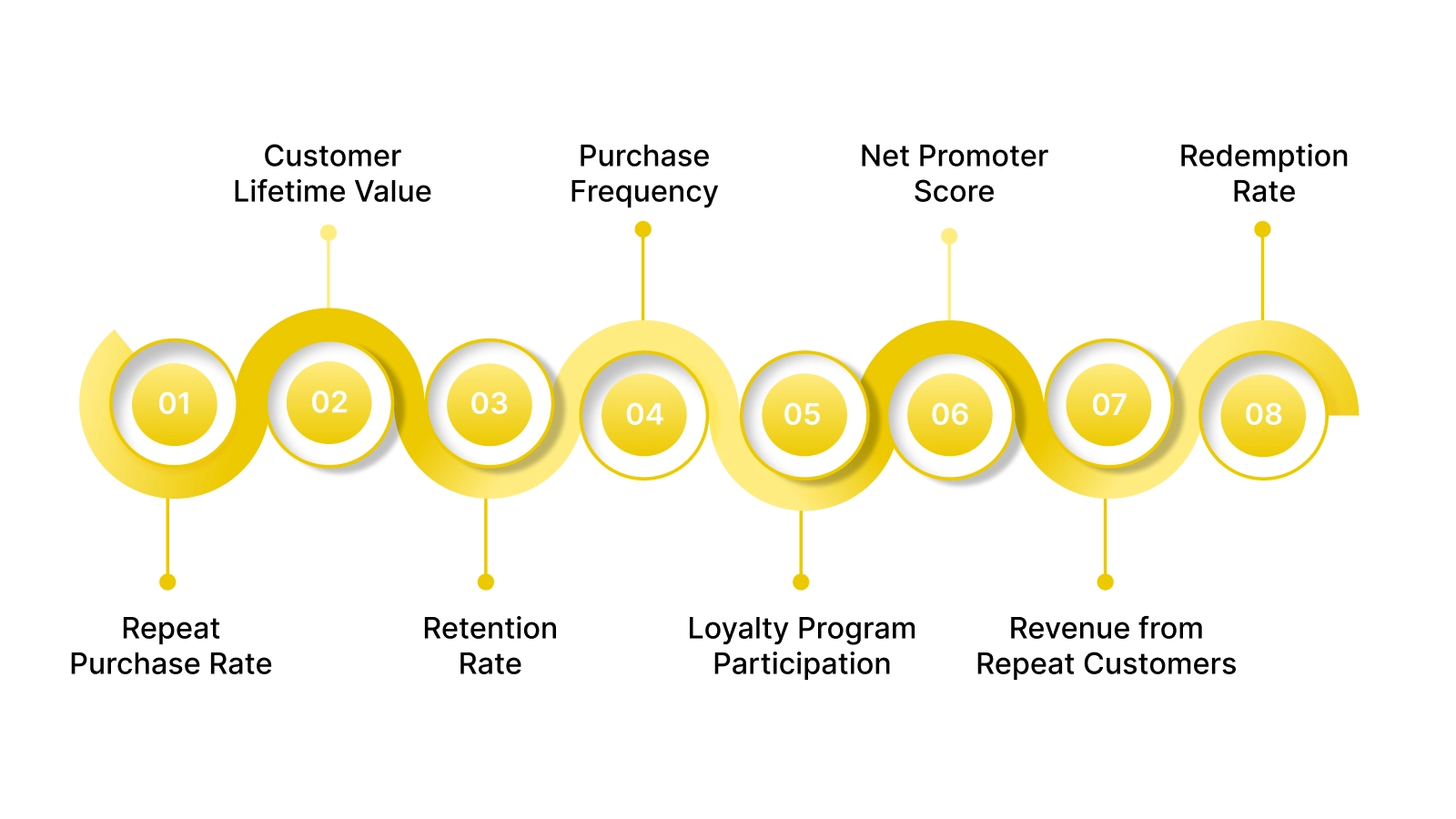
The right metrics tell you whether your loyalty initiatives are working and where to double down your efforts. These core indicators should be tracked consistently over time to spot trends and measure improvement.
Critical metrics to monitor:
- Repeat Purchase Rate: Percentage of customers who make a second purchase within a specific timeframe (typically 90-180 days). This is your most direct loyalty indicator. Calculate it by dividing the number of customers who bought more than once by the total customers in that period. Benchmark: Healthy e-commerce repeat rates range from 25% to 35% by category.
- Customer Lifetime Value (CLV): Total revenue you can expect from a customer over their entire relationship with your brand. Calculate it by multiplying the average order value, purchase frequency, and average customer lifespan. Rising CLV means your loyalty efforts are working. Track CLV by acquisition channel and customer segment to identify your most valuable sources.
- Retention Rate: Percentage of customers from a specific period who make another purchase in a subsequent period. Calculate it by dividing the number of customers who bought in both periods by the total number of customers in the first period. Track this monthly or quarterly to see if retention improves as you implement loyalty strategies.
- Purchase Frequency: How often customers buy within a given timeframe. Calculate the average days between purchases or the number of orders per customer per year. Increasing frequency means customers are thinking of your brand more often, which is the goal of retention efforts.
- Loyalty Program Participation: Percentage of customers enrolled in your loyalty program and percentage of enrolled customers actively earning or redeeming rewards. Low participation means your program is not compelling enough or not visible enough.
- Net Promoter Score (NPS): Measures customer willingness to recommend your brand on a scale of 0-10. While not purely transactional, NPS strongly correlates with repeat purchase behavior and predicts future growth. Survey customers regularly to track this.
- Revenue from Repeat Customers: Total revenue generated by customers making their second or subsequent purchase. Compare this to new customer revenue. As loyalty improves, repeat revenue should grow as a percentage of total revenue. Target has 40-60% of revenue from repeat customers.
- Redemption Rate: Percentage of earned loyalty points or rewards that customers actually redeem. Low redemption suggests rewards are not compelling or the process is too complex. Aim for a 20-40% redemption rate.
Tracking these metrics helps you see the impact of your loyalty initiatives, optimize your efforts, and invest in actions that truly drive repeat business.
Also Read: How Smart Brands Are Redefining Loyalty to Drive Retention (2026 edition)
Supercharge Customer Loyalty and Repeat Purchases with Nector
.webp)
Building an effective loyalty program from scratch takes significant development resources and ongoing maintenance. Most e-commerce brands lack the technical bandwidth to develop and manage this internally.
Nector is a complete loyalty and retention platform explicitly designed for Shopify and WooCommerce stores, delivering enterprise-level capabilities without the complexity or cost. Instead of piecing together separate tools for rewards, referrals, reviews, and engagement, you get a unified system where everything works together.
- Customizable loyalty programs with points for purchases, referrals, reviews, social engagement, birthdays, and milestones. Set your own earning rules and redemption options to match your brand and margins.
- Built-in referral system that tracks referred customers automatically, distributes rewards to both parties, and provides shareable links across email, SMS, and social channels.
- Review collection and display with automated requests, photo and video uploads, AI-powered summaries, and customizable on-site widgets that build trust and improve conversion.
- VIP tier structures that segment customers by value and unlock progressively better benefits, creating aspirational goals that drive increased spending.
- Automated engagement workflows for post-purchase sequences, win-back campaigns, reward redemption reminders, and behavior-triggered messages that keep customers engaged without manual work.
- Omnichannel points tracking so customers can earn and redeem rewards consistently, whether shopping on the web, mobile app, or in-store, if you have physical locations.
- Deep analytics dashboard showing repeat purchase rates, program ROI, member versus non-member behavior, redemption patterns, and all the metrics covered in the previous section.
- 50+ integrations with email platforms (Klaviyo, Mailchimp), marketing tools (MoEngage, WebEngage), customer support systems, and checkout solutions, ensuring Nector fits into your existing tech stack.
- Developer-friendly APIs are available if you need custom functionality beyond the standard features, giving you flexibility to build exactly what your brand needs.
- Dedicated support and migration assistance to move from existing loyalty platforms without losing customer points or creating confusion during the transition.
The interface lets you customize everything without writing code, while providing the technical depth larger operations need. Nector grows with your business, with pricing that scales with order volume.
Customer Loyalty Success Stories
Many brands assume customers don’t return because products fall short. In reality, repeat purchase drops when customers don’t feel recognized or rewarded after the first order.
The following case studies show how different brands addressed specific loyalty gaps and the measurable outcomes that followed.
317% Lift in Repeat Purchases After Loyalty Took Shape
DTC innerwear brand
Rapid growth attracted first-time buyers, but very few returned. The turning point came when loyalty became an ongoing relationship rather than a post-checkout add-on.
The brand introduced points for purchases, reviews, referrals, and milestones, supported by a tiered structure that rewarded continued engagement.
As a result:
- Repeat purchases increased by 317%.
- Customers actively earned and redeemed rewards.
- The average order value rose as shoppers moved to higher tiers.
70× ROI from Loyalty for a Premium Baby Furniture Brand
High-ticket products and infrequent buying made retention difficult to predict. Instead of relying on discounts, the brand focused on staying visible between purchases.
Points were tied to non-purchase actions, such as referrals and social engagement, while automated reminders ensured customers didn’t forget the value they had already earned.
The impact was clear:
- 70× return on loyalty investment within the first year.
- Vigorous referral activity from existing customers.
- Repeat purchases across complementary categories.
These success stories share common elements: clear loyalty value propositions, rewards for multiple behaviors beyond purchases, visible program benefits, and consistent communication about points and rewards.
Wrapping Up
Low customer loyalty is not a reflection of your product but of the systems that surround it. When first-time buyers disappear, it means your brand has not given them reasons to return, stay present, or make repeat purchases effortless.
You can use platforms like Nector to get a complete loyalty and retention system that helps you implement rewards, referrals, social proof, and automated engagement without heavy technical resources.
Start turning one-time buyers into repeat customers today and build lasting loyalty that drives revenue growth with Nector. Book a demo now!
Frequently asked questions
How can subscription models improve customer loyalty?
Subscription models create predictable revenue and continuous engagement by providing convenience, exclusive benefits, and personalized offerings, encouraging repeat purchases and a stronger emotional connection with your brand over time.
What role does packaging play in retaining customers?
Packaging influences first impressions and repeat perception. Memorable, functional, and branded packaging reinforces quality, builds trust, and enhances customer experience, encouraging buyers to return and recommend your brand.
Can gamification boost repeat purchases?
Gamification introduces challenges, rewards, and interactive elements, motivating customers to engage more frequently, explore products, and accumulate benefits, thereby increasing purchase frequency and strengthening brand loyalty over time.
How does post-purchase content affect loyalty?
Providing tutorials, usage tips, and care guides after purchase reduces confusion, improves product satisfaction, and demonstrates brand care, increasing the likelihood of repeat purchases and positive customer advocacy.
What influence do social responsibility initiatives have on loyalty?
Brands that support social causes or sustainability initiatives resonate with customer values, creating emotional bonds, differentiating from competitors, and motivating repeat purchases from socially conscious consumers.


.webp)