

.avif)
.avif)
Most e-commerce brands focus heavily on acquisition, yet the real leak happens after the first purchase. Only 15 to 30 percent of customers return, which means the majority churn early and never place a second order.
For small teams and founder-led stores, that churn is costly. It increases dependence on paid ads and makes growth feel like starting from zero each month.
Reducing churn is not about bigger campaigns.
It comes from simple, consistent retention workflows that keep customers engaged and returning to their natural buying cycle.
This guide covers the most effective churn reduction strategies for modern e-commerce brands and how loyalty, personalization, and automation work together to lift repeat purchases with less effort.
At a glance:
- Churn reduction is about building simple, consistent workflows that keep customers engaged after their first purchase.
- Reducing churn improves revenue predictability, lowers acquisition costs, and increases customer lifetime value.
- Effective churn strategies include structured post-purchase journeys, loyalty rewards, personalized offers, and omnichannel consistency.
- Identifying at-risk customers early and running lifecycle reminders significantly improves repeat purchase rates.
- Loyalty programs and review-based trust building turn occasional buyers into long-term loyal customers.
- A strong win-back framework helps recover inactive customers and reduces long-term revenue loss.
What Are Churn Reduction Strategies?
Churn reduction strategies are the systems and workflows a brand uses to prevent customers from dropping off after their first purchase. In e-commerce, churn often shows up as long gaps between orders, declining engagement, or customers quietly shifting to competitors.
The goal of churn reduction is to keep customers active, interested, and moving toward their next purchase without adding extra workload for the team.
Why Do They Matter for E-Commerce Brands?
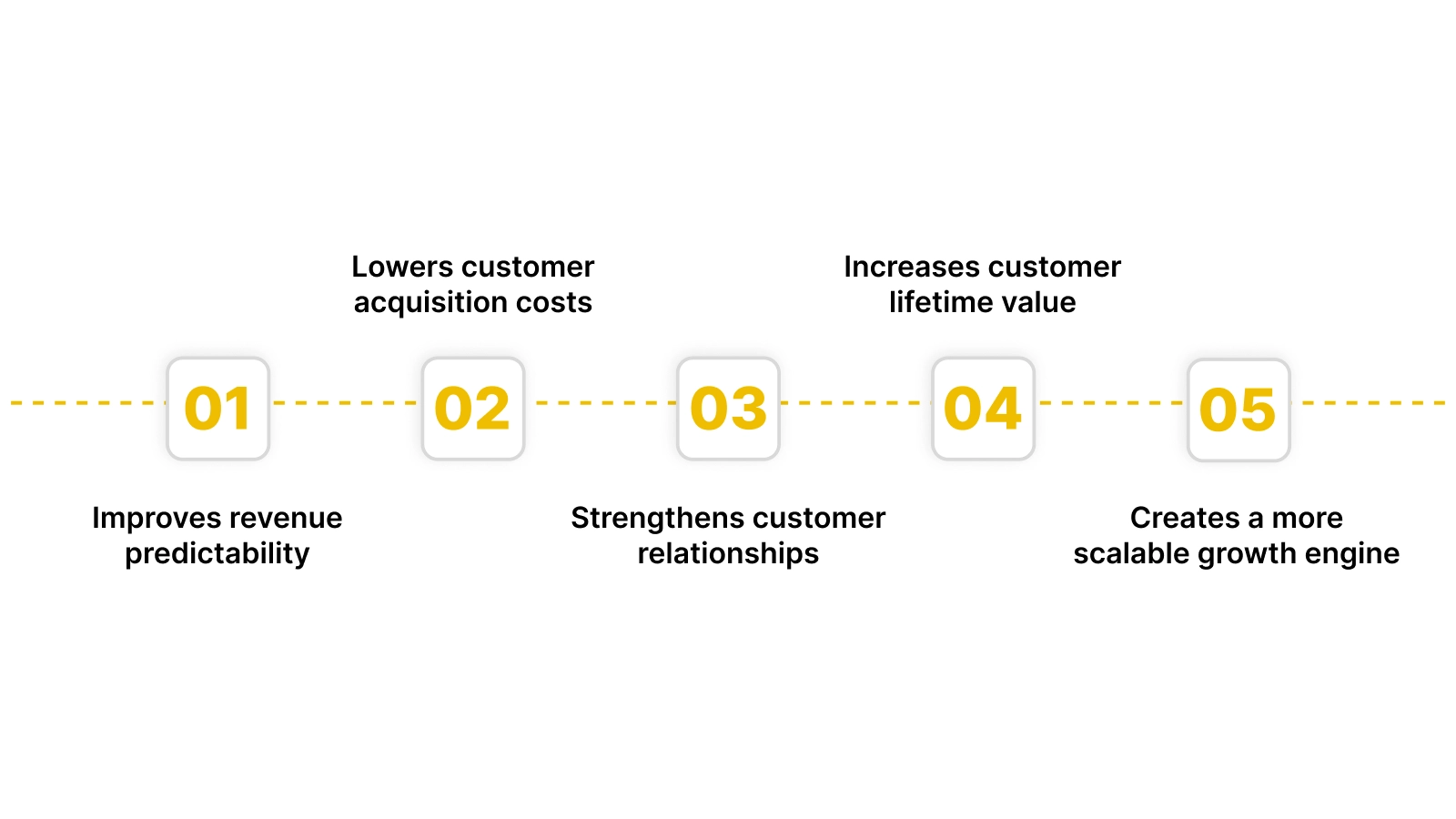
Churn reduction strategies matter because they directly influence how sustainably a brand grows. Here is what they help you achieve:
- Improves revenue predictability: Repeat customers create steady, month-over-month revenue, which reduces the pressure to acquire new customers just to hit basic targets.
- Lowers customer acquisition costs: When a higher percentage of your customers return naturally, you spend less on paid ads. This improves CAC efficiency and protects margins in competitive categories.
- Strengthens customer relationships: Returning customers interact with more content, emails, and touchpoints. This makes it easier to understand their behavior and deliver personalized offers that feel relevant.
- Increases customer lifetime value: Each additional purchase expands LTV, giving brands more room to invest in product, marketing, and customer experience without sacrificing profitability.
- Creates a more scalable growth engine: With churn under control, teams no longer feel like they are replacing lost customers every month. It becomes easier to plan, forecast, and grow across channels.
A strong churn reduction strategy makes growth more predictable, efficient, and sustainable for any e-commerce brand.
Also read: Customer Churn vs Retention: Key Differences Explained

The Most Effective Churn Reduction Strategies for E-Commerce Brands
Most churn happens quietly, with customers slipping away over time rather than making a conscious decision to leave. The most effective way to prevent this is by putting simple, consistent retention workflows in place.
The strategies below show where to start.
.webp)
1. Build a Structured Post-Purchase Journey
A structured post-purchase journey guides customers from the moment they place an order to the point where they are ready to buy again. It fills the quiet period after delivery with useful communication instead of leaving customers on their own.
When customers receive clear instructions, helpful tips, and small engagement prompts, they stay connected to the brand and are far more likely to return within the first 30 days.
What to do:
- Send product-use instructions: Help customers get value from the product quickly, which increases satisfaction and reduces early churn.
- Automate follow-ups based on delivery date: Trigger check-ins, care tips, or reorder reminders at the right time based on when the product arrives.
- Offer points for sharing feedback or posting a review: Reviews create engagement while giving customers a reason to return to your store.
- Share educational or “how to get the most out of your purchase” content: Build trust and reduce confusion or misuse.
A thoughtful post-purchase journey keeps customers engaged at the exact moments when brands typically lose them, turning early interest into long-term loyalty.
2. Launch a Loyalty Program That Rewards Repeat Behavior
A loyalty program motivates customers to return by giving them clear rewards for every action they take. When customers can see their progress toward a reward, they are more likely to come back sooner, spend more, and stay engaged over longer cycles.
This turns repeat purchasing into a habit rather than a one-time decision.
What to do:
- Award points for core actions: Give points for purchases, account creation, birthdays, and repeat orders so customers feel rewarded from the start.
- Add tiered rewards with visible progress: Tiers, progress bars, and badges create momentum and give customers a reason to return more often.
- Offer early-access perks or exclusive benefits: Small VIP perks reinforce loyalty and make customers feel valued.
- Run limited-time bonus point events: Use short promotional windows to drive action from idle customers.
- Reward non-purchase actions: Give points for referrals, social engagement, or wishlist activity to keep customers active.
A well-designed loyalty program gives customers a clear reason to keep coming back, creating repeat purchase habits that strengthen retention month after month.
Nector makes it easy for small teams to set up a customizable loyalty program with points, tiers, progress tracking, and automated rewards. Everything runs in the background, so customers stay engaged without adding work to your team.
3. Use Personalized Offers Based on Purchase Patterns
Personalized offers use a customer’s buying habits, timelines, and product preferences to deliver incentives that feel relevant.
Instead of sending generic discounts, you target customers based on when they usually reorder, what they prefer to buy, or how their engagement has changed.
This reduces churn because customers respond more to offers that match their actual behavior.
What to do:
- Identify customers who are delayed for their next purchase: Track expected reorder windows and flag customers who are falling behind their usual cycle.
- Send targeted offers through email or SMS: Share bonus points, personalized discounts, or product recommendations tailored to each customer's pattern.
- Use time-bound incentives to encourage quicker returns: Short-term rewards or limited-time bonus points prompt faster re-engagement.
- Recommend complementary products: Increase relevance and help customers discover new items.
Personalized incentives feel relevant and timely, which makes customers far more likely to re-engage instead of drifting to competitors.
4. Identify At-Risk Customers Early
At-risk customers are those who have stopped engaging, delayed their usual reorder, or haven’t interacted with the brand in a while.
Identifying them early is one of the most effective churn reduction tactics because it gives you a window to re-engage them before they lapse completely. A small, timely nudge often brings them back, while waiting too long usually results in permanent churn.
What to do:
- Track days since last purchase: Compare current activity against each customer’s typical buying cycle to flag early warning signs.
- Monitor drops in engagement: Look for reduced email opens, fewer site visits, or declining loyalty activity to identify slipping interest.
- Trigger win-back reminders or incentives: Send targeted emails, bonus point offers, or personalized messages that encourage customers to return.
- Segment customers by risk level: Treat “slightly delayed” and “long inactive” customers differently.
Catching slipping customers early gives your team a realistic chance to win them back before they churn permanently.
5. Strengthen the Repeat Purchase Experience
A strong repeat purchase experience removes friction and makes it easy for customers to buy again.
When the path to reordering is simple, well-timed, and rewarding, customers are much less likely to switch to another brand. This matters especially for products with predictable usage cycles, where even small delays can turn into churn.
What to do:
- Reduce steps in the reorder journey: Make it easy for customers to repurchase through quick links, pre-filled carts, or dedicated reorder buttons.
- Send reminders based on product lifecycle: Use delivery dates or consumption timelines to trigger well-timed nudges that bring customers back before interest fades.
- Reward customers for timely reorders: Offer bonus points or small perks to encourage customers to stick to their usual buying cycle.
- Surface personalized reorder suggestions: Recommend the right variant, size, or bundle based on history.
- Add subscription or auto-replenishment options: Give customers an easy alternative to manual reordering.
When reordering is fast, simple, and rewarding, customers naturally return without requiring aggressive discounts or heavy remarketing.
6. Convert First-Time Buyers Into Members Quickly
The first purchase is the best moment to turn a new customer into a loyal one. When customers join your loyalty or referral program early, they immediately gain a sense of progress and belonging.
This reduces the chance of one-and-done purchases because customers now have a reason to come back, earn more, and redeem rewards.
What to do:
- Offer bonus points for account creation: Give new customers an immediate reward for joining your loyalty program right after their purchase.
- Use limited-time activation incentives: Encourage customers to activate their accounts quickly with expiring bonus points or early-access perks.
- Introduce referral benefits early: Show new buyers how they can earn rewards by bringing in friends, which increases engagement and repeat visits.
- Trigger a “welcome to the brand” flow: Set expectations and highlight key benefits of staying engaged.
Early membership builds momentum, making first-time buyers feel invested in your brand from the start and reducing one-and-done purchases.
7. Build Trust Through Reviews and Social Proof
Reviews and social proof reduce churn by strengthening customer confidence. Gartner’s research shows that 90 percent of buyers rely on some form of social proof when comparing products, and customer reviews have the greatest influence on their decisions.
When shoppers consistently see real experiences and credible feedback, they feel more secure returning to your brand.
Strong review cycles also reduce post-purchase uncertainty, which is one of the biggest reasons first-time buyers do not return.
What to do:
- Trigger automated review requests: Ask for reviews after delivery or after the customer has had time to use the product, ensuring higher-quality feedback.
- Reward customers for detailed reviews: Offer points for text, photo, or video reviews to increase the volume and depth of user-generated content.
- Display key insights across product pages: Highlight summaries, ratings, and common themes so customers can make faster, more confident decisions.
- Showcase customer stories or UGC: Build credibility through real experiences.
- Use review-based recommendations: Help customers discover products that match their needs.
Consistent reviews and visible proof of quality reassure customers, increasing confidence and improving their likelihood of returning.
8. Reduce Friction for Customers Who Purchase Both Online and Offline
Customers who shop across online stores and physical outlets expect one unified experience. When loyalty points, rewards, and purchase history are fragmented across channels, customers lose trust and often disengage.
Reducing friction in this omnichannel experience ensures that customers can earn and redeem rewards anywhere, which increases satisfaction and encourages consistent repeat purchases.
What to do:
- Sync POS purchases with online profiles: Make sure in-store transactions reflect instantly in the customer’s account so they can track points and rewards in one place.
- Allow earning and redemption at checkout: Let customers use points easily during POS checkout without long lookups or manual staff inputs.
- Give customers one unified reward dashboard: Provide a single view where they can see points, tiers, and rewards earned across both online and offline purchases.
- Reward customers for channel switching: Offer small incentives for customers who shop online and offline to reinforce omnichannel behavior.
When customers experience the same rewards, visibility, and benefits across every channel, they stay loyal longer and are far more likely to return for repeat purchases.
Also read: 7 Reasons Online Customer Reviews Drive Trust & Sales (+ How to Run a Review Program)
9. Create Lifecycle-Based Reminder Campaigns
Different customers buy on different timelines. Lifecycle-based reminders help brands reach customers at the exact moment they are most likely to need a refill, replacement, or restock.
These reminders reduce churn by catching customers right before they drift away or switch to a competitor.
What to do
- Map typical reorder timelines for each product: Identify when customers usually return and use those ranges to time your reminders.
- Send event-based nudges: Trigger emails or WhatsApp alerts when a customer hits a key lifecycle moment, such as running low or finishing the product.
- Offer bonus points for timely engagement: Reward customers who purchase within their ideal lifecycle window.
- Add educational nudges: Share care tips or usage instructions at the right time to maintain product satisfaction.
- Use category-specific automation: Tailor reminders for fast-moving items, slow cycles, or seasonal products.
Together, these lifecycle reminders create a steady, predictable pattern of engagement that keeps customers returning on time instead of drifting into inactivity.
10. Build a Win-Back Framework for Long-Inactive Customers
Some customers inevitably go inactive, but not all inactivity leads to permanent churn. A structured win-back framework gives brands a systematic way to re-engage lapsed customers before they fall out completely. A well-timed “we miss you” prompt or bonus reward often brings back customers who simply needed a reason to return.
What to do:
- Define inactivity segments (30, 60, 90+ days): Treat each group differently based on how long they’ve been silent.
- Send personalized “come back” offers: Provide bonus points, tailored product suggestions, or small incentives to reignite interest.
- Remind customers of unused rewards: Highlight unredeemed points or upcoming tier expiries to pull them back.
- Ask for feedback from deeply inactive users: This gives insight into product gaps or service issues that may be causing churn.
- Reintroduce the brand with value-led messaging: Share bestsellers, new launches, or improved versions of past purchases.
With a structured win-back system in place, you can recover a meaningful share of inactive customers and turn one-time buyers back into long-term loyalists.
How Nector Helps Reduce Churn and Increase Repeat Purchases
Nector’s Loyalty module gives e-commerce brands a complete retention stack that is simple to set up, fully customizable, and powerful enough for long-term growth. For founder-led stores, small teams, and growing D2C brands, Nector acts as the engine that keeps customers engaged, rewarded, and coming back without adding operational burden.
Key features:
A Smart, Customizable Loyalty Program That Drives Repeat Sales
Nector automatically turns every shopper into a loyalty member and lets teams create custom earning rules, tiers, and rewards in minutes. It keeps customers engaged between purchases, makes rewards visible across touchpoints, and encourages timely reorders with on-brand incentives.
Fully White-Labeled and Designed to Match Your Brand
Nector blends seamlessly into your storefront, letting you launch a fully on-brand loyalty experience in hours. Every element, from point rules to tiers and visuals, can be customized to match your brand.
End-to-End Personalization Across the Entire Customer Journey
Nector adapts rewards and nudges based on each customer’s behavior, showing relevant points, offers, and reminders at the right moment to encourage smoother repeat purchases.
Built for Fast Redemption and Low Friction
Customers can redeem points like cash at checkout, creating a frictionless flow that reduces hesitation and boosts conversions with visible rewards and smart coin expiry.
40+ Features That Support Retention Out of the Box
Nector offers a full suite of retention tools, including VIP tiers, rewards pages, campaign bonuses, review incentives, and store credits, so that brands can manage loyalty efficiently without extra operational work.
Integrates With 50+ E-Commerce and Marketing Tools
Nector connects with your existing stack across email, WhatsApp, reviews, checkout, and storefront systems, ensuring personalized rewards show up at every touchpoint.
Stronger retention starts with the right system. Create your loyalty, referral, and review engine with Nector and sign up today.
Wrapping Up
Churn reduction is not about aggressive discounts or constant campaigns. It is about building simple, consistent workflows that keep customers engaged after their first purchase. When brands use structured post-purchase journeys, personalized offers, loyalty rewards, and smooth online-to-offline experiences, customers return more often and stay connected longer.
For small teams and growing e-commerce brands, the challenge is doing all this without extra operational load. Nector makes it easier by automating loyalty, reviews, and personalized engagement, so retention improves in the background while your team focuses on growth.
If you want to reduce churn with less effort, book your demo with Nector and see how quickly it strengthens repeat purchases.
FAQs
How do you reduce churn?
You reduce churn by keeping customers engaged after their first purchase and removing friction from their buying journey. This includes structured post-purchase communication, personalized offers, loyalty rewards, lifecycle reminders, and win-back campaigns for at-risk customers.
What is the meaning of churn reduction?
Churn reduction refers to the strategies and workflows used to prevent customers from leaving or going inactive. In e-commerce, it focuses on motivating customers to return, repurchase, and stay connected to the brand over time.
What does a 20% churn rate mean?
A 20 percent churn rate means that 20 percent of your customers stopped buying from your brand during a specific period. For example, if you had 1,000 active customers at the start of the month, 200 did not return or repurchase.
What is the KPI for churn rate?
The main KPI is the percentage of customers lost during a defined time period. Many brands also track related KPIs such as repeat purchase rate, customer retention rate, customer lifetime value, and active customer count to understand churn more accurately.





Start Building Customer Retention That Lasts