
%201.webp)
.avif)
.avif)
Customer loyalty isn’t built by getting customers to buy once. It’s built by giving them a clear reason to come back. As acquisition costs rise and competition increases, repeat purchases have become the real growth lever for ecommerce brands.
In fact, loyal customers spend around 31% more than new customers, making retention one of the most reliable ways to grow revenue without increasing ad spend.
Yet many loyalty efforts fall short because they focus on signups, points, or discounts instead of behavior. Customers join, earn once, and disappear. The gap between the first and second purchase remains wide, and loyalty never compounds.
This guide breaks down practical customer loyalty strategies for repeat purchases. They focus on what actually brings customers back, how to avoid common mistakes, and how to measure whether loyalty is driving real, sustainable growth.
At a glance:
- Repeat purchases are the true measure of loyalty. Customers who come back and buy again signal real value, trust, and habit formation, which loyalty enrollment alone cannot prove.
- The first-to-second purchase gap is the most critical retention moment. Most ecommerce churn happens here, and loyalty strategies must prioritize nudging customers back quickly after their first order.
- Visible progress and easy redemption drive repeat behavior. Loyalty only works when customers can clearly see what they’re earning, how close they are to rewards, and can redeem without friction.
- Discount-heavy loyalty weakens long-term retention. Programs that rely too much on upfront discounts train deal-seeking behavior, while progress-based rewards and milestones build repeat buying habits.
- Effective loyalty systems tie incentives directly to revenue actions. Rewarding purchases, referrals that convert, and redemptions at checkout turn loyalty from a cost center into a compounding growth lever.
Why Repeat Purchases Are the Real Measure of Loyalty
In ecommerce, loyalty isn’t defined by how many customers sign up for a program. It’s defined by how many come back and buy again. Repeat purchases are the clearest signal that customers see enough value, trust, and convenience to choose your brand more than once.
The economics of repeat buyers are straightforward:
- Lower acquisition cost per order: Returning customers don’t require the same level of paid spend to convert.
- Higher lifetime value: Repeat buyers tend to spend more over time and convert faster.
- More predictable revenue: Retained customers create steadier demand compared to one-time buyers.
The biggest drop-off in ecommerce happens between the first and second purchase. Many customers buy once and disappear, not because the product failed, but because there was no clear reason or reminder to return.
When repeat purchases increase, revenue starts to compound. Each retained customer contributes multiple orders, reduces dependence on paid acquisition, and improves overall profitability.
This is why repeat purchase behavior, not loyalty enrollment or surface-level engagement, is the most reliable way to measure true customer loyalty.
Also read: How Smart Brands Are Redefining Loyalty to Drive Retention (2026 edition)
Customer Loyalty Strategies That Drive Repeat Purchases
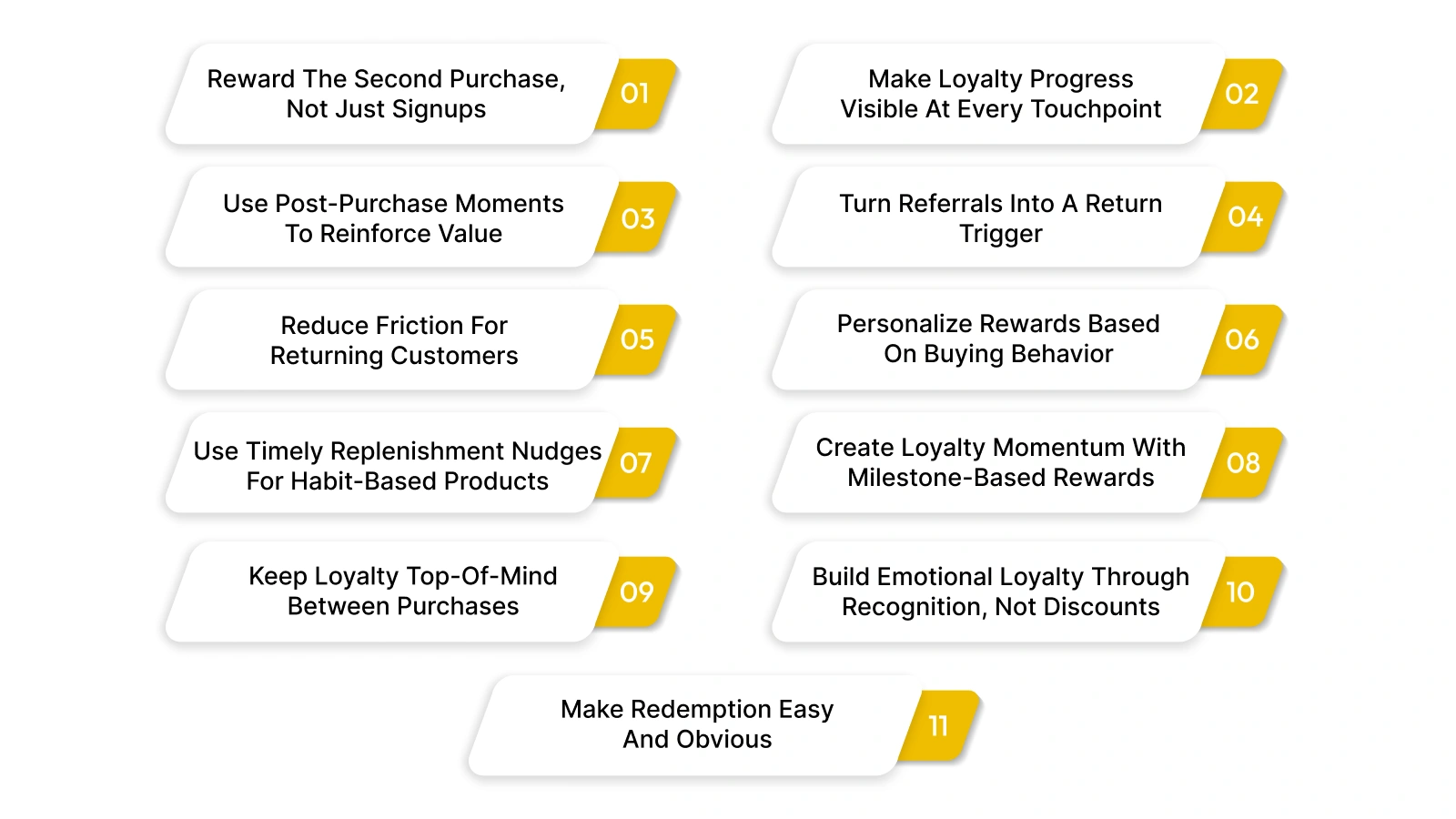
Effective loyalty strategies focus on bringing customers back, not just getting them to sign up or earn points once. The goal is to shorten the gap between purchases and make returning feel easier and more rewarding each time.
1. Reward the Second Purchase, Not Just Signups
The second purchase requires a deliberate decision. Customers no longer buy out of curiosity, they buy only if the experience, value, and timing give them a clear reason to return.
How to do it:
- Time incentives post-delivery: Introduce rewards after the first order arrives, when satisfaction is highest.
- Add a short window: Offer a bonus if the second purchase happens within a defined timeframe.
- Tie rewards to action: Make it clear that the benefit unlocks only after buying again.
- Reinforce progress visually: Show how close customers are to earning or unlocking their next reward.
2. Make Loyalty Progress Visible at Every Touchpoint
Loyalty motivates action when customers can see momentum. Visible progress reduces hesitation by showing that each purchase moves them closer to a tangible reward, not just another transaction.
How to do it:
- Show points and milestones on PDPs and cart: Reinforce value before checkout.
- Use tiers to signal progression: Make advancement feel earned and achievable.
- Highlight next rewards: Focus attention on what’s coming, not what’s already earned.
- Surface progress in post-login views: Let customers see their status whenever they return.
3. Use Post-Purchase Moments to Reinforce Value
Post-purchase is a high-trust moment. Customers are most receptive right after buying, making it the ideal time to reinforce value and set up the next reason to return.
How to do it:
- Set clear expectations: Use order confirmation and delivery updates to reduce uncertainty.
- Reinforce value earned: Highlight rewards, points, or benefits gained from the purchase.
- Introduce the next step: Guide customers toward what they can do next to earn more.
- Acknowledge the customer’s choice: Use thank-you messaging that reinforces brand value.
4. Turn Referrals Into a Return Trigger
Referrals are most effective when they don’t stop at acquisition. When referral rewards require redemption, customers return to use what they’ve earned, turning advocacy into a repeat purchase driver.
How to do it:
- Use in-store redeemable rewards: Ensure referral incentives can only be used in your store.
- Reward after conversion: Issue rewards only once the referred customer completes a purchase.
- Prompt referrals after positive moments: Ask when customers are most satisfied with the experience.
- Reinforce earned value: Remind referrers about unused rewards and expiry timelines.
Nector helps brands turn referrals into repeat purchases with dual-sided rewards that are earned after conversion and redeemed in-store, giving referrers a clear reason to come back and use what they’ve unlocked.

5. Reduce Friction for Returning Customers
Repeat loyalty strengthens when buying again feels familiar and effortless. Once trust is built, even small points of friction can interrupt momentum and delay return purchases.
How to do it:
- Streamline repeat checkout: Save preferences and minimize steps for returning buyers.
- Remove repeat friction: Avoid forcing logins or re-entering details customers have already shared.
- Maintain consistency: Keep pricing, policies, and experience predictable across visits.
- Prioritize speed: Ensure fast load times, especially for logged-in or returning users.
6. Personalize Rewards Based on Buying Behavior
Generic rewards lose impact over time. When incentives reflect how customers actually shop, loyalty feels relevant, and repeat purchases become more intentional.
How to do it:
- Avoid blanket rewards: Don’t offer the same incentive to every customer.
- Use frequency and value signals: Adjust rewards based on how often and how much customers buy.
- Align rewards to categories: Incentivize purchases in categories customers already prefer.
- Vary incentive strength: Reserve stronger rewards for high-value or at-risk segments.
7. Use Timely Replenishment Nudges for Habit-Based Products
For consumable or repeat-use products, repeat purchases depend more on timing than persuasion. Customers are most likely to return when reminders align with real usage patterns, making reordering feel helpful rather than promotional.
How to do it:
- Estimate usage cycles: Base reminders on category norms and past purchase intervals.
- Trigger before depletion: Nudge customers slightly before they are likely to run out.
- Pair with light incentives: Reinforce the reminder without relying on heavy discounts.
- Reference past purchases: Remind customers what they bought last and when.
8. Create Loyalty Momentum With Milestone-Based Rewards
One-off rewards create short-term spikes, not habits. Milestone-based rewards work because they give customers a clear path forward, making each purchase feel like progress toward something meaningful rather than an isolated transaction.
How to do it:
- Define clear milestones: Second order, fifth order, or lifetime spend thresholds.
- Celebrate progress: Acknowledge milestones with messages or small bonuses.
- Show what’s next: Always surface the next achievable milestone.
- Keep milestones attainable: Avoid long gaps that break motivation.
9. Keep Loyalty Top-of-Mind Between Purchases
Customers often lapse simply because they forget. Subtle, well-timed loyalty visibility keeps your brand present between orders without overwhelming attention or creating fatigue.
How to do it:
- Use low-frequency reminders: Share points balance or upcoming rewards occasionally.
- Integrate loyalty into content: Highlight rewards inside newsletters or updates.
- Avoid over-messaging: Prioritize relevance over frequency.
- Anchor reminders to value: Focus on what customers can unlock next.
10. Build Emotional Loyalty Through Recognition, Not Discounts
Emotional loyalty reduces price sensitivity and increases long-term retention. When customers feel recognized for their relationship with your brand, they’re more likely to return even without a financial incentive attached.
How to do it:
- Acknowledge milestones: Birthdays, anniversaries, or loyalty tenure.
- Use personalized messaging: Address customers by name and reference past interactions.
- Reward loyalty status: Make long-term customers feel distinct from first-time buyers.
- Keep recognition timely: Deliver messages close to the milestone moment.
11. Make Redemption Easy and Obvious
Rewards lose impact when redemption is complicated or hidden. A clear, frictionless redemption experience is essential to converting earned value into repeat purchases.
How to do it:
- Simplify redemption paths: Reduce steps required to apply rewards.
- Surface redemption at checkout: Show rewards where purchase decisions happen.
- Remove confusion: Clearly communicate eligibility, value, and expiry.
- Confirm redemption success: Reinforce satisfaction after rewards are used.
Effective loyalty strategies work because they avoid common pitfalls. Before moving forward, it’s worth understanding where loyalty efforts often break down.
7 Common Loyalty Mistakes That Prevent Repeat Purchases
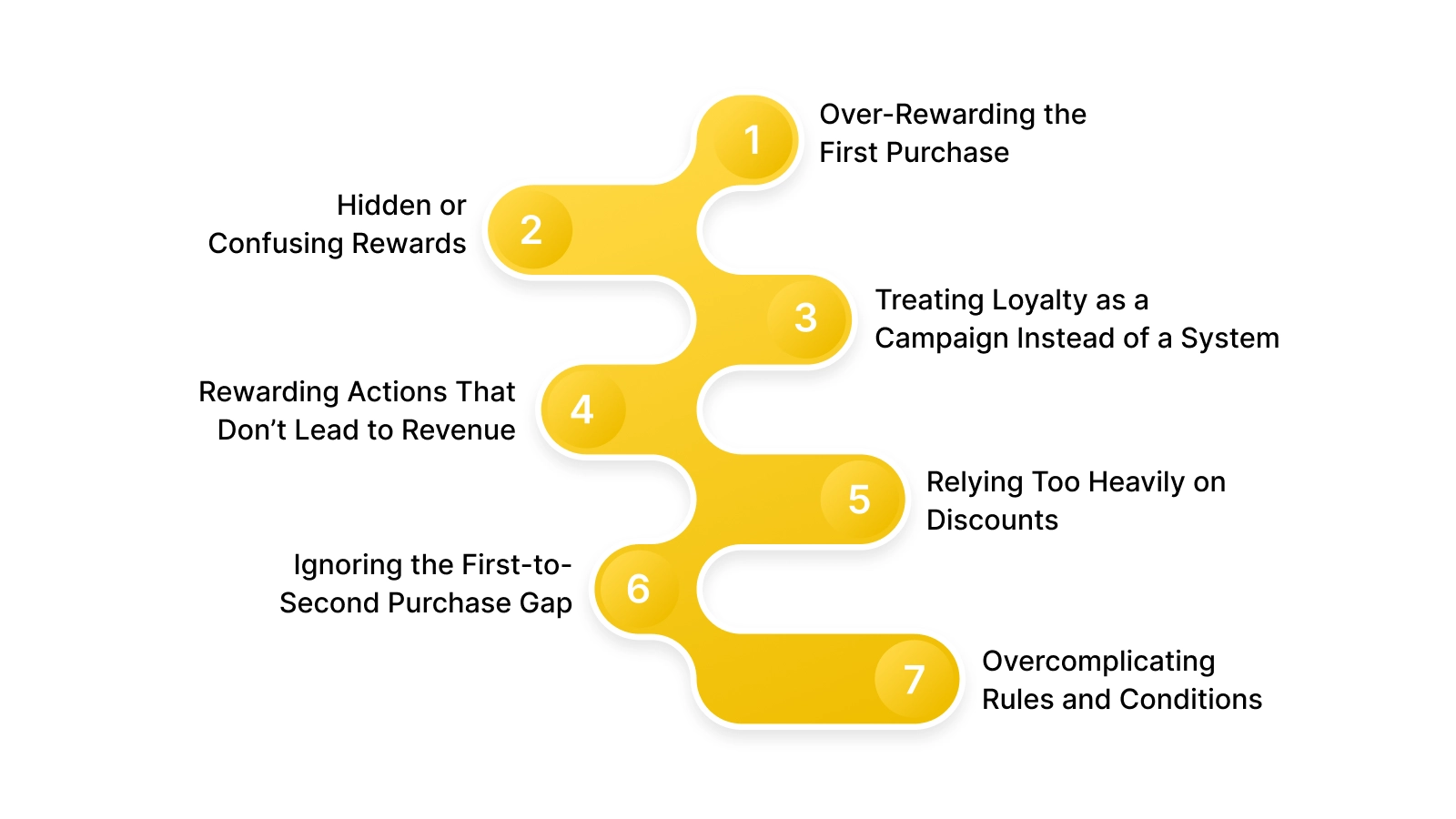
Many loyalty programs fail not because rewards don’t exist, but because they’re designed in ways that don’t encourage customers to come back. These mistakes often inflate costs without improving retention.
1. Over-Rewarding the First Purchase
Heavy incentives on the first order attract deal-seekers, not loyal customers. When most value is given upfront, customers redeem once and disengage. This pulls demand forward without creating a reason to return, leaving no momentum for second or third purchases.
2. Hidden or Confusing Rewards
Rewards that are buried, poorly explained, or difficult to redeem lose their motivational power. Customers can’t act on the value they don’t clearly understand or easily access. When rewards feel complicated, loyalty becomes invisible and participation drops quickly after enrollment.
3. Treating Loyalty as a Campaign Instead of a System
Running loyalty as occasional promotions breaks continuity. Customers need consistent rules, visible progress, and predictable benefits across purchases. Without structure, loyalty feels temporary and transactional, failing to build habits or long-term engagement that drives repeat buying.
4. Rewarding Actions That Don’t Lead to Revenue
Incentivizing low-intent actions like signups or social follows without tying rewards to purchases weakens the connection between loyalty and revenue. Customers learn how to earn rewards without buying again, turning loyalty into a cost center rather than a growth driver.
5. Relying Too Heavily on Discounts
Discount-heavy loyalty trains customers to wait for price drops instead of returning naturally. While discounts may drive short-term spikes, they erode margins and reduce perceived value. Over time, customers associate loyalty with savings rather than preference or habit.
6. Ignoring the First-to-Second Purchase Gap
Many loyalty programs focus on long-term tiers while neglecting the most fragile moment in retention: the second purchase. Without timely incentives or reminders, customers drop off before habits form, making advanced loyalty features irrelevant for most of the audience.
7. Overcomplicating Rules and Conditions
Complex earning rules, unclear expiry policies, or restrictive redemption conditions reduce participation. Confusion creates friction, and friction kills motivation. When customers need to think too hard about how loyalty works, they disengage before it influences behavior.
Also read: 10 Best Brand Loyalty Tools for Lasting Success
How to Fix These Loyalty Gaps
Fixing loyalty issues isn’t about adding more rewards or running more campaigns. It’s about aligning incentives, visibility, and timing with how customers actually behave after their first purchase.
- Rebalance incentives toward repeat behavior: Move value away from first-purchase rewards and toward second and third purchases, where habits are formed and loyalty actually begins.
- Make loyalty value visible at decision points: Customers should see their points, progress, and upcoming rewards on product pages, in cart, and at checkout, not hidden in a separate dashboard.
- Anchor rewards to revenue-driving actions: Prioritize incentives tied to purchases, referrals that convert, and reviews that influence buying decisions.
- Treat loyalty as a system, not a promotion: Consistent rules, progression, and visibility across purchases build momentum far better than short-term campaigns.
- Simplify earning and redemption logic: Clear, predictable rules increase participation and reduce drop-off caused by confusion.
- Focus on the first-to-second purchase window: Use post-delivery communication, milestones, and time-bound incentives to bridge the most fragile stage of the customer journey.
- Limit discount dependency: Use discounts selectively and support them with progress-based rewards to protect margins while driving repeat purchases.
When these gaps are addressed, loyalty becomes a repeatable growth lever rather than an expense that’s hard to justify.
Metrics to Track Loyalty Effectiveness
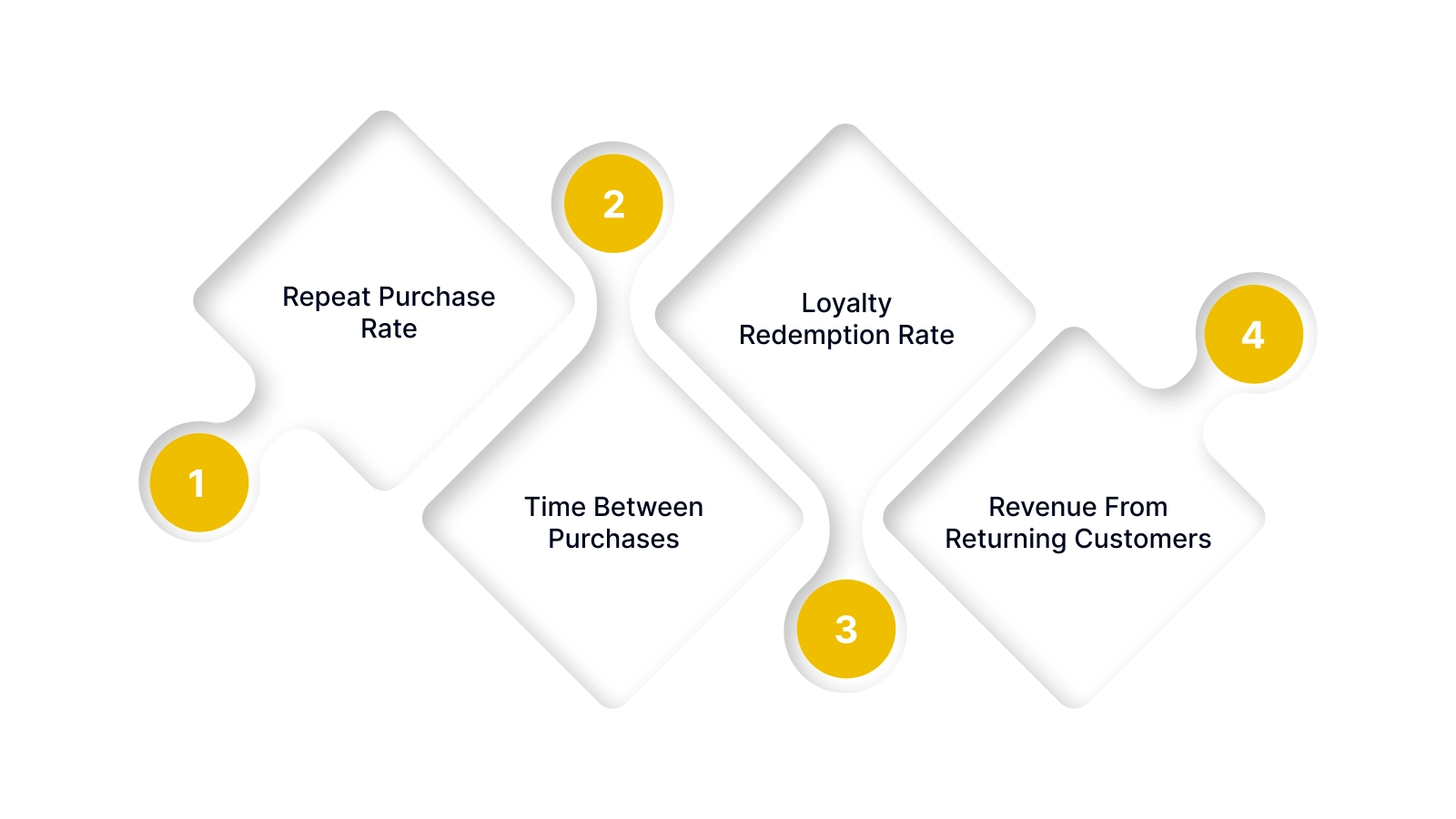
Loyalty only works if it changes customer behavior. These metrics help you understand whether your strategies are actually driving repeat purchases or just creating surface-level engagement.
1. Repeat Purchase Rate
This shows the percentage of customers who place more than one order. It’s the clearest signal of whether loyalty efforts are influencing customers to return rather than buy once and leave.
How to calculate:
Repeat Purchase Rate = (Number of customers with 2+ purchases ÷ Total customers) × 100
2. Time Between Purchases
This measures how long it takes for customers to place their next order. A shorter gap indicates that loyalty incentives, reminders, and post-purchase experiences are effectively nudging customers back at the right time.
How to calculate:
Average Time Between Purchases = Total days between purchases ÷ Number of repeat purchases
3. Loyalty Redemption Rate
Redemption rate tracks how many earned rewards are actually used. High redemption signals that rewards are visible, relevant, and easy to apply. Low redemption often points to unclear value or complicated redemption flows.
How to calculate:
Redemption Rate = (Total rewards redeemed ÷ Total rewards issued) × 100
4. Revenue From Returning Customers
This metric shows how much of your total revenue comes from repeat buyers. Growth here indicates that loyalty is contributing to sustainable revenue rather than short-term spikes driven by discounts or campaigns.
How to calculate:
Revenue From Returning Customers = (Revenue from repeat buyers ÷ Total revenue) × 100
How Nector Helps Drive Repeat Purchases Through Loyalty
Nector is designed to help ecommerce brands turn first-time buyers into repeat customers through a structured, visible, and customizable loyalty system. Instead of treating loyalty as a separate layer, Nector embeds rewards, progress, and incentives directly into the shopping journey to encourage customers to return and buy again.
The platform is built for fast setup, brand control, and ongoing engagement, making it suitable for founder-led stores as well as growing ecommerce teams.
Key Loyalty Features That Support Repeat Purchases
- Automatic Loyalty Enrollment: Every registered customer becomes a loyalty member automatically, ensuring no friction between purchase and participation.
- Customizable Earning Rules: Define how customers earn rewards across purchases, referrals, and campaigns, with full control over points, bonuses, and VIP tiers.
- Visible Rewards Across the Store: Show points and potential rewards on product pages, cart, checkout, and thank-you pages to reinforce value at decision moments.
- Redeem Points at Checkout: Allow customers to use loyalty points like cash during checkout, reducing friction and increasing redemption-driven repeat purchases.
- Dedicated Rewards Page: Give customers a branded space to track points, rewards, and progress, making loyalty easy to understand and use.
- Smart VIP Tier Management: Automatically unlock tier-based benefits as customers progress, encouraging long-term repeat behavior.
- Campaign-Based Bonuses: Run time-bound bonus campaigns tied to launches or seasons to re-engage customers without permanent discounting.
- Store Credits for Refunds: Retain revenue by issuing refunds as store credits, encouraging customers to return and repurchase.
- Real-Time Analytics and Insights: Monitor loyalty activity, redemption behavior, and engagement from a single dashboard.
- Easy Integrations: Connect Nector with Shopify and 50+ tools across email, WhatsApp, reviews, and checkout for a consistent loyalty experience.
Nector helps brands move loyalty beyond points and discounts by making rewards visible, easy to redeem, and directly tied to repeat buying behavior. Sign up to get started.
Wrapping Up
Customer loyalty strategies only work when they’re designed to bring customers back to buy again, not just to sign up or collect points. Repeat purchases are driven by clear value, visible progress, and well-timed incentives that fit naturally into the customer journey.
When loyalty is treated as a system rather than a campaign, it compounds revenue, reduces dependence on acquisition, and builds long-term customer relationships.
Nector helps brands put these strategies into action by making loyalty easy to run, visible at every touchpoint, and directly connected to repeat purchases. Book a demo with Nector and see how it works in practice.
FAQs
What is the best loyalty strategy for repeat customers?
The most effective loyalty strategies focus on rewarding second and third purchases, making rewards visible, personalizing incentives based on behavior, and ensuring rewards are easy to redeem rather than relying on one-time discounts.
Are loyalty programs better than discounts for repeat purchases?
Yes, loyalty programs are more sustainable than discounts because they encourage long-term behavior, protect margins, and motivate customers to return through progress, rewards, and recognition instead of price cuts.
How do you measure the success of customer loyalty strategies?
Success is measured through repeat purchase rate, time between purchases, loyalty redemption rate, and revenue from returning customers, which together show whether loyalty efforts are driving real retention and growth.
Can small ecommerce businesses use loyalty strategies effectively?
Yes, small ecommerce businesses can use simple loyalty strategies like points for repeat purchases, referral rewards, and visible progress to drive retention without needing large teams or complex systems.




.webp)

Start Building Customer Retention That Lasts