

.avif)
.avif)
Many e-commerce brands pour money into acquiring new customers. Still, data shows that more than half of a company’s revenue comes from existing customers, underscoring the immense value of repeat buyers.
That’s why tracking the right customer retention metrics in ecommerce is more important than ever. Returning customers tend to spend more, purchase more often, and generate stable revenue, giving brands a sustainable edge when acquisition costs are rising and competition is fierce.
This guide walks you through 10 essential retention metrics, with formulas, examples, and benchmarks, to help you measure what really drives loyalty, spot churn risks early, and build long-term growth.
Key Takeaways
- Customer retention metrics in ecommerce provide formulas and benchmarks that help brands accurately measure repeat purchase behavior, churn risk, and lifetime revenue contribution.
- Reviewing metrics like repeat purchase rate, purchase frequency, LTV, churn rate, and reward-driven purchases helps identify which customer cohorts drive the most profit.
- Using these metrics to guide segmentation and loyalty triggers enables brands to run targeted programs that increase reorder cycles.
- Brands that monitor and optimize retention metrics consistently reduce their dependence on acquisition and build stable revenue streams.
What Customer Retention Metrics Are and Why They Matter in E-commerce?
Customer retention metrics show how well a brand keeps customers coming back after their first purchase. They quantify how frequently customers buy, how long they stay active, how much revenue they generate over time, and when they begin to disengage.
These metrics matter because they reveal the proper health of a customer base. They uncover how many shoppers become loyal customers, which cohorts drive the most revenue, where churn occurs, and which parts of the customer journey need improvement.
Stronger retention isn’t just about lowering acquisition costs. It protects margins by generating revenue without new ad spend, drives predictable growth through repeat buying, confirms product-market fit through organic reorders, and gives brands an advantage competitors can’t quickly copy.
10 Must-Track Customer Retention Metrics for Your E-commerce Store
Understanding which retention metrics to track and how to calculate them accurately forms the foundation of any successful retention strategy. These 10 customer retention metrics for ecommerce cover purchase behavior, loyalty performance, revenue patterns, and satisfaction signals that drive e-commerce success.
Let’s look at them in detail:
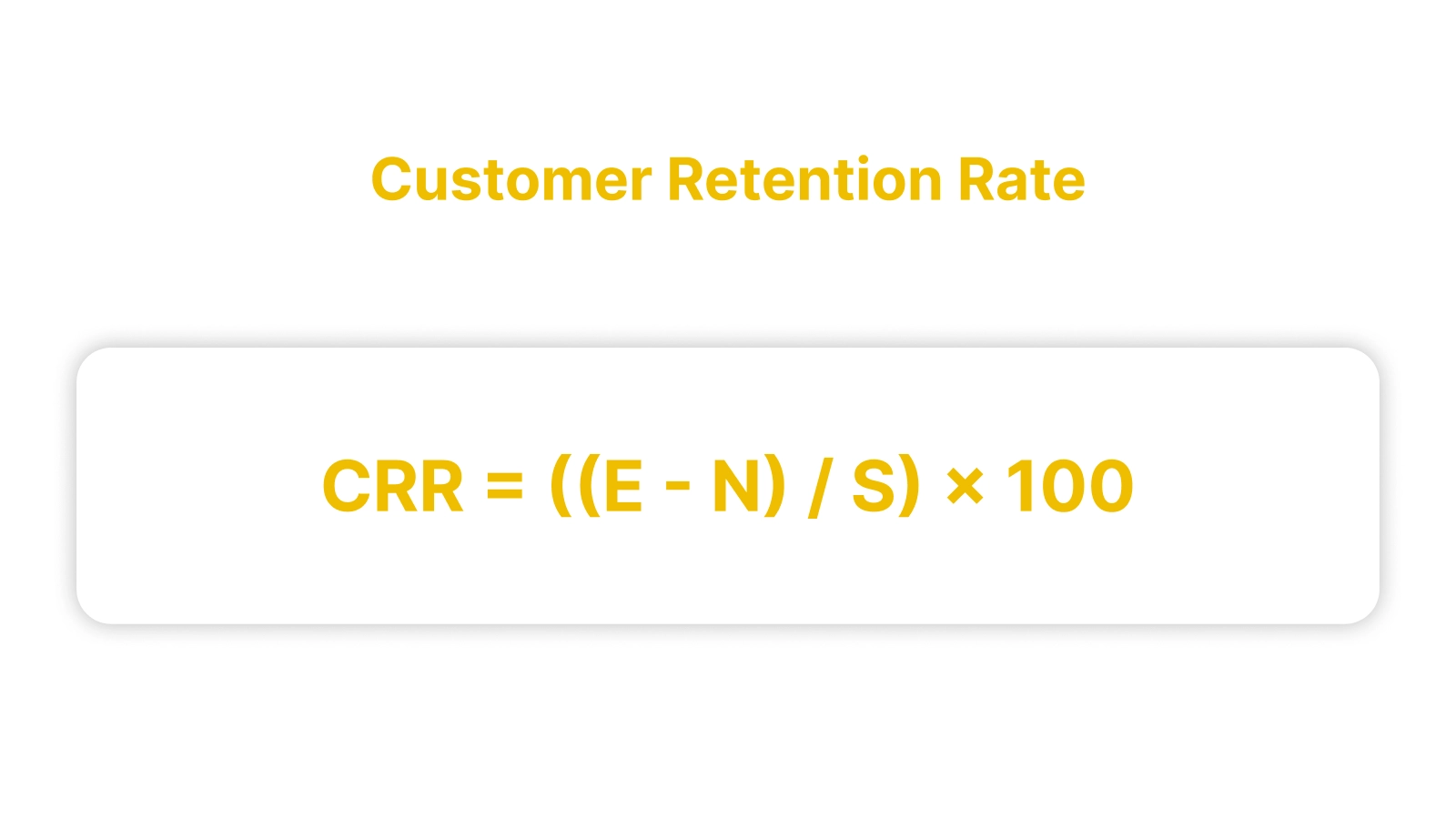
1. Customer Retention Rate (CRR)
The Customer Retention Rate shows how well your brand retains existing customers over a given period. It’s the baseline indicator of customer stickiness and long-term brand preference.
How it’s calculated:
CRR = ((E − N) / S) × 100
- E: Customers at the end of the period.
- N: New customers acquired during the period.
- S: Customers at the start of the period.
What it looks like in practice
If you begin January with 500 customers, acquire 150 new ones, and finish with 550 total customers, your retention rate is:
((550 − 150) / 500) × 100 = 80%
How to interpret it
In e-commerce, CRR typically ranges from 20% to 40%, depending on the category. Subscription-based and consumable products often reach 60–80%, while fashion and electronics usually fall between 20–30%. Context matters more than absolute numbers, so make sure to track trends over time.
Note: CRR and Churn Rate are often inversely related (CRR + Churn ≈ 100%, excluding net growth).
2. Customer Churn Rate
Churn rate is the percentage of customers who stop purchasing over a specific period. While retention tells you who stays, churn shows you where relationships are breaking down.
Calculation formula: Churn Rate = (Customers Lost / Customers at Start of Period) × 100
Tip: Don’t treat churn as a single number to “keep low.” Break it down by customer age and product category. If churn spikes early, the issue is your onboarding or first-purchase experience. If it rises later, value erosion or competition is likely at play. Where churn happens tells you far more than how significant the number is.
3. Repeat Purchase Rate (RPR)
Repeat Purchase Rate measures how many customers come back for a second (or third) purchase. It’s one of the clearest signals of absolute customer loyalty.
Formula: RPR = (Customers with 2+ purchases ÷ Total customers) × 100
How to read it:
- 25–30% → typical for most e-commerce brands.
- 40–50%+ → strong retention and product-market fit.
- 15–25% → standard for high-ticket or infrequent purchases.
Why it matters: A higher RPR means lower acquisition costs, higher lifetime value, and more predictable revenue.
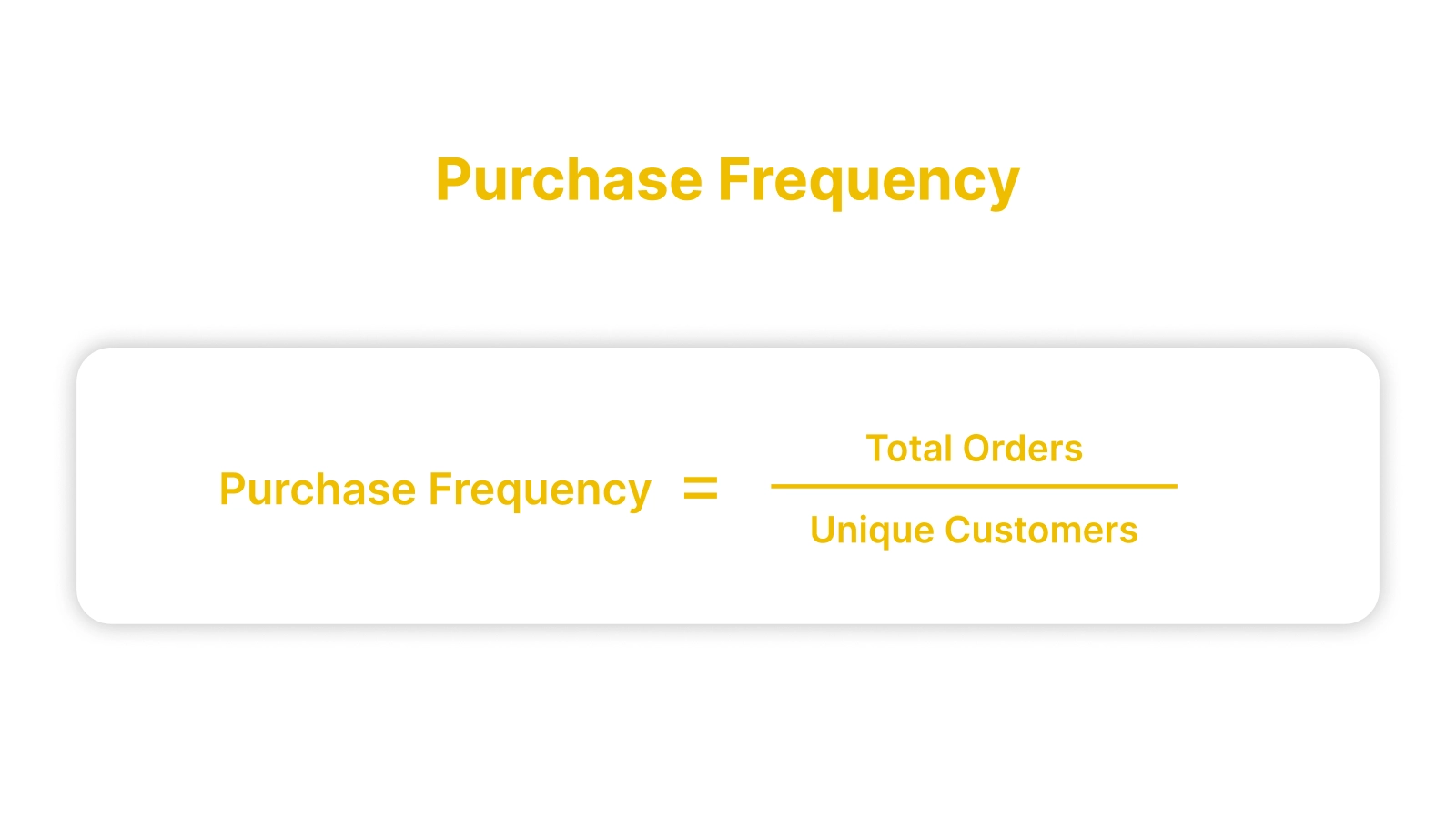
4. Purchase Frequency
Purchase Frequency measures the average number of orders per customer within a specific timeframe. It reveals how often customers actually buy from you.
Formula:
Purchase Frequency = Total Orders / Unique Customers
Example: You have 5,000 orders from 2,000 unique customers in a year. Purchase Frequency = 5,000 / 2,000 = 2.5 orders per customer
Although this varies significantly by product type, consumables target 4-6+ orders per year; fashion aims for 2-3; furniture or electronics may see 1-1.5 orders per year. Focus on improving your own baseline rather than comparing across categories.
5. Customer Lifetime Value (CLV)
Customer Lifetime Value estimates the total revenue a customer generates across their entire relationship with your brand. It’s the most strategic retention metric for long-term planning.
Core formula: CLV = Average Order Value × Purchase Frequency × Average Customer Lifespan
As a rule of thumb, CLV should be at least 3× your Customer Acquisition Cost (CAC). Leading e-commerce brands often achieve CLV-to-CAC ratios of 5:1 or higher. Subscription businesses should ensure CLV comfortably exceeds the value of a 12-month subscription.
6. Average Order Value (AOV)
Average Order Value measures the average dollar amount spent per order. Increasing AOV directly boosts revenue without acquiring more customers.
Formula: AOV = Total Revenue / Number of Orders
Benchmark: AOV varies by category but generally ranges from $50 to $ 150 for most e-commerce. Fashion averages $80-100, beauty $40-70, and home goods $100-150. Focus on growing your AOV 10-20% year-over-year through bundling, upsells, and loyalty rewards.

7. Cohort Retention Rate
Cohort Retention tracks how groups of customers acquired in the same period behave over time. It reveals patterns in the customer lifecycle and identifies when churn typically occurs.
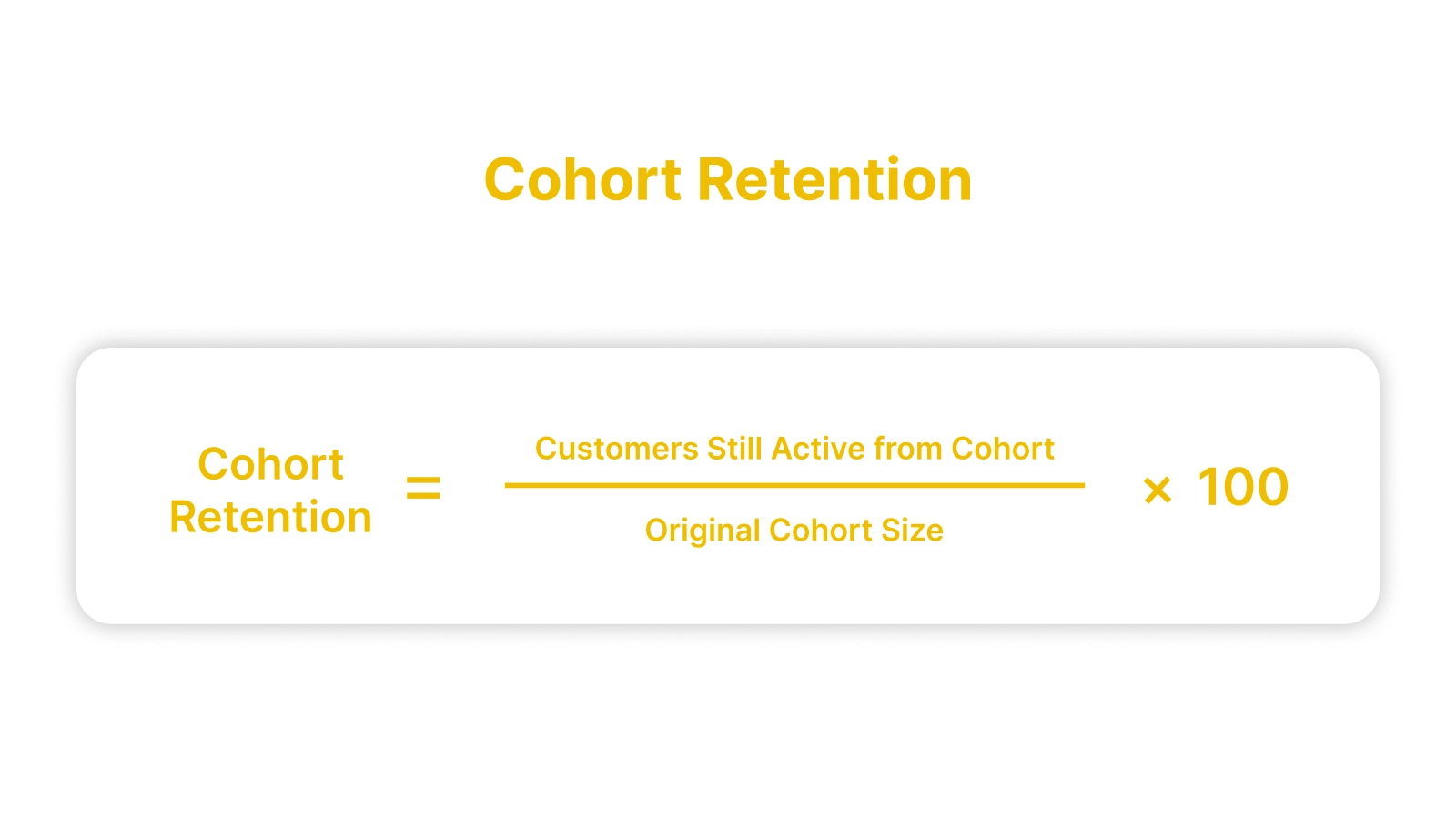
Formula: Cohort Retention = (Customers Still Active from Cohort / Original Cohort Size) × 100
For example, if your January cohort started with 500 customers and only 175 are still active six months later, your 6-month cohort retention is 35%.
Tips:
- Time re-engagement campaigns based on cohort behavior rather than fixed calendars. High-churn moments, such as month three, are often the most effective time to run win-back offers and can lift lifetime value by 25–95%.
- Use cohort comparisons to identify what is working. Replicate patterns from high-retention groups, such as full-price buyers, while addressing weaker cohorts with targeted perks, reminders, or tailored messaging.
8. Revenue Retention Rate (Gross & Net)
Revenue Retention measures whether your customer base is generating more or less revenue over time, factoring in expansion, contraction, and churn.
Formula:
Gross Revenue Retention = (Revenue from Cohort at End - Churned Revenue) / Starting Revenue × 100
Net Revenue Retention = (Revenue from Cohort at End Including Expansion) / Starting Revenue × 100
Example: A cohort started at $100,000 monthly revenue. After 12 months: $75,000 remains from existing customers, $15,000 came from expanded purchases. GRR = $75,000 / $100,000 = 75% NRR = $90,000 / $100,000 = 90%
Suggested Read: Customer Churn vs Retention: Key Differences Explained
9. Net Promoter Score (NPS)
The Net Promoter Score measures customer loyalty by asking customers how likely they are to recommend your brand on a 0-10 scale. It predicts organic growth potential.
Formula: NPS = % Promoters (9-10) - % Detractors (0-6)
If you survey 200 customers, 100 score 9-10 (promoters), 60 score 7-8 (passives), and 40 score 0-6 (detractors). NPS = (100/200 × 100) - (40/200 × 100) = 50% - 20% = 30
In e-commerce, scores above 50 are considered excellent, 30–50 indicates healthy loyalty, and anything below 30 signals room for improvement. Industry leaders often reach 70+, while most e-commerce brands cluster around 30–40.
10. Return/Refund Rate
Return and refund rates measure the percentage of orders that customers return or request refunds for. High rates hurt profitability and signal mismatches between products and expectations.
Formula: Return Rate = (Returned Orders / Total Orders) × 100
Across e-commerce, return rates typically range from 20–30%, with fashion trending higher and electronics trending lower. What matters most is product-level analysis. When specific SKUs consistently exceed category norms, the issue is usually sizing clarity, product quality, or misleading descriptions, not customer intent.
These 10 metrics provide complete visibility into retention health. Track them consistently, segment by cohort and category, and use insights to drive strategic improvements.
Suggested Read: Maximize Customer Retention with Advanced Technologies
How to Use These Metrics to Improve Retention (Step-by-Step)
Tracking metrics without action is pointless. The brands winning on retention operationalize insights into systematic improvements. Here's how to turn data into retention gains.
.webp)
Step 1: Spot Drop-Off Moments Before They Become Churn
Cohort analysis helps you see when customers disengage, not just if they do.
What to look at
- Group new customers by the month they first purchased.
- Follow their activity weekly for the first 90 days, then monthly.
- Identify repeat patterns where engagement consistently dips (e.g., around week 3 or month 2).
How to act on it
- Treat these drop-off points as proactive touchpoints, not post-churn fixes.
- Schedule emails or SMS campaigns before these moments hit.
- If most customers repurchase around day 30, introduce a compelling nudge around day 25.
- Compare cohorts by acquisition channel or first product purchased, then double down on what top cohorts have in common.
Step 2: Know Who Deserves Attention (and What Kind)
Not all customers need the same message. RFM segmentation helps you prioritize effort where it matters most.
How segmentation works
- Score customers based on how recently they bought, how often they buy, and how much they spend.
- Combine these scores to form groups like Champions, Promising, At-Risk, or Lapsed.
How to use it effectively
- Reward Champions with early access, exclusives, or surprise bonuses.
- Target at-risk customers with timely win-back incentives.
- Encourage Promising customers to join loyalty or subscribe.
- Tools like Nector can automate scoring, dynamically update segments, and trigger rewards or win-back flows, so retention scales without manual effort.
Step 3: Focus First on the Second Purchase
The jump from first to second order has the most significant impact on long-term retention.
Where to intervene
- Immediately after the first purchase, while intent is still high.
- During product usage, when customers are forming habits.
Tactical moves that work
- Grant points that expire within 30 days to create urgency.
- Run post-purchase education flows that help customers get more value from what they bought.
- Recommend complementary products instead of generic bestsellers.
- Track repeat purchase rate by channel and refine underperforming ones.
Step 4: Make Churn Predictable and Preventable
Once you understand your average repurchase cycle, churn stops being random.
How to identify risk
- Calculate your typical reorder window by product category.
- Flag customers who pass that window without repurchasing.
How to pull them back
- Send reminders that feel helpful, not salesy (e.g., “You might be running low”).
- Pair recommendations with loyalty points or exclusive perks.
- Test different timing and incentives to find the highest recovery rate.
- Avoid mass discounts; personal relevance beats blanket offers.
Step 5: Grow Lifetime Value With Status and Stored Value
VIP programs work because they tap into progress, exclusivity, and momentum.
Designing tiers that motivate
- Set tier thresholds based on real purchasing behavior, not aspirational numbers.
- Make benefits feel tangible and valuable.
Execution ideas
- Offer higher earn rates, free shipping, or early access at upper tiers.
- Show progress clearly (“You’re $50 away from Gold”).
- Run bonus-point events during slower periods.
- Use cashback-style points so rewards feel like money saved, not abstract perks.
Step 6: Increase Cart Size Without Discounting Everything
You don’t need constant sales to lift AOV; smart incentives do the job.
How to structure incentives
- Tie bonus points to clear spend thresholds.
- Use multipliers to spotlight specific categories or excess inventory.
Best practices
- Examples: “Spend $100 → Earn 2x points” or “Orders over $150 earn 500 bonus points.”
- Show point earnings in real time inside the cart.
- Visually highlight how close customers are to their next reward.
- Compare AOV between loyalty members and non-members to measure lift.
Step 7: Turn Happy Customers Into a Growth Channel
Referrals convert better and stick longer than cold traffic.
What makes referrals work
- Incentives for both sides.
- Zero friction in sharing.
How to scale referrals
- Offer points or store credit for every successful referral.
- Give new customers a strong first-order incentive or discounts (e.g., 20% off).
- Let referrals count toward VIP tier progression.
- Enable one-click sharing via SMS, email, and social.
When executed consistently, these systems turn raw metrics into predictable retention gains. Brands that build retention into their daily operations outperform competitors, not by spending more, but by keeping customers coming back.
Suggested Read: Powerful Customer Retention Strategies You Need to Know
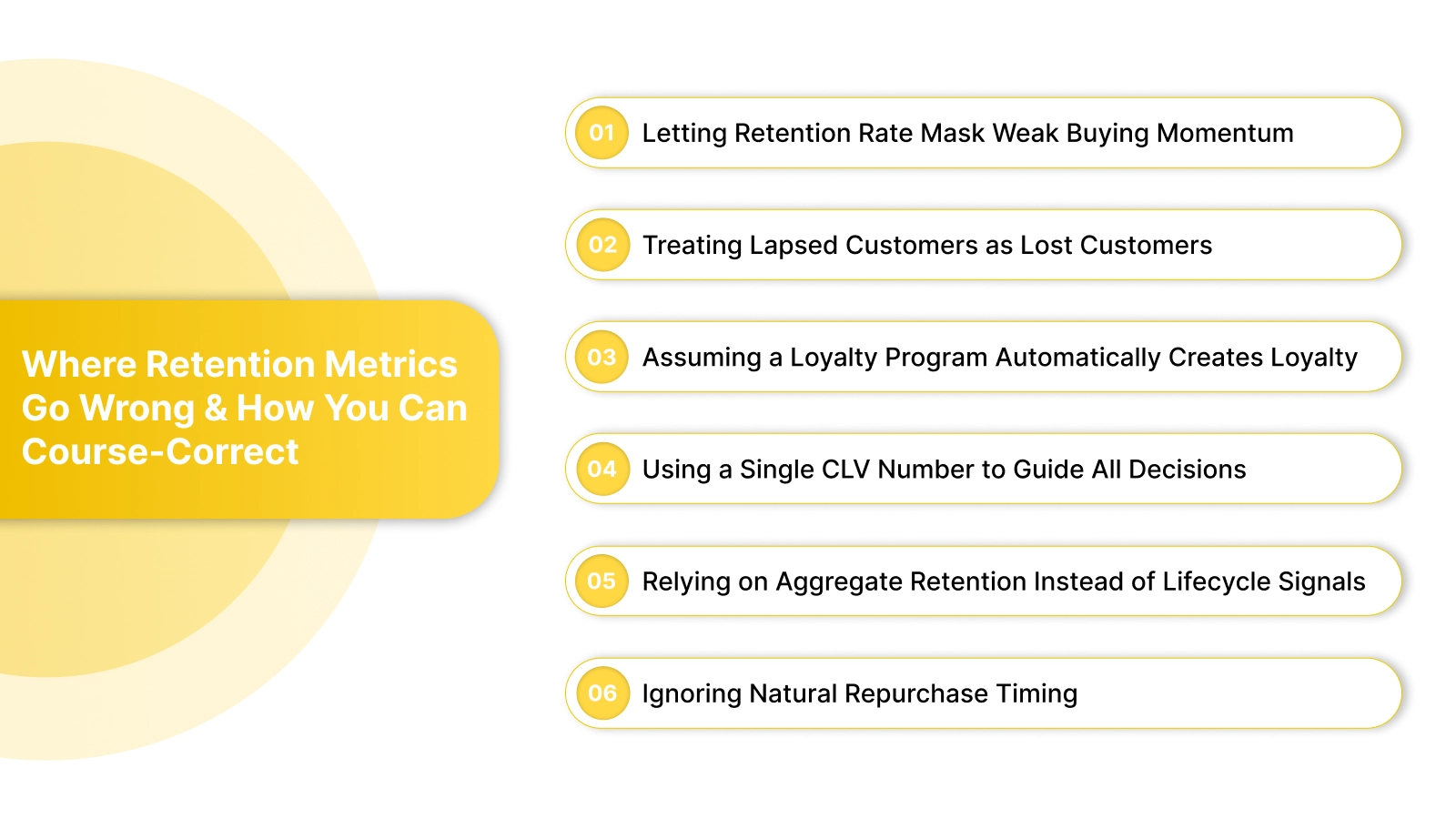
Where Retention Metrics Go Wrong and How You Can Course-Correct
Most e-commerce brands aren’t short on retention data. What holds them back is how that data gets interpreted, and where action breaks down. Metrics that should guide smarter decisions end up reinforcing false confidence or triggering the wrong responses.
These are the most common failure points, and how you can correct course before they impact revenue.
Mistake #1: Letting Retention Rate Mask Weak Buying Momentum
The Customer Retention Rate can remain high even as real engagement fades. Customers who haven’t purchased in months, or even a year, still count as “retained,” creating the illusion of stability while revenue stalls.
Course-correction starts by grounding retention in behavior, not labels. Pair CRR with Repeat Purchase Rate and purchase timing. When CRR looks healthy, but RPR lags, the signal is clear: customers aren’t leaving—they’re not moving. That’s your cue to focus on second-purchase nudges, product education, and early loyalty incentives.
Mistake #2: Treating Lapsed Customers as Lost Customers
Many brands shift attention to acquisition the moment a customer stops buying, assuming silence equals churn. In reality, most lapsed customers still have intent; they just need the right timing or reminder.
The correction is to stop thinking in absolutes and start thinking in stages. Use historical purchase intervals to flag early-, mid-, and late-stage lapses. Light-touch reminders work best early; more substantial incentives should only appear when churn risk actually increases.
Mistake #3: Assuming a Loyalty Program Automatically Creates Loyalty
Points and tiers don’t drive retention on their own. When rewards accumulate too slowly, or progress feels invisible, customers disengage, even if the program exists.
To correct this, audit your loyalty experience from the customer’s perspective. Can they earn something meaningful quickly? Do they see their balance and progress during checkout and post-purchase moments? When loyalty value is immediate and visible, behavior starts to change.
Mistake #4: Using a Single CLV Number to Guide All Decisions
Blended CLV averages flatten your customer base into something that doesn’t exist. They obscure your most valuable segments and lead to underinvestment where it matters most.
A better approach is to recalibrate CLV by segment. High-frequency buyers and VIPs often deliver multiples of the average customer’s value. Your retention spend, perks, and attention should scale accordingly. Treating top customers like average ones is a silent growth killer.
Mistake #5: Relying on Aggregate Retention Instead of Lifecycle Signals
Overall retention curves hide the most actionable insight: when churn actually happens. Without that clarity, interventions become reactive and expensive.
Course-correct by shifting to cohort views. Monthly acquisition cohorts quickly reveal early drop-off points and show whether newer customers are behaving better, or worse, than older ones. The earlier you identify friction, the easier it is to fix.
Mistake #6: Ignoring Natural Repurchase Timing
Outreach that isn’t aligned with how customers buy feels random at best and intrusive at worst. That’s how reactivation campaigns turn into wasted spend.
The fix here is precision. Map product-specific purchase cycles and align reminders, replenishment prompts, and incentives to those rhythms. When outreach arrives at precisely the moment a customer is likely to need the product again, it feels helpful rather than promotional.
When retention data is read through the lens of customer behavior, it stops explaining the past and starts shaping what to fix next.
Suggested Read: Customer Retention Automation Assistant: Tools & Strategies
How Nector Helps E-commerce Brands Track & Improve Retention Metrics?
Tracking retention metrics is only the first step. Turning those insights into meaningful improvements is where most brands struggle. Nector helps close this gap by giving e-commerce teams the tools to track, interpret, and act on the retention metrics that influence repeat sales and long-term customer value.
It brings loyalty, rewards, referrals, segmentation, and analytics together so teams can make retention measurable and manageable.
Here’s how Nector practically and measurably supports retention improvement.
Unified Retention Dashboard
A single dashboard brings together repeat purchase rate, purchase frequency, lifetime value, cohort retention, loyalty engagement, and referral performance. Teams gain a clear view of their retention health without having to collect data from multiple sources.
Automated Cohort Tracking
Nector automatically groups customers by acquisition month and behavior patterns. Brands can see when churn typically occurs and whether new cohorts are improving or declining. This helps them understand timing-based drop-offs with clarity.
Built-in RFM Segmentation
Every customer is scored on recency, frequency, and monetary value. High-value, at-risk, and first-time customers are identified automatically. Each group can receive its own tailored retention strategy, such as VIP benefits, win-back flows, or onboarding education.
Loyalty Program Analytics
Points earned and used, tier participation, reward redemption, and purchase behavior triggered by incentives are all tracked in detail. This shows which loyalty activities increase purchase frequency and which require adjustment.
Purchase Latency Insights
Nector identifies the typical repurchase window for each product or customer segment. When a customer approaches or passes this window, the platform can trigger relevant nudges or rewards designed to encourage timely repeat orders.
Referral Performance Tracking
Referral participation, conversion, and lifetime value of referred customers are measured in real time. This allows brands to understand how referral-driven customers compare to those acquired through paid channels.
Brands using Nector have reported a 320% increase in monthly orders and 317% growth in repeat purchase rates, loyalty engagement, and customer lifetime value. These results show how retention metrics produce measurable growth when paired with the right systems.
Wrapping Up
Customer retention metrics in ecommerce are more than just numbers. They show you which customers keep coming back, which products drive loyalty, and where you might be losing opportunities to grow.
With Nector, you can turn these insights into real action. You can identify high-value customers, re-engage those at risk of churning, and reward loyalty in ways that encourage repeat purchases. You get clarity without juggling spreadsheets or guessing what works.
Take control of your retention today and start your free trial with Nector to make every customer count.
FAQs
What is a reasonable customer retention metric for e-commerce?
A reasonable customer retention rate for e-commerce typically falls between 25 and 30 percent, indicating strong repeat purchasing behavior and stable revenue growth driven by existing customers.
Is a 90% customer retention metric in ecommerce good?
A 90% customer retention rate is excellent because it signals very high customer loyalty, strong product-market fit, and consistent revenue from repeat buyers.
What are the three R's of customer retention?
The three R's of customer retention are retention, repeat purchase, and referrals, focusing on keeping customers active, encouraging additional orders, and driving organic growth through advocacy.
Which KPI measures customer loyalty?
Customer lifetime value is the most reliable KPI for measuring loyalty because it reflects the revenue a customer generates throughout their relationship with a brand.
What are the three pillars of customer retention?
The three pillars of customer retention are customer experience, personalization, and value delivery, ensuring shoppers feel satisfied, recognized individually, and consistently motivated to keep purchasing.


_1_11zon.avif)




Start Building Customer Retention That Lasts