

.avif)
.avif)
Rising ad costs are making customer acquisition harder to justify. Paid channels are becoming more expensive, results are less predictable, and sustaining growth through ads alone is no longer reliable. In contrast, referral-driven customers often convert faster and cost less, which is why even small referral tests can deliver quick wins.
At the same time, owned channels such as email, SMS, and organic search offer a more cost-effective way to reach customers while providing more precise performance data. These channels play a key role in keeping acquisition costs under control over the long term.
In this blog, you’ll find the exact formula for calculating customer acquisition cost, a clear breakdown of what to include and exclude, when to use blended versus cohort CAC, and practical strategies to reduce CAC through referrals, loyalty, and owned channels.
Key Takeaways
- Customer acquisition cost shows how efficiently you turn marketing and sales spend into new customers, and it should never be evaluated in isolation.
- Accurate CAC depends on including all acquisition-related costs and excluding retention, COGS, and fixed overhead to avoid distorted decisions.
- Use blended CAC for high-level reporting and cohort CAC to identify which channels, campaigns, or time periods deliver faster payback.
- A healthy CLV: CAC ratio, often close to 3:1, signals sustainable growth and helps guide budget allocation across channels.
- The most reliable way to lower CAC is to increase repeat purchases, referrals, and loyalty-driven revenue, thereby reducing reliance on rising paid media costs.
Customer Acquisition Cost: Definition and Its Importance
Every e-commerce brand, from beauty and wellness to fashion, home decor, and specialty goods, relies on attracting new customers to grow. But how do you know if you’re spending efficiently? That’s where Customer Acquisition Cost (CAC) comes in.
CAC represents the average amount a brand spends to gain one new customer over a specific period. Understanding this metric helps you evaluate the effectiveness of your marketing, sales, and customer loyalty efforts and ensures your growth is profitable.
In practical terms, CAC includes all costs tied to acquiring new customers, such as:
- Marketing spend: Paid ads, influencer campaigns, email marketing, and content creation.
- Sales and incentives: Commissions, discounts, or rewards linked to new customers.
- Operational costs: Staff time, tools, and platforms dedicated to customer acquisition.
What Total Expenses Usually Include:
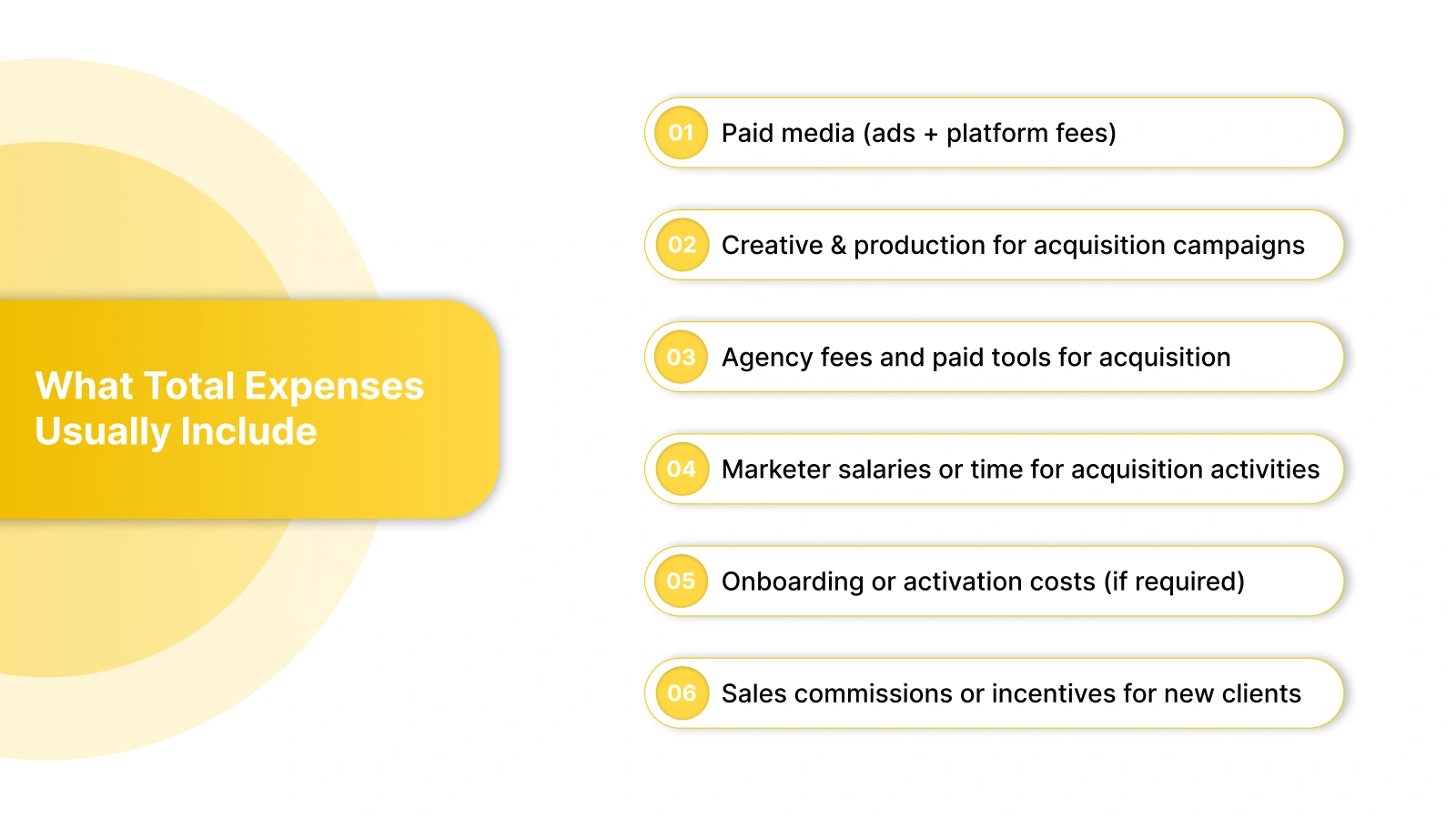
- Paid media (ads + platform fees): Direct spend to reach and convert prospects.
- Creative & production for acquisition campaigns: Costs to produce ads that drive conversions.
- Agency fees and paid tools for acquisition: Expenses tied to running and managing campaigns.
- Salaries or allocated marketer time for acquisition activities: The portion of staff time spent on acquiring new customers, ensuring unit economics reflect true labor costs.
- Onboarding or activation costs (if required): Initial fulfillment or setup necessary to convert a new customer into an active one (only the portion tied to new customers).
- Sales commissions or direct incentives for new customers: Payments such as bounties or commissions linked to new account acquisition.
Prorated or shared costs should be included only when they can be reliably allocated to acquisition, and the allocation method should be documented.
What to Exclude in CAC:
Items that belong elsewhere in your financial picture, and why they’re excluded from CAC:
- Cost of goods sold (COGS) and fulfillment per order: these affect gross margin, not the cost of winning a customer.
- Ongoing support and retention costs (unless part of initial onboarding): these drive lifetime value, not first-customer acquisition.
- Fixed overhead and corporate expenses: keep these in general overhead so CAC focuses on acquisition efficiency.
- Refunds/returns as a routine operating outcome: track separately against revenue and margin, only adjust CAC if refunds are explicitly part of your new-customer processing cost.
Getting these items right changes the CAC number and affects how you set budgets and judge channel performance.
With the definition in place, the next step is understanding why CAC plays such a central role in ecommerce performance.
Why CAC Is Critical for E-Commerce Brands?
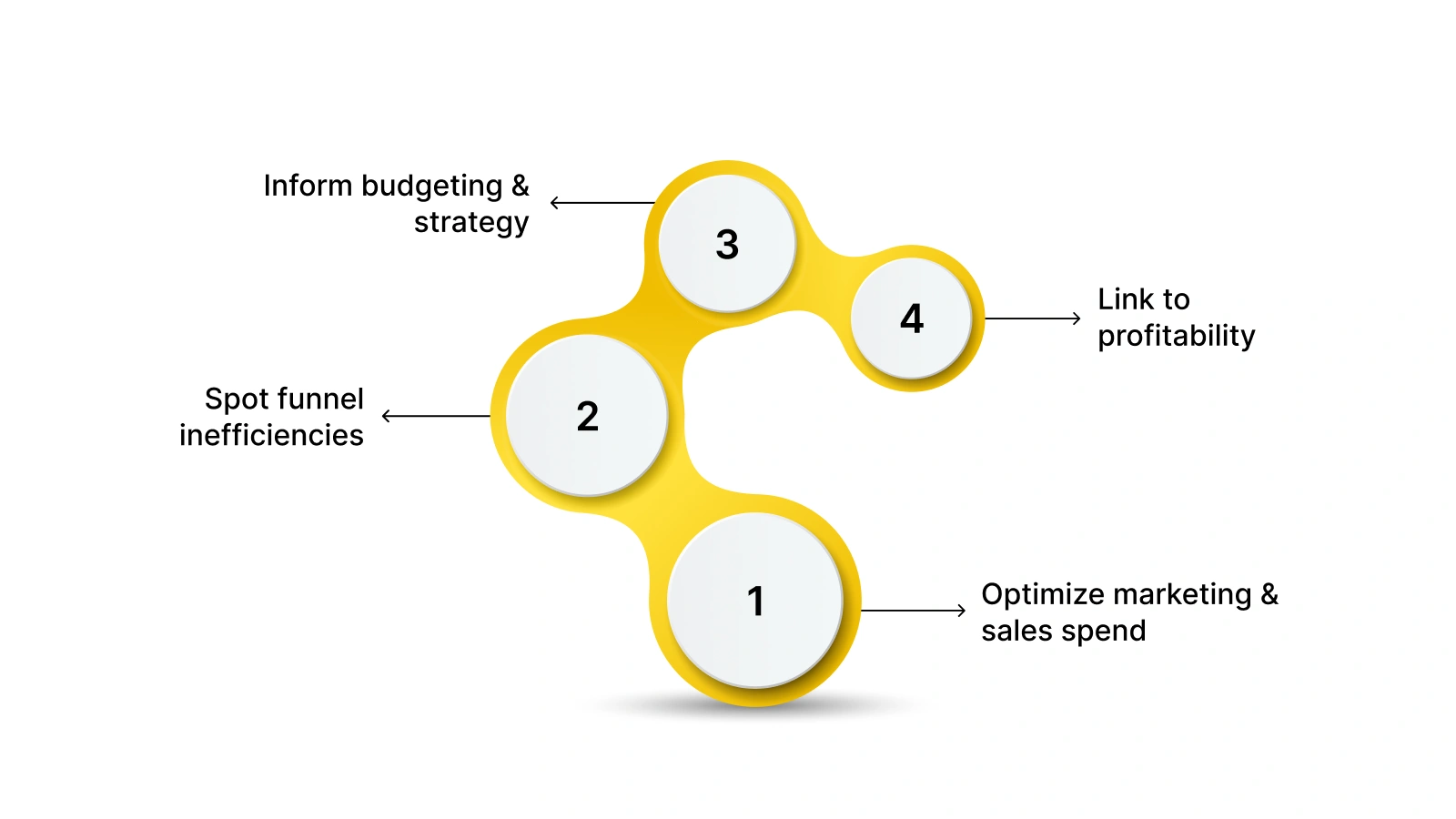
Tracking CAC gives you insight into your business efficiency and helps you make strategic decisions. Here’s why it matters:
- Optimize marketing and sales spend: By identifying campaigns and channels that deliver the highest return on investment.
- Spot funnel inefficiencies: Highlight stages in your buyer journey that need attention and improvement.
- Inform budgeting and strategy: Decide where to allocate resources for acquisition and retention initiatives.
- Link to profitability: Compared with Customer Lifetime Value (CLV), CAC indicates whether acquiring a customer is sustainable and profitable.
For example, a fashion brand might find that Instagram ads generate many new customers but at a higher cost than email campaigns. CAC analysis allows the brand to reallocate resources to channels that bring better results.
CAC is more than just a number; it’s a strategic tool for e-commerce brands. By tracking it carefully, you can improve acquisition efficiency, make smarter marketing decisions, and enhance long-term revenue.
Once CAC is established as a core metric, the focus shifts to how it’s measured.
Important CAC Measurement Choices: Blended vs. Cohort
Before you can improve customer acquisition cost, you need to measure it effectively. Not all CAC metrics are created equal; choosing the right approach helps you make informed decisions and optimize spend. Two widely used approaches are Blended CAC and Cohort CAC.
Blended CAC gives you a high-level overview of efficiency, while Cohort CAC allows you to track specific customer groups and understand which campaigns or channels deliver the best return. The table below highlights the differences and examples for both methods.
Once you understand these metrics, you can apply them strategically: use Blended CAC to get a quick snapshot of overall performance, and Cohort CAC to identify which specific campaigns or customer segments generate the fastest returns.
Tracking both metrics together ensures you see the big picture while gaining actionable insights to reduce CAC and improve long-term profitability.
Also Read: How to Boost Customer Retention with a Shopify Loyalty Program?
After choosing the right measurement approach, you can calculate CAC using your own data.
How to Calculate Customer Acquisition Cost (CAC) Manually?
%20Manually_.webp)
Understanding the cost of acquiring new customers is crucial for e-commerce brands across sectors such as beauty, wellness, fashion, and home decor. CAC helps you measure whether your marketing and sales efforts are generating profitable growth.
The simplest way to calculate CAC is to sum all marketing and sales expenses for a specific period and divide by the number of new customers acquired during that same period.
To calculate your customer acquisition cost effectively, follow these four steps, each building on the previous one:
- Determine the time period: Start by deciding the period you want to evaluate, such as a month, quarter, or year. This sets a clear frame of reference for measuring spend and comparing results over time.
- Add together all acquisition-related expenses: Next, sum up all marketing and sales costs tied to gaining new customers. This includes ad spend, creative production, salaries, agency fees, onboarding, and any incentives. Accurately capturing these costs ensures your CAC reflects true acquisition efficiency.
- Divide total expenses by the number of new customers: Once you have the total spend, divide it by the number of customers acquired during the same period. This step transforms your raw expenses into a tangible cost per customer, giving you a measurable metric to track.
- Review and interpret your CAC: Finally, analyze the resulting CAC to determine whether your acquisition strategy is efficient. Compare it to benchmarks or your customer lifetime value (CLV) to understand the return on your investment and identify opportunities to optimize campaigns.
By following these steps in order, you move from setting a timeframe to measuring exact costs, then to understanding results, making your CAC calculation both precise and actionable for e-commerce growth.
Now, apply the standard formula used across ecommerce teams.
Customer acquisition cost (CAC) is the average amount spent to acquire a new customer over a specified period. Use this standard formula:
CAC = (Total marketing + sales expenses for a period) ÷ (Number of new customers acquired in that period).
As your acquisition strategy expands across multiple channels, calculating CAC manually can become time-consuming and error-prone. A CAC calculator helps you estimate customer acquisition cost quickly and consistently across reporting periods.
To see how this works in practice, consider the following example:
Company X spent $150,000 on marketing and $100,000 on sales during one quarter.
In that same period, the company acquired 300 new paying customers.
CAC = ($150,000 + $100,000) ÷ 300 = $833
This means Company X spent $833 per new customer during that quarter.
Calculating CAC manually can become complex for multi-channel campaigns. A CAC calculator helps estimate acquisition costs quickly:
- Total marketing spend: $150,000
- Total sales spend: $100,000
- Number of new customers: 300
Estimated CAC: $833
This allows e-commerce brands to plan budgets, optimize channels, and measure ROI effectively.
After calculating CAC, the next step is evaluating whether it’s sustainable.
What’s a Good CAC and How Should You Measure It with CLV?
Determining a “good” customer acquisition cost depends on the revenue your customers generate over time. Instead of looking at CAC alone, focus on the CLV: CAC ratio, which measures your business’s long-term health more accurately.
Customer lifetime value (CLV) is the total revenue a customer generates over their relationship with your brand. Comparing CLV to your acquisition spend shows whether you are investing efficiently in new customers.
To calculate CLV:
- Multiply your company’s annual revenue per customer by the average customer lifespan. This gives the total revenue generated by a typical customer.
- Compare this figure to the cost of acquiring that customer to determine your CLV: CAC ratio.
While there isn’t a universal benchmark, a widely accepted target is 3:1. This means for every $1 spent on acquiring a customer, you ideally generate at least $3 in revenue. Meeting or exceeding this ratio ensures that your marketing spend is sustainable and that your acquisition strategy supports long-term growth.
Once those drivers are clear, optimization becomes more actionable.
4 Factors That Influence Customer Acquisition Cost and Lifetime Value
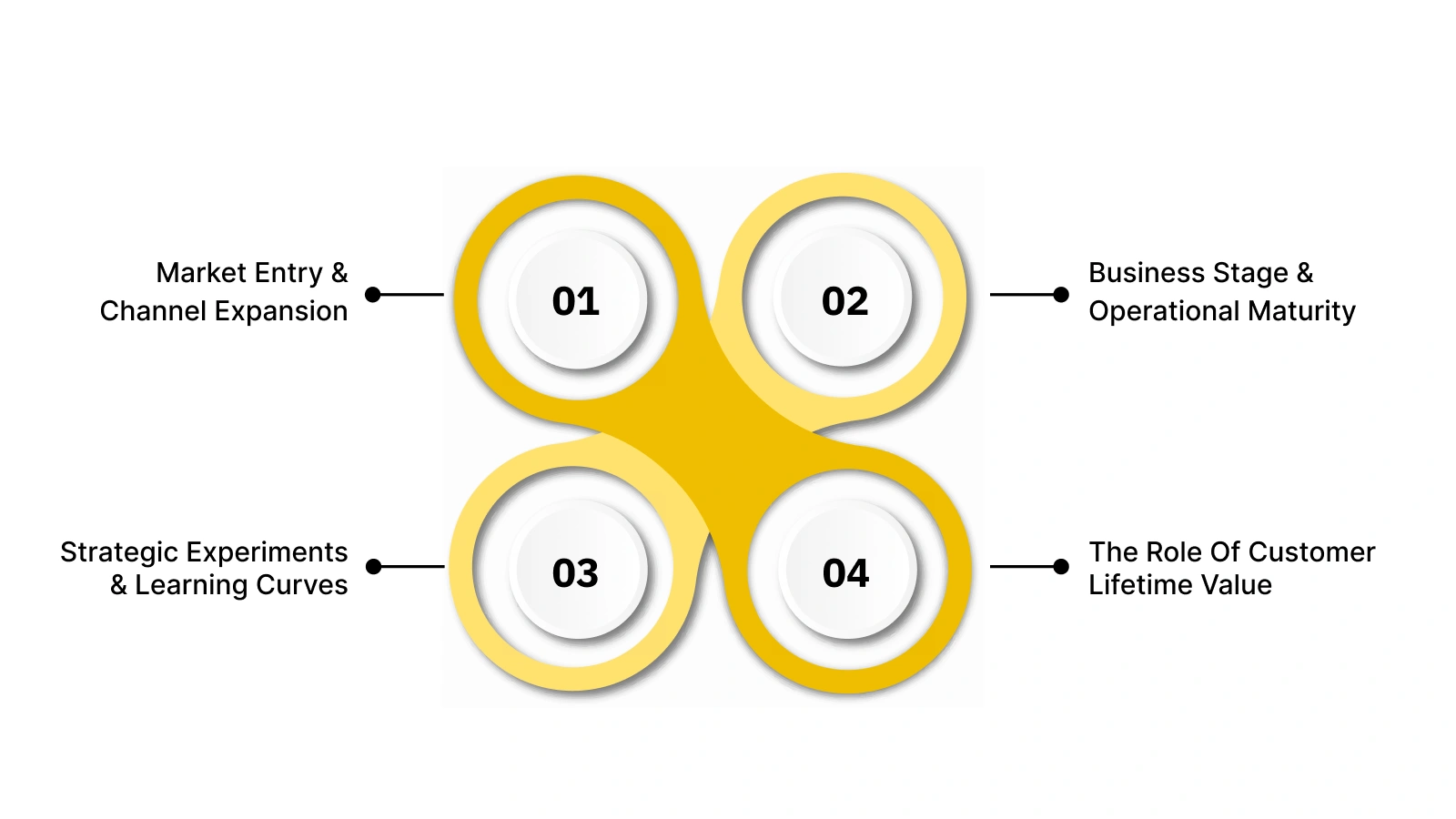
Customer acquisition cost is not a static number. It changes based on your market, business stage, and how effectively you turn first-time buyers into long-term customers. Some factors are within your control, while others require strategic patience and ongoing optimization.
1. Market Entry and Channel Expansion
When you enter a new market or test a new acquisition channel, your customer acquisition cost usually increases. Early spend goes toward testing messaging, targeting, and offers before performance stabilizes. As data improves and winning patterns emerge, CAC typically declines through optimization.
2. Business Stage and Operational Maturity
Newer ecommerce brands often face higher CAC because teams are still refining processes, onboarding tools, and validating acquisition strategies. More established brands benefit from historical performance data, brand recognition, and repeat customers, which naturally lowers acquisition costs over time.
3. Strategic Experiments and Learning Curves
Launching new products, expanding into new regions, or adjusting growth strategies often increases CAC in the short term. These increases are not inherently negative if they support long-term growth. The key is tracking performance closely and making informed adjustments rather than scaling prematurely.
4. The Role of Customer Lifetime Value
Customer lifetime value directly determines how much you can afford to spend on acquisition. When customers stay longer, purchase more often, and generate higher margins, higher CAC becomes more sustainable.
Lifetime value is influenced by:
- The length of time customers remain active
- Repeat purchase frequency and retention rates
- Total revenue generated per customer over time
- Profit margins after accounting for acquisition costs
- Average gross margin across the customer lifecycle
When lifetime value is substantial, investing more in acquisition can still deliver healthy returns. This is especially true when customers return consistently, leave reviews, and refer others organically.
Read Also: Maximizing Growth with CLV: A Strategic Loyalty Approach
By increasing repeat purchases, engagement, and referrals, brands reduce reliance on paid acquisition alone.
Now, connect acquisition costs with loyalty, retention, and repeat purchases.
7 Practical Strategies to Reduce CAC and Enhance ROI
If you want lower acquisition costs and more substantial returns, the best path is to focus on practical, proven tactics. Here are strategies you can apply right away to reduce customer acquisition cost (CAC) and improve ROI:
- Measure first: Track CAC by channel and by cohort (customers acquired the same way or during the same period). Cohort CAC reveals which campaigns last; blended CAC hides details.
- Focus on owned channels: Such as email, SMS, organic search, and your content. They cost less per touch than ads. Build a short welcome series, segment your lists, and add simple win-back flows. These steps reduce the cost of acquiring new customers over time.
- Put a referral program live: Referred customers usually cost less and convert better. Offer a small, double-sided reward (for both the referrer and the friend). Make the code or link trackable and scale what works.
- Raise CLV: Increasing repeat purchases makes any CAC more acceptable. Try subscriptions, bundles, post-purchase reorder prompts, and a basic loyalty layer that rewards repeat buys.
- Tighten paid media: Reduce waste by narrowing targeting, frequently testing creatives, and directing traffic to high-converting landing pages. Run small holdout or A/B tests to measure accurate incremental return.
- Use social proof: Add recent reviews and user-generated content (UGC) to product pages and ad creative to raise conversion. Better conversion lowers CAC fast.
- Measure attribution and run experiments: Link spend to real revenue. If full attribution isn’t possible, use simple A/B or geo tests. Run many small tests and scale winners.
Pick one or two tactics, measure the change in CAC and CLV, and keep scaling what works. Small, steady wins add up.
While strategies help reduce costs, benchmarks provide context. They show how your CAC compares to others in your industry and whether your customer value ratio is sustainable.
Also Read: Maximizing Growth with CLV: A Strategic Loyalty Approach
How to Improve Customer Acquisition Cost: 5 Proven Tactics
Customer acquisition cost continues to rise across paid channels, especially for consumer-focused ecommerce brands. To control CAC, you need clarity on how shoppers discover your brand, what convinces them to convert, and where acquisition spend delivers measurable returns.
Listening to customer behavior, acting on real feedback, and reviewing campaign performance allows you to acquire customers more efficiently.
Below are five practical ways to reduce customer acquisition cost while maintaining consistent growth.
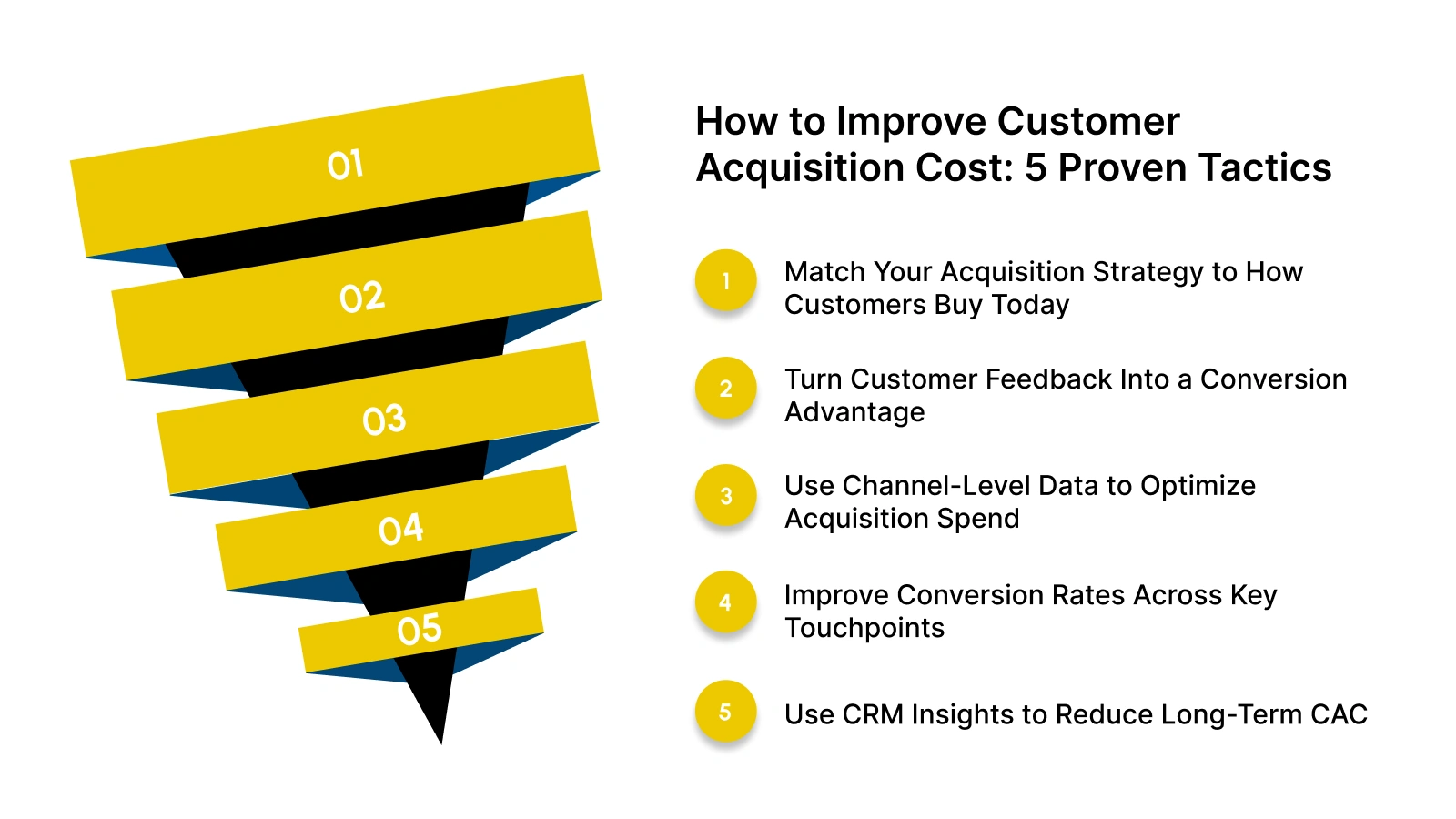
1. Match Your Acquisition Strategy to How Customers Buy Today
Buying behavior has shifted toward digital-first experiences across beauty, wellness, fashion, and specialty ecommerce categories. When your acquisition strategy does not reflect this shift, conversion rates drop and CAC increases.
To stay aligned with buyer preferences:
- Support self-serve purchasing: Most buyers now prefer online self-serve journeys with optional remote assistance rather than in-store or sales-led interactions.
- Sell higher-value products online: Clear product education, guided flows, and cross-sell recommendations help customers complete larger purchases with confidence.
- Use preferred communication channels: Many shoppers initiate brand conversations through chat, social messaging apps, and SMS instead of email.
When your acquisition channels match how customers prefer to shop, conversion rates improve and acquisition costs decline.
2. Turn Customer Feedback Into a Conversion Advantage
Customer acquisition cost depends heavily on how well your product experience matches customer expectations. If customers do not see value quickly, acquisition spend becomes inefficient.
You can improve conversion quality by operationalizing feedback:
- Share insights across teams: Customer feedback collected during demos, support interactions, and post-purchase surveys should reach product and growth teams quickly.
- Create a feedback loop: Encourage support teams to forward recurring themes from reviews, surveys, and social messages to product stakeholders.
- Act on high-impact signals: Addressing common friction points improves product-market fit and increases referral-driven acquisition.
Brands that act on customer feedback build trust, which lowers CAC over time.
3. Use Channel-Level Data to Optimize Acquisition Spend
Lowering customer acquisition cost requires precision, not averages. Instead of reviewing total spend, evaluate performance at the channel level.
Focus on the following:
- Track CAC by channel: Measure acquisition costs separately for paid search, paid social, referrals, email, and loyalty-driven campaigns.
- Monitor the CLV-to-CAC ratio: A healthy ratio is around 3:1. If it drops, review retention, referral activation, and repeat-purchase behavior.
- Reallocate budget strategically: Referral and loyalty-driven acquisition often outperform paid channels as customer lifetime value increases.
Data-backed decisions help you scale efficiently without increasing acquisition spend.
4. Improve Conversion Rates Across Key Touchpoints
Even minor conversion improvements can significantly reduce customer acquisition cost. When visitors drop off before converting, paid traffic becomes expensive.
To improve conversion performance:
- Analyze customer behavior: Identify friction points such as slow load times, confusing navigation, or cart abandonment.
- Test high-impact pages: A/B-test landing pages, product pages, and checkout flows to eliminate unnecessary steps.
- Strengthen trust signals: Reviews, ratings, and user-generated content build confidence and improve the effectiveness of paid traffic.
Higher conversion rates allow you to acquire more customers with the same budget.
5. Use CRM Insights to Reduce Long-Term CAC
A CRM helps you move beyond first-purchase metrics and focus on long-term acquisition efficiency.
With CRM data, you can:
- Identify repeat purchase patterns: Understand when customers return and which products they repurchase most often.
- Segment high-value customers: Use this data to attract similar profiles through referrals and targeted campaigns.
- Collect ongoing feedback: Surveys and engagement data help refine messaging and acquisition strategy.
CAC Benchmarks for Ecommerce in 2025-26: What Actually Matters
Customer acquisition cost is not a single number you can judge in isolation. It is shaped by product pricing, purchase frequency, and the channel used to acquire customers, whether paid ads, organic traffic, or referral programs.
Some ecommerce categories rely on impulse purchases, which often produce lower CAC but weaker retention. Others operate with higher upfront acquisition costs because repeat purchases and lifetime value justify the spend. This is why CAC benchmarks should be used to identify opportunities, not to set rigid targets.
Here’s the typical Ecommerce CAC range in 2025-26:
And here’s how to interpret these benchmarks:
- Use benchmarks as reference points: CAC will vary by channel, audience segment, and acquisition strategy, even within the same category.
- Compare CAC to lifetime value: A CAC within the “normal” range may still be inefficient if LTV does not justify the spend.
- Watch the LTV-to-CAC ratio: In 2025-26, many ecommerce teams aim for a ratio close to 3:1, though acceptable levels depend on margins and growth goals.
The most effective approach is to calculate CAC by cohort, then compare each cohort’s CAC against its actual lifetime value. The gaps you uncover show whether you should optimize acquisition efficiency, increase repeat revenue, or address both.
Benchmarks provide context, but your own customer data should drive decisions. Nector’s Loyalty Program helps ecommerce brands actively lower effective CAC by increasing repeat purchases, referrals, and customer value in real time.
How Nector Helps Reduce Customer Acquisition Cost for Businesses?
Rising customer acquisition costs are a challenge that almost every e-commerce brand faces today. Paid traffic is becoming more expensive, and relying only on first-time purchases makes it harder to recover that spend. This is where Nector steps in.
Nector helps brands lower customer acquisition costs by increasing the value generated from every customer you already acquire. Instead of paying repeatedly for new traffic, you turn one-time buyers into repeat customers and brand advocates, improving profitability over time.
Key ways Nector lowers Customer Acquisition Cost:
- Loyalty programs for Repeat Revenue: Launch fully white-labeled loyalty points and VIP tier programs that increase repeat purchases and average order value, making your initial acquisition spend more profitable.
- Incentivized Reviews and Social Proof: Collect and display text, image, and video reviews on product pages and ads to improve conversion rates and reduce wasted paid media spend.
- Automated Engagement and Retention: Use built-in automations and email triggers to re-engage inactive customers and drive repeat purchases without additional advertising costs.
- Referral-Driven Customer Acquisition: Turn existing customers into advocates who bring in high-quality referrals that convert faster and stay longer, lowering overall customer acquisition cost.
- Dashboard analytics + integrations: Track loyalty, referral, and repeat revenue through a central dashboard with integrations across Shopify, Klaviyo, Omnisend, Judge.me, and more, so customer acquisition cost stays measurable and actionable.
Brands often begin with a small loyalty or referral test. As repeat sales and referral revenue increase without increasing ad spend, customer acquisition cost naturally declines.

With Nector, reducing customer acquisition cost becomes an ongoing growth strategy, not a one-time fix. Start optimizing how much value you earn from every customer you acquire.
Final Thoughts
To measure the actual cost of customer acquisition, include all direct expenses along with shared costs. Use blended CAC for high-level reporting and cohort CAC to see which campaigns deliver faster returns.
Run small, measurable tests, scale only what works, and improve results by increasing repeat purchases through simple subscriptions, bundles, and post-purchase flows.
Nector helps lower effective CAC by driving repeat purchases, referrals, and reviews through points and VIP tiers, automated referral flows, and built-in reporting. It integrates with Shopify, Klaviyo, Omnisend, and Judge.me, and offers a 7-day free trial.
Start with a small loyalty or referral test, then book a demo with Nector to see the impact.
FAQs
How is CAC different from CPA?
CAC represents the total cost of acquiring a paying customer across all sales and marketing activities. CPA measures the cost of a specific action, such as a click or sign-up, and is typically tracked within advertising platforms.
How can you estimate CAC before launching a new channel?
Create a practical forecast using expected ad costs like CPC or CPM, projected conversion rates, and fixed setup expenses. This approach helps you arrive at a realistic CAC range rather than relying on a single number.
How should CAC be calculated for freemium or trial models?
Approach acquisition in two stages. First, measure the cost of bringing users into the free or trial tier. Next, calculate the cost per paying customer by factoring in the free-to-paid conversion rate and any support costs associated with free users.
How does seasonality impact CAC, and what should you compare it against?
CAC often shifts with seasonal demand and ad competition; compare same-month year-over-year figures and use rolling averages to spot real trends versus short spikes.CAC often changes due to seasonal demand and shifts in ad competition. Compare results for the same months year over year and use rolling averages to distinguish long-term trends from short-term fluctuations.
How should early-stage startups set CAC targets?
Begin with scenario-based models aligned with your runway and revenue goals. Use conservative conversion assumptions, test multiple CAC scenarios, and select targets that support fundraising while you validate acquisition channels.


.avif)




Start Building Customer Retention That Lasts