
.avif)
.avif)
Every brand wants loyal customers, people who return without hesitation, recommend you to others, and overlook the occasional slip-up. Yet for all the talk around retention, most brands still can’t answer one essential question: what is the most direct cause of customer loyalty?
Many assume it’s convenience, rewards, or great service. These help, but they’re only surface-level symptoms of something deeper.
Real loyalty doesn’t come from discounts or one-off delight. It comes from a repeated pattern of value delivered, trust reinforced, and friction removed. When customers believe your brand will consistently meet their expectations with minimal effort or risk, they stay, and that belief is the true driver of loyalty.
This article breaks down the psychology behind loyalty in 2025, the four forces that shape retention, and how modern brands are engineering trust at scale. Because loyalty isn’t bought anymore, it’s built through consistent, trustworthy experiences.
Key Takeaways
- Customers stick with brands that consistently deliver on promises, not those that throw discounts their way.
- When people feel safe, understood, and confident that a brand will “get it right” every time, price stops being the deciding factor.
- Frictionless experiences, smooth checkouts, clear communication, and simple redemptions turn satisfaction into repeat behavior.
- Loyalty grows when customers feel seen and appreciated, not just transacted with. Personalized messages and milestones go further than points.
- The lasting formula blends trust, value, ease, and recognition, working together to turn customers into advocates who stay by choice, not by incentive.
Defining Loyalty: Emotional vs. Behavioral
Before we can isolate what directly causes loyalty, we have to understand what loyalty actually is.
Most brands confuse repeat behavior with true loyalty, and that misunderstanding is where most retention strategies begin to fail.
A customer who keeps buying because they trust the brand will deliver value every time, that’s loyalty.
In behavioral science, researchers distinguish between two kinds of loyalty:
Most brands focus heavily on the first behavioral loyalty because it’s easier to measure: repeat orders, engagement points, or app opens.
But the second emotional loyalty is what actually sustains relationships and defends against churn.
So what turns repeat behavior into emotional loyalty?
It’s the moment when customers feel that a brand consistently delivers on its promise, without demanding unnecessary effort or attention in return.
That’s why the most direct cause of loyalty isn’t “low price” or “best rewards.”
It’s consistently perceived value delivered with trust and ease.
When a customer’s expectations are repeatedly met and doing business with you feels effortless, the brain codes that experience as safe and reliable. Over time, that familiarity becomes loyalty.
In other words: Loyalty isn’t a marketing outcome. It’s a behavioral reflex built on trust earned through consistency.
What the Data Says: The Direct Causes in Numbers
Every brand has a theory about what drives loyalty, but the numbers consistently point in one direction.
Across studies from McKinsey, PwC, and Edelman, one pattern repeats: customers stay loyal because they trust the brand to deliver consistent value, without unnecessary effort.
Let’s look at the data shaping loyalty in 2025:
- PwC’s Global Consumer Insights Pulse Survey (2025) found that 71% of consumers remain loyal to brands they perceive as trustworthy, even when competitors offer lower prices.
- Salesforce’s State of the Connected Customer Report (2025) showed that 76% of customers switch brands after just one poor experience, even if they were previously satisfied.
- Edelman’s Trust Barometer (2025) revealed that trust has overtaken price and quality as the top loyalty driver in consumer decision-making.
- According to McKinsey research, 78% of customers say personalized communications increase their likelihood to repurchase, suggesting that feeling understood, not just rewarded, plays a crucial role.
When you distil these insights, three clear themes emerge:
1. Trust is the strongest predictor of long-term loyalty.
It’s not about being perfect, it’s about being predictable. Customers forgive mistakes when they trust your intent and consistency.
2. Ease is the multiplier of trust.
Even great experiences lose their value if they require too much effort. Frictionless design, easy checkout, clear communication, and simple redemptions signal reliability.
3. Recognition turns satisfaction into attachment.
Customers don’t just want rewards; they want to feel seen. Progress bars, personalized messages, and milestone acknowledgements strengthen emotional connection.
If we visualize the findings across industries, it looks like this:
The takeaway is clear:
While discounts can attract customers, it’s perceived value, not price alone, that keeps them.
That’s the throughline across industries, whether it’s a D2C skincare brand, a subscription app, or a retail chain.
Loyalty forms where confidence meets comfort.
Let’s break down these four forces: trust, value, ease, and recognition, the mechanics that work together to create the conditions where loyalty naturally thrives.

The Four Forces That Create Loyalty (and How They Interact)
If loyalty were purely emotional, it would be unpredictable.
If it were purely rational, discounts would win every time.
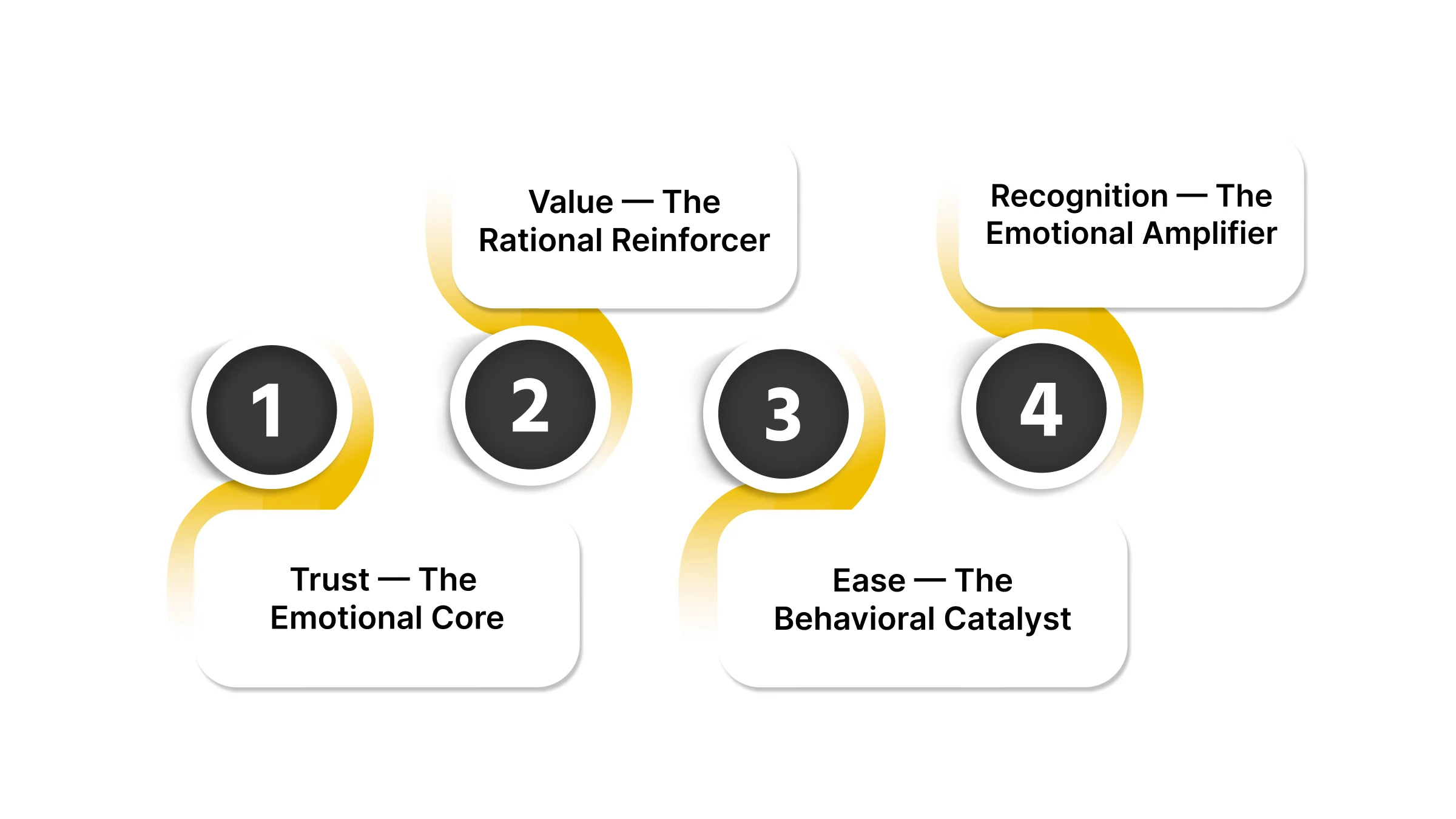
In reality, customer loyalty is shaped by the interplay of four forces, each one reinforcing the other in subtle but measurable ways.
When aligned, they create a compounding effect: satisfaction turns into habit, habit becomes trust, and trust evolves into advocacy.
Let’s break them down.
1. Trust — The Emotional Core
Trust is the bedrock of loyalty.
Trust is built not through grand gestures, but through consistent follow-through:
- Deliver what you promise, every time.
- Communicate transparently, especially when something goes wrong.
- Protect data privacy and show customers how their information adds value, not risk.
Every interaction either reinforces or erodes trust. The most direct cause of long-term loyalty is knowing what to expect and experiencing it repeatedly.
2. Value — The Rational Reinforcer
Trust draws people in, but value keeps them.
Value is the perceived fairness between what customers give (money, time, attention) and what they get (quality, experience, satisfaction).
Modern consumers are value-calculators.
They don’t only measure the product, they measure time saved, convenience gained, and effort avoided.
That’s why brands that make life simpler or more efficient often outperform those that only discount heavily.
Ease, reliability, and helpfulness have become part of a brand’s value equation.
3. Ease — The Behavioral Catalyst
Ease is the silent driver that amplifies all other loyalty levers.
When customers experience frictionless journeys, from browsing to checkout to support, they subconsciously associate your brand with comfort and predictability.
Customer journey tools like FullStory help teams see exactly where friction appears in these journeys, making it easier to fix what actually disrupts the experience.
Behavioral economists call this the “effort heuristic”; the brain rewards low-effort experiences with repeated behavior.
Ease works in micro-moments:
- Clear return policies.
- Single-click reorders.
- Seamless reward redemptions.
- Unified login and payment systems.
These are loyalty architecture.
Ease converts satisfaction into automatic preference.
4. Recognition — The Emotional Amplifier
Humans are wired to seek acknowledgment.
Recognition transforms a neutral transaction into a personal relationship.
When customers feel noticed, not just numbered, they start identifying with the brand itself.
Examples:
- “Welcome back, you’re only 50 points from your next tier.”
- “Thanks for your 10th order, you’re part of our core circle.”
- “We noticed your favorite category, here’s something just for you.”
These cues trigger reciprocity: the instinct to give back when valued.
Recognition fuels emotional loyalty, the kind that makes customers advocates rather than repeaters.
How the Four Forces Interact
When brands align all four, they move from transactional loyalty (“I buy because it’s easy”) to transformational loyalty (“I buy because I believe in this brand”).
This framework also reveals the real hierarchy: Loyalty isn’t caused by one single factor; it’s sustained by the equilibrium between trust, value, ease, and recognition.
Context Matters: How Loyalty Drivers Shift by Industry

While trust, value, ease, and recognition drive loyalty everywhere, the weight of each force changes by industry. Customer expectations, purchase frequency, and emotional investment shape what loyalty looks like in practice.
Here’s how the most direct cause of loyalty shifts across major sectors, in a compact, high-impact breakdown.
1. E-Commerce & D2C: Ease and Recognition Lead the Way
In online retail, friction is the enemy. Slow delivery, clunky checkout, or unclear returns instantly push customers elsewhere.
Ease is the primary driver, but once the basics are smooth, recognition, milestone rewards, personalized prompts, and “almost there” nudges deepen attachment.
Direct cause: A fast, effortless shopping experience reinforced by timely, personalized recognition.
2. SaaS and Subscription Businesses: Trust Is Everything
Subscription loyalty depends on confidence that the product will keep improving and remain worth the recurring cost. Transparent updates, stable performance, and responsive support matter more than discounts.
Direct cause: Steady, trustworthy delivery of evolving value customers can rely on month after month.
3. Retail & Hospitality: Recognition and Emotional Connection Dominate
Here, the human element shapes loyalty. Customers remember how they were treated — whether preferences were recalled, whether service felt personal. Recognition builds emotional equity, which directly fuels repeat visits.
Direct cause: Personal acknowledgment that makes customers feel known and valued.
4. Financial Services & Fintech: Trust + Ease in Tandem
Money-related experiences leave zero room for doubt. One compliance error or confusing UI breaks loyalty instantly. Customers stay with brands that feel both safe and simple to manage.
Direct cause: High reliability delivered through an interface and experience that feels effortless and transparent.
5. Lifestyle & Luxury Brands: Emotional Value Over Transactional Gain
In aspirational categories, loyalty is tied to self-image. Customers here are buying alignment, community, and aesthetic identity. Recognition supports this, but emotional value is the anchor.
Direct cause: A sense of identity and belonging strengthened by consistent brand storytelling and exclusivity.
The Universal Truth
Every brand earns loyalty differently, but the outcome is always the same: Customers stay loyal when they trust you to deliver consistent value with minimal effort.
Loyalty is earned through predictability and care, repeated over time.
Operationalizing Loyalty: Turning Insight into Action

Understanding what drives loyalty is only half the work.
The real challenge lies in turning those insights: trust, value, ease, and recognition, into repeatable, scalable actions across every customer touchpoint.
Modern brands don’t build loyalty through slogans or surprise campaigns; they design for it.
That means embedding reliability, personalization, and simplicity directly into how the business operates, not just how it markets.
Here’s how loyalty becomes operational, not aspirational.
1. Design for Predictability, Not Perfection
Predictability breeds trust, and trust breeds return behavior.
Operationalizing predictability means setting clear expectations at every stage of the customer journey:
- Be transparent about delivery times, return policies, and product availability.
- Communicate proactively when issues occur.
- Make sure every channel, website, email, social, or support speaks the same language.
When customers never have to guess what to expect, confidence replaces uncertainty and loyalty follows.
2. Automate Recognition Without Losing the Human Touch
Personalization doesn’t have to mean manual effort.
The most successful brands automate recognition, milestone messages, tier upgrades, and birthday rewards, while keeping tone and timing deeply human.
Automation ensures no loyal moment goes unnoticed:
- Reward progress in real time (“You’re just one purchase away from Gold status”).
- Use behavioral triggers to recognize meaningful actions, not just transactions.
- Integrate loyalty signals directly into emails, checkout pages, and support flows.
When acknowledgment happens seamlessly, customers feel remembered, not managed.
It’s the difference between a loyalty program that runs for customers and one that runs with them.
3. Turn Friction Points into Trust Signals
Every brand has friction, a return process, a delayed shipment, and a support ticket.
The brands that retain customers are the ones that handle friction transparently.
Operational excellence in loyalty means building trust recovery loops:
- Empower teams to resolve issues instantly, not escalate endlessly.
- Close the loop with personal follow-ups (“We’ve fixed it, and added 50 bonus points for the trouble”).
- Use these moments to demonstrate reliability in action.
4. Create Feedback Loops That Refine Value
The best loyalty programs evolve because they listen.
Customer behavior, redemptions, inactivity, and purchase intervals are a feedback system in disguise.
Operational brands treat this data as a living pulse.
To translate feedback into value:
- Track which rewards actually drive repeat purchases.
- Retire perks that don’t move the needle.
- Introduce new reward types based on what customers actually do, not what you assume they want.
Loyalty is designed, measured, and tuned like a growth engine.
5. Make Ease the Default, Not the Upgrade
Ease should feel like the brand’s DNA.
Whether it’s checkout, redemption, or referral, every extra step is a chance for a dropout.
Operational simplicity is what turns satisfaction into a habit:
- One-click redemptions at checkout.
- Unified dashboards for tracking points, referrals, and tiers.
- Seamless integrations that eliminate switching between apps or tools.
The easier loyalty feels, the more naturally it becomes part of the customer’s rhythm.
The Shift That Defines Retention Leaders
What separates retention leaders from everyone else is operational empathy.
They build systems that don’t just deliver rewards but deliver reassurance.
When trust, ease, and recognition are baked into operations, not bolted on as campaigns, loyalty stops being a metric and becomes a reflex.
And while these principles are universal, executing them consistently across touchpoints, tools, and teams takes more than intention; it takes the right infrastructure.
That’s where modern loyalty platforms like Nector bridge the gap, helping brands operationalize trust and recognition at scale.
How Nector Enables Trust-Led Loyalty
Building loyalty is about removing friction between systems, data, and the customer experience.
Most brands know what drives loyalty. Few can execute it consistently.
That’s because delivering real-time recognition, seamless experiences, and measurable trust requires precision, not just intention.
And that’s exactly where Nector makes the difference.
Nector helps e-commerce and D2C brands turn loyalty from a campaign into an ecosystem, one that’s unified, automated, and personalized at scale.
Here’s how it brings the four loyalty forces, trust, value, ease, and recognition, to life operationally.
1. One Unified Platform for Rewards, Referrals, and Reviews
In most brands, retention lives in silos, one app for points, another for referrals, and a third for reviews.
Nector eliminates that fragmentation.
All three loyalty pillars connect into a single system, ensuring:
- Every customer action, from purchase to referral to review, contributes to one consistent journey.
- Rewards stay accurate and transparent across all touchpoints.
- Teams get a unified view of engagement, redemption, and lifetime value.
That cohesion builds trust by design; customers see one brand, not disconnected programs.
2. Real-Time Engagement and Instant Recognition
In loyalty, timing defines trust.
Nector’s automation engine ensures that customers are recognized instantly, not hours or days later.
Points, tiers, and milestones update automatically the moment a customer completes an action, whether it’s a purchase, referral, or review.
That instant acknowledgment creates emotional momentum, the sense that the brand sees me right when it matters.
For brands, it means fewer errors, fewer complaints, and a consistent experience that scales effortlessly.
3. Personalization Without the Complexity
Nector lets brands personalize experiences without adding operational strain.
Through simple, no-code rules and behavioral triggers, teams can design rewards and messages tailored to customer intent and milestones, automatically.
Examples:
- Send “You’re 50 points away from Silver” nudges.
- Offer category-specific rewards based on purchase behavior.
- Trigger birthday or anniversary perks instantly.
It’s personalization that feels human, delivered through automation that feels effortless.
4. Actionable Analytics That Turn Data Into Retention Decisions
To understand loyalty, you need to understand why customers return.
Nector’s analytics dashboard helps brands measure what actually drives retention, not just signups or redemptions.
Teams can instantly see:
- Which rewards generate the highest repeat purchase rates?
- Where customers drop off in the loyalty journey.
- How loyalty members compare to non-members in lifetime value.
This visibility transforms loyalty from a guessing game into a growth lever that can be optimized like any revenue channel.
5. Built to Scale With You
Whether you’re a founder-led Shopify brand or a multi-store enterprise, Nector scales as you grow.
Its white-labeled design ensures the loyalty experience looks and feels like your brand, not a plugin.
With 400+ integrations across e-commerce, CRM, and marketing platforms, Nector fits naturally into your stack, keeping operations simple while loyalty runs itself.
Loyalty That Runs Quietly, but Works Powerfully
The most powerful loyalty systems are invisible to customers; they simply work.
That’s what Nector delivers:
- Real-time rewards.
- Seamless experiences.
- Consistent trust.
It’s not just loyalty software, it’s a retention engine designed for modern brands that want to keep customers for the right reasons:
Because they trust you, not because you discount for them.
If you’re ready to move beyond points and build loyalty that feels effortless, Nector makes it possible.
Book a Demo Today and experience the difference.
Wrapping Up
Enduring loyalty comes from doing the simple things well, every time: clear expectations, fair value, and experiences that never make customers work harder than they should. When people trust you to deliver consistently and with minimal friction, they return by choice, not because a coupon pushed them.
The brands that win are the ones that engineer loyalty into their operations, not just their marketing. That’s where the right infrastructure matters.
FAQs
1. What is the most direct cause of customer loyalty?
Trust built through consistent value and low effort. When customers feel confident you’ll “get it right” every time, they stay.
2. How is true loyalty different from repeat purchases?
Repeat purchases can come from habit or discounts. True loyalty is emotional — customers choose you even when alternatives are cheaper or closer.
3. How can brands build trust through loyalty programs?
Be clear, consistent, and fair. Reward meaningful actions, communicate transparently, and recognize customers promptly.
4. Why do many loyalty programs fail?
They focus on discounts instead of relationships. If customers don’t feel valued or understood, points won’t keep them around.
5. What role does personalization play in loyalty?
Personalization makes customers feel seen. Tailored messages, milestones, and rewards deepen emotional connection.

Related Blogs


%201.webp)
%201.webp)

Start Building Customer Retention That Lasts