
.avif)
.avif)
The ecommerce industry in the U.S. is experiencing rapid growth, with online retail sales projected to soar to USD 2.08 trillion by 2030. However, as more businesses enter the market, the competition for customer loyalty intensifies.
With so many options available, customers can easily switch brands, which makes reducing churn extremely important for sustained success. High churn rates, when customers stop purchasing from your store, can drain resources and affect your growth.
This blog will explain what churn rate in ecommerce is, how to calculate it, why it matters for your business, and, most importantly, how you can reduce it. By the end, you’ll have actionable insights into how you can retain more customers and build stronger, more profitable relationships with them.
Key Takeaways
- Churn rate is an important metric for ecommerce businesses, indicating how many customers stop buying over a specific period. It helps to assess customer retention strategies.
- Different types of churn, customer, revenue, logo, and net revenue provide unique insights that help businesses pinpoint areas for improvement.
- Calculating churn rates involves understanding both customer and revenue losses, with formulas tailored to each type, helping businesses measure churn accurately.
- Cohort analysis and time-based tracking allow businesses to spot patterns in customer behavior, making it easier to predict and prevent churn before it happens.
- Effective churn reduction strategies include enhancing customer service, improving user experience, and utilizing loyalty programs, all of which directly impact retention and customer satisfaction.
What is Churn in Ecommerce?
Churn, in simple terms, refers to the customers who stop buying from your ecommerce store over a specific period. High churn rates can be a red flag, signaling that something may be wrong with your product, service, or customer experience.
Churn can be broken down into various types depending on what aspect of your business you’re analyzing. Below, we’ll look at the different types of churn that ecommerce businesses commonly track and manage.
Types of Churn
There are four types of churn, including customer, revenue, logo, and net churn. Understanding each of them gives unique insights into your losses and helps tailor the right strategies.
- Customer Churn: This is the number of customers who stop buying from your business. It’s a simple count of lost customers during a certain period.
- Revenue Churn: Unlike customer churn, which focuses on the number of customers, revenue churn measures the amount of lost revenue during a period. It’s more relevant to businesses with varied customer spending.
- Logo Churn: This refers to the number of customers who stop engaging with your business altogether, regardless of their spend or transaction history.
- Net Revenue Churn: This metric combines both customer and revenue churn by factoring in the replacement of churned revenue with new or retained customers. It helps you see if your business is growing or shrinking.
Once you identify and categorize churn, the next step is to measure it accurately. Knowing how to calculate churn rate in ecommerce will help you track trends and implement data-driven strategies to reduce it. Let’s explore how to do that next.
Also Read: Customer Churn vs Retention: Key Differences Explained
How to Calculate Churn Rate in Ecommerce?
Calculating churn is essential for understanding how your business is performing and where you might be losing customers. To help, we’ll walk through the formulas that are the most useful and commonly used for understanding and tracking churn in ecommerce.
1. Formula for Customer Churn Rate
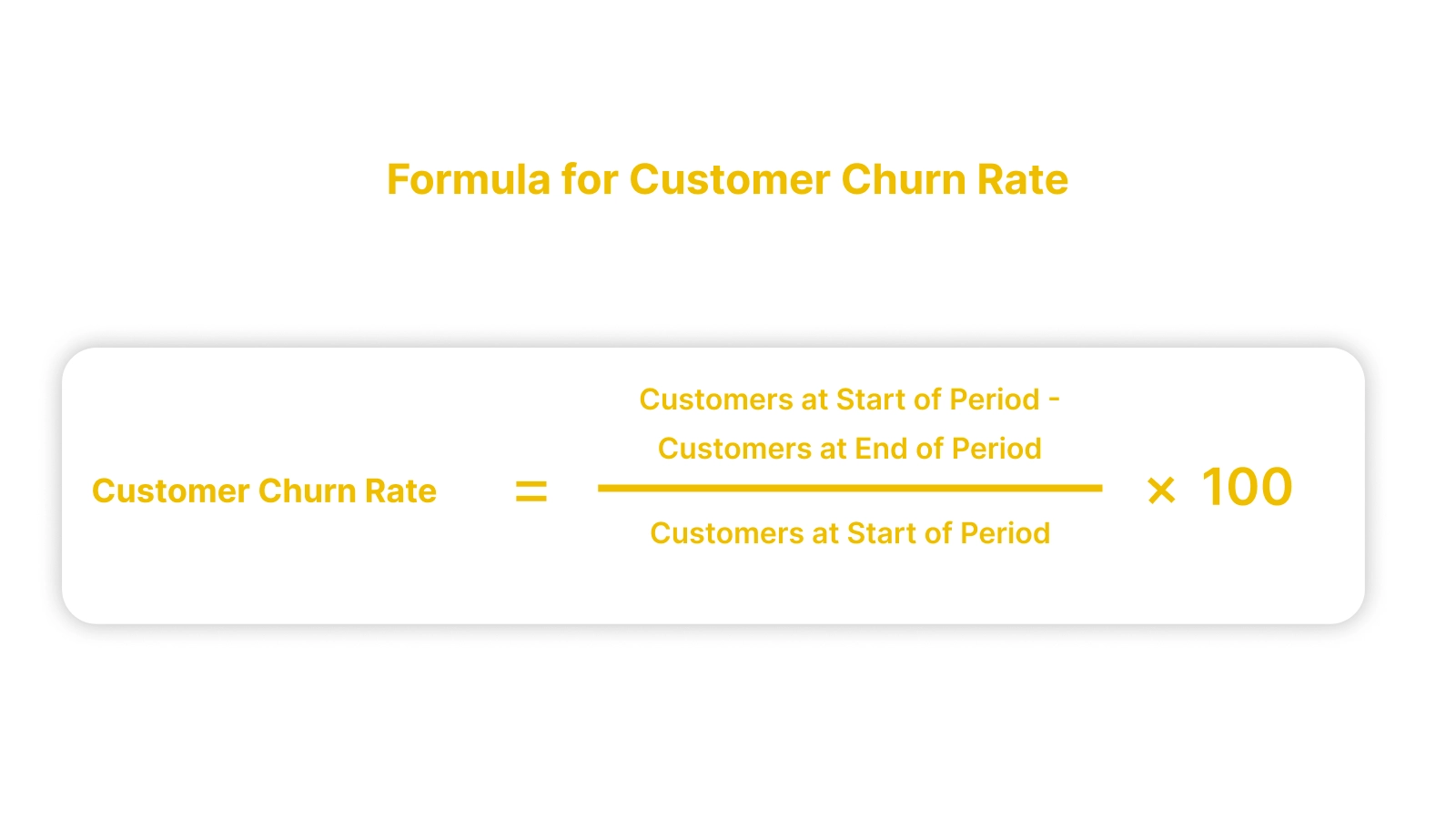
The formula to calculate customer churn is straightforward:
Customer Churn Rate = ((Customers at Start of Period - Customers at End of Period) / Customers at Start of Period) × 100
For example, if you had 1,000 customers at the start of the month and 900 customers at the end of the month, your churn rate would be:
Customer Churn Rate = ((1000 - 900) / 1000) × 100 = 10%
2. Formula for Revenue Churn Rate
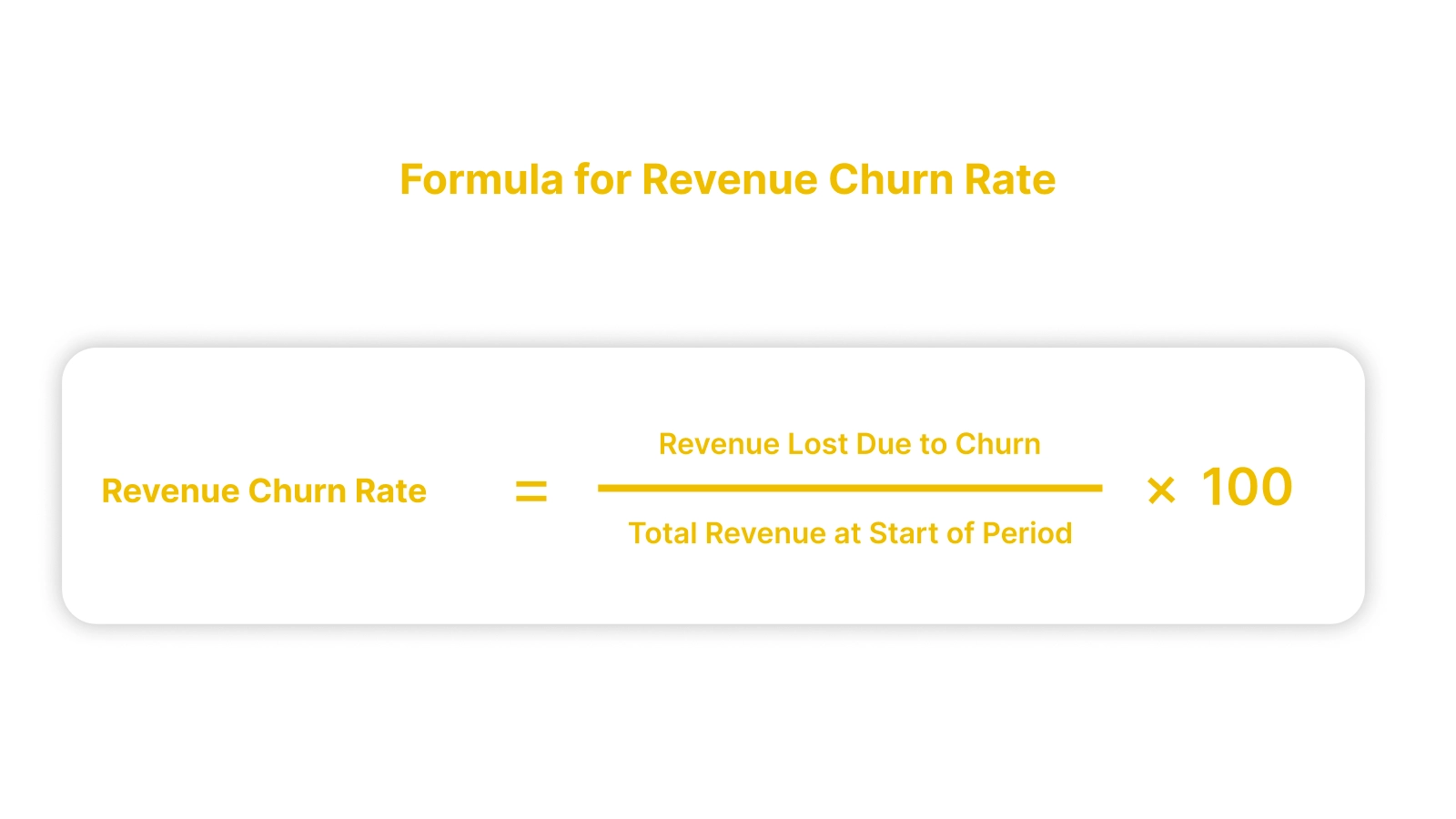
Revenue churn is calculated by looking at the lost revenue from churned customers:
Revenue Churn Rate = (Revenue Lost Due to Churn / Total Revenue at Start of Period) × 100
If your revenue at the start of the month was $50,000, and you lost $5,000 in churned revenue, the formula would look like:
Revenue Churn Rate = (5000 / 50000) × 100 = 10%.
By calculating both customer and revenue churn, you can better understand your losses, but to take effective action, you need to examine how churn varies across different customer segments. Let’s explore that next.
How Do Churn Rate Ecommerce Differ Across Customer Segments?
Churn varies across customer segments, and segmenting your churn data helps identify high-risk groups. By doing so, you can take more targeted actions to address their needs.
1. Cohort Analysis
Cohort analysis groups customers based on shared characteristics, like the month they made their first purchase. By tracking these groups, you can identify trends and see if certain cohorts are more likely to churn. For example, customers who made their first purchase during a promotion might churn more than those who discovered your brand organically.
2. Time-Based Considerations
Churn often occurs at specific times in the customer lifecycle. New customers may churn after their first purchase if they don’t find value. Long-term customers may show signs of churn if they feel the experience has become stale, such as due to a lack of new products or offers. Recognizing these timing patterns helps you intervene before they leave.
Understanding churn across segments allows you to take proactive steps. Once you've segmented your data and identified risk areas, the next step is to determine what constitutes a "healthy" churn rate for your business.
What is a Good Churn Rate in Ecommerce?
Churn rate is an important metric, but what constitutes a "good" churn rate? A good churn rate depends on factors like the nature of your business, your customer demographics, and your growth stage.
Healthy vs. Unhealthy Churn
A churn rate under 5% is generally considered excellent, especially for businesses that rely on repeat purchases. Anything above 20–25% could be an indicator of a deeper problem. However, what’s considered "good" can vary by business model:
- Subscription Services: A churn rate below 10% is excellent.
- Non-Subscription (Traditional E-Commerce): Anything under 30% is typically acceptable.
The Business Impact of Ecommerce Churn
Churn doesn’t just affect customer numbers. It can significantly impact your profitability and long-term growth. High churn rates increase your customer acquisition costs (CAC) because you need to constantly find new customers to replace the ones who leave. A lower churn rate means you retain customers longer, reducing the cost of acquisition and improving customer lifetime value (CLV).
How to Identify and Measure At-Risk Ecommerce Customers?
Identifying customers who are at risk of churning is essential for preventing it. Here are the steps to spot these customers early:
- Low Engagement: Customers who stop opening emails or interacting with your website may be at risk.
- Cart Abandonment: If customers consistently add items to their cart but don’t complete purchases, they may be losing interest.
- Decreased Purchases: A drop in purchase frequency is a common churn indicator.
Tools for Tracking
Customer relationship management (CRM) tools and customer data platforms (CDPs) help track engagement levels and pinpoint at-risk customers. Tools like Klaviyo and HubSpot provide detailed insights into customer behavior. Besides, Nector enhances this by focusing on customer retention, tracking engagement through loyalty, referral, and review programs, and offering insights tailored to reducing churn.
By understanding how to track customer engagement, you can identify at-risk customers early, but the next step is to uncover the reasons behind their churn. Let’s explore why ecommerce customers decide to leave.

Also Read: From Clicks to Customers: Improving Shopify Checkout Process for D2C Success
Why Do Ecommerce Customers Churn?
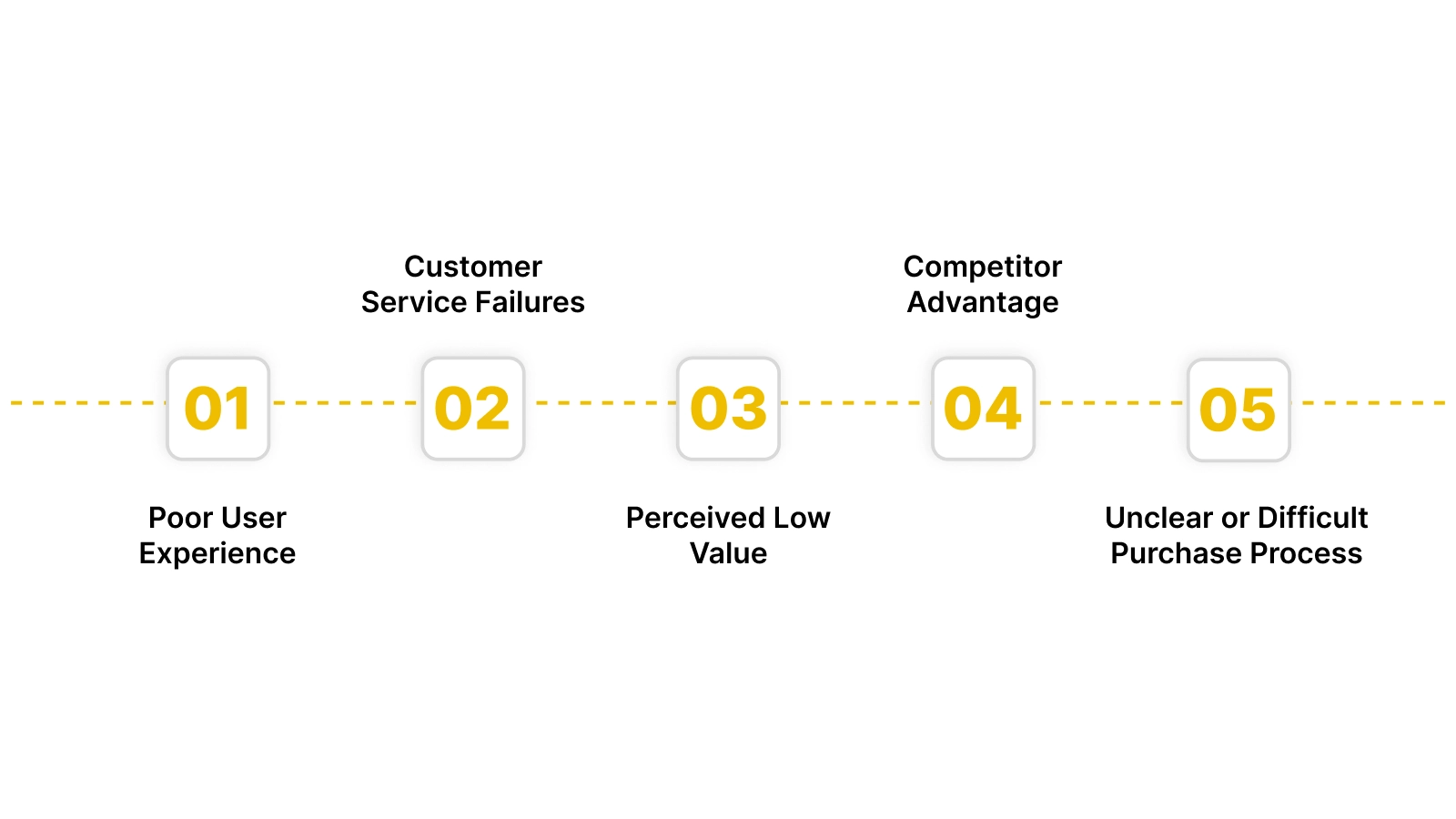
Understanding the root causes of churn is key to reducing it. Here are some of the most common reasons customers leave:
- Poor User Experience (UX): A confusing website, slow loading times, or a difficult checkout process can drive customers away. Ensure your website is easy to navigate, visually appealing, and optimized for both desktop and mobile.
- Customer Service Failures: When customers encounter problems and can’t easily get help, they may look elsewhere. Invest in responsive customer service with multiple channels of communication like live chat, email, and phone support.
- Perceived Low Value: If customers don’t see the value in your product or service, they won’t return. Show them why your product matters through personalized experiences and clear benefits.
- Competitor Advantage: If a competitor offers better pricing, a smoother experience, or higher-quality products, customers might leave. Continuously monitor your competitors and adjust your offering accordingly.
- Unclear or Difficult Purchase Process: If customers find the checkout process confusing or lengthy, they may abandon their cart. Simplify the purchase process with fewer steps and clear instructions.
Now that you have learned the reasons behind churn, let’s see how ecommerce churn analysis can provide the insights needed to tackle these issues effectively.
What Is Ecommerce Churn Analysis and Why Does It Matter?
Churn analysis helps businesses understand why customers are leaving, so they can take corrective action. Here’s how to perform effective churn analysis:
- Tracking Churn Indicators: Use tools to track indicators like website activity, purchase history, and customer feedback to identify churn risks early.
- Cohort-Based Tracking: By segmenting customers into cohorts based on when they first made a purchase, you can track how long different groups stay loyal and identify patterns that predict churn.
- Time-Based Analysis: This method tracks when customers tend to churn, which helps you intervene before they leave.
- Customer Satisfaction (CSAT) and Net Promoter Scores (NPS): Both CSAT and NPS scores can give you a direct gauge of how satisfied customers are with their experience. Low scores often correlate with higher churn.
Once you’ve identified the indicators and causes of churn, the next step is taking action. Let’s explore 7 proven strategies to reduce churn and improve customer retention in your ecommerce business.
7 Proven Ways to Reduce Churn in Your Ecommerce Business
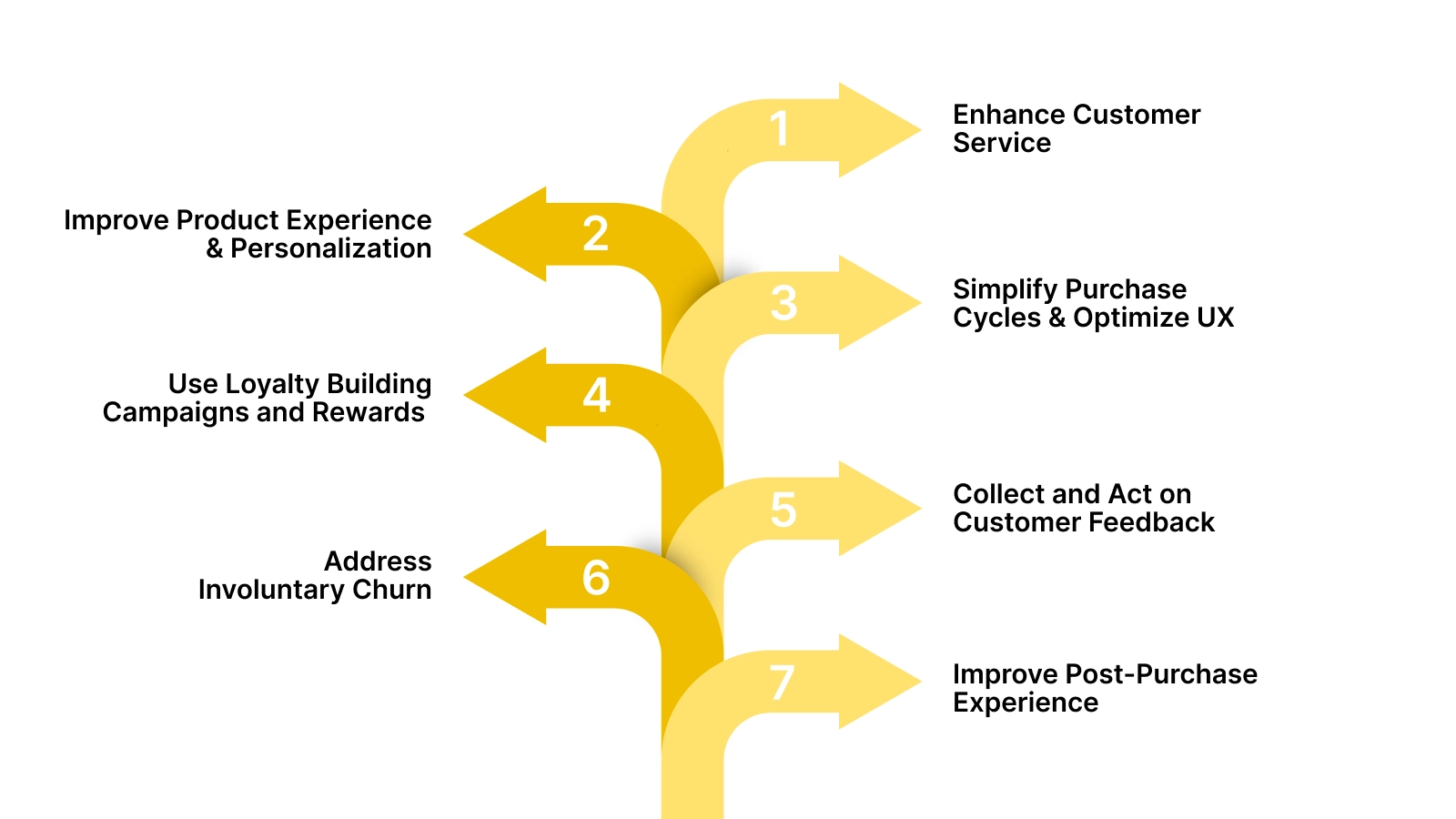
Reducing churn requires a laser focus on key customer touchpoints, optimizing every interaction to build trust and loyalty. By addressing friction points and enhancing engagement, you can significantly improve retention and customer lifetime value. Here’s a more targeted approach to tackling churn:
1. Enhance Customer Service
Customer service can make or break your retention efforts. Providing 24/7 support across multiple channels ensures that customers feel heard and valued. Offering personalized solutions based on past interactions builds stronger relationships, reducing the risk of churn.
Steps to Take:
- Integrate live chat support for instant problem resolution.
- Use customer relationship management tools to track interactions and provide personalized support.
- Set up a proactive support system to reach out before customers need assistance.
2. Improve Product Experience and Personalization
Customers expect personalized experiences that cater to their preferences. Using data to deliver tailored product recommendations, exclusive offers, and rewards can make customers feel appreciated, increasing the chances of repeat purchases.
Steps to Take:
- Implement a dynamic recommendation engine based on purchase history and browsing behavior.
- Create exclusive offers or personalized discounts for repeat customers.
- Utilize automated emails or push notifications for tailored product suggestions.
3. Simplify Purchase Cycles and Optimize UX
Friction during the purchasing process leads to abandoned carts and lost sales. A simplified, intuitive checkout experience on both desktop and mobile increases conversion rates and reduces the likelihood of churn.
Steps to Take:
- Simplify your checkout process by minimizing form fields and offering guest checkout.
- Optimize your site for mobile users, ensuring quick load times and easy navigation.
- Enable one-click reordering for returning customers, saving them time and effort.
4. Use Loyalty Building Campaigns and Rewards
Loyalty programs not only incentivize repeat purchases but also promote long-term relationships. Offering tiered rewards, referral bonuses, and exclusive deals keeps customers engaged and encourages them to stay loyal.
Steps to Take:
- Create a points-based loyalty system, with the help of Nector, that rewards customers for each purchase and social engagement.
- Launch a referral program where both the referrer and referee get benefits, driving new and repeat business.
- Offer exclusive deals or early access to products for your most loyal customers.
5. Collect and Act on Customer Feedback
Understanding why customers leave is essential for improving retention strategies. Regularly collecting feedback through surveys, NPS, or CSAT allows you to address pain points before they lead to churn.
Steps to Take:
- Set up automated post-purchase surveys to capture immediate customer feedback.
- Use NPS to identify satisfied vs. at-risk customers.
- Act on feedback quickly, making changes that show you’re listening to your customers.
6. Address Involuntary Churn
Involuntary churn, caused by payment failures or missed renewals, can be prevented with proactive steps. Automated reminders and payment retries can reduce the number of customers lost due to technical issues or simple forgetfulness.
Steps to Take:
- Implement automated payment retries for subscription-based businesses.
- Send reminders via email and SMS before subscription renewals or payment failures.
- Offer easy access to update payment details within customer accounts.
7. Improve Post-Purchase Experience
The post-purchase experience is often overlooked, yet it plays an important role in customer retention. Following up with personalized messages, offering loyalty rewards, and providing order tracking can keep customers engaged long after the sale.
Steps to Take:
- Send automated emails with order tracking details and delivery updates.
- Follow up with customers asking for feedback on their experience or product usage.
- Remind customers of unused loyalty points or reward milestones they can redeem.
By implementing these strategies, you can effectively reduce churn and build stronger, more loyal customer relationships.
Also Read: The Role of User Experience in Building Ecommerce Customer Loyalty
How Nector Helps You Reduce Churn and Retain Customers?
When it comes to reducing churn, Nector stands out as a powerful tool for e-commerce businesses. With a clear focus on customer retention, we simplify loyalty management, making it easy to engage customers and encourage repeat purchases. Unlike generic solutions, Nector offers a tailored approach that grows with your business.
By integrating seamlessly with your existing systems, Nector provides:
- Loyalty Programs: Reward repeat customers and incentivize their loyalty with customizable rewards.
- Referral System: Encourage customers to bring in new business with referral incentives.
- Review and Feedback Management: Use automated review requests to capture valuable feedback and enhance your service.
With Nector, you can continuously improve customer retention while keeping processes efficient and straightforward, ensuring a lasting relationship with every customer.
Conclusion
Churn is an inevitable part of running an ecommerce business, but understanding it is key to long-term growth. By identifying early signs of churn and implementing targeted retention strategies, you can not only reduce customer losses but also build stronger, more loyal relationships that contribute to sustained revenue.
Nector is the solution designed to simplify this process. With its powerful loyalty, referral, and review management systems, Nector helps businesses keep customers engaged and encourage repeat purchases. By integrating seamlessly into your existing ecommerce platform, Nector allows you to act on insights and prevent churn before it happens.
Reduce ecommerce churn with loyalty, referral, and review programs built for retention. Start using Nector today.
FAQs
What does a 20% churn rate mean?
A 20% churn rate means that 20% of your customers have stopped buying from your business over a set period. For ecommerce, this suggests that 1 in 5 customers is not returning, which could impact profitability if not addressed.
What is the purpose of calculating a company's churn rate?
Calculating churn rate helps businesses understand how many customers are leaving, identify underlying issues, and assess the effectiveness of customer retention strategies. It allows companies to make data-driven decisions to improve customer loyalty and overall business health.
Is the churn rate bad for business?
A high churn rate signals customer dissatisfaction or unmet needs, which can harm long-term growth. However, a low churn rate indicates strong customer retention. This leads to higher customer lifetime value and reduced acquisition costs, beneficial for sustainable business growth.
What role does segmentation play in reducing churn?
Segmentation helps businesses identify at-risk customers by grouping them based on behaviors, preferences, or demographics. By tailoring retention strategies to specific segments, companies can deliver more personalized experiences, increasing customer satisfaction and reducing churn.







Start Building Customer Retention That Lasts