





%202.webp)
.avif)
.avif)
What if we told you many e-commerce brands are now paying more to acquire a customer than they earn from them? That’s the reality today; businesses are losing nearly $29 for every new customer acquired. With ad prices steadily rising and competition becoming more intense, the real question isn’t how do we get more customers? It’s how can we reduce the cost of customer acquisition without slowing growth?
Simply pouring more money into Meta or Google ads isn’t a long-term strategy anymore. It often leads to diminishing returns. E-commerce brands that stay resilient over the next few years will be the ones who think smarter, optimize better, and design customer journeys that convert without exhausting budgets.
In this blog, we’ll explore practical, proven ways to bring CAC down, whether through stronger retention, smarter segmentation, or data-backed optimization. By the end, you’ll have a clearer understanding of where to refine efforts, where to invest, and how to make every marketing dollar work more effectively.
Key Takeaways
- CAC measures the cost of acquiring a new customer, helping businesses assess the efficiency of their marketing efforts.
- Increased ad competition, algorithm changes, and oversaturation of paid media drive rising CAC.
- Benchmarking CAC against industry standards allows businesses to optimize spending and improve marketing efficiency.
- Retaining existing customers is more cost-effective than acquiring new ones, making loyalty programs key to lowering CAC.
- AI, segmentation, and automation help target high-potential customers, optimizing acquisition strategies and reducing CAC.
What is Customer Acquisition Cost and Why Does It Matter?
Customer Acquisition Cost is the total amount a business spends to acquire a new customer, including marketing, sales, and advertising expenses. It is a key metric for evaluating the efficiency of customer acquisition strategies and helps businesses calculate the cost involved in acquiring each new customer.
For small to mid-sized e-commerce businesses, reducing CAC is extremely important as it directly impacts profitability. Lowering your customer acquisition cost enables you to acquire more customers with less investment, driving greater returns. Additionally, as CAC rises across industries, it’s essential to optimize spending to ensure long-term, sustainable growth.
What’s the Formula for CAC?
The formula for calculating CAC is straightforward:
.webp)
CAC = Total Marketing and Sales Costs / Number of New Customers Acquired
This simple equation allows businesses to track their acquisition costs and compare them against customer lifetime value to determine the efficiency of their customer acquisition efforts.
Visual Breakdown of CAC Calculations
Let’s break down the formula with an example for better understanding. Here’s how a small e-commerce business would calculate its CAC:
- Marketing Costs: $10,000
- Sales Team Costs: $5,000
- Number of New Customers Acquired: 500
CAC = ($10,000 + $5,000) / 500 = $30 per customer
In this example, the business is spending $30 to acquire each new customer. This simple math block demonstrates how you can calculate your CAC using actual numbers from your business. Keeping the formula in mind, let's now check the reasons behind the rise of CAC.
Also Read: 8 Ways to Optimize Your Cost for Marketing in 2025
Why Customer Acquisition Costs Are Rising in 2025?

Understanding why Customer Acquisition Cost is rising is essential for businesses seeking cost-effective strategies. Several key factors are contributing to higher CAC, and recognizing them will help you adapt your approach to maintain profitability.
1. Increasing Competition for Ad Space
As businesses increasingly allocate resources to digital advertising, the cost of ad space on platforms like Google, Facebook, and Instagram continues to rise. To combat this, optimize targeting by narrowing your audience segments, ensuring you spend your ad budget more efficiently and reach higher-converting prospects.
2. Algorithm Changes Driving Up Costs
Google, Facebook, and other platforms frequently update their algorithms, often increasing the cost per click (CPC) or impressions. Stay agile by continually monitoring these algorithm shifts, testing new bidding strategies, and adjusting your ad creatives to maintain cost-effectiveness despite rising costs.
3. Saturation of Paid Media Channels
With many businesses relying heavily on paid media for customer acquisition, the costs have soared due to oversaturation. To reduce CAC, diversify your marketing efforts by integrating organic growth strategies like content marketing, SEO, and referral programs to balance your spending.
Besides, to tackle rising CAC, businesses must benchmark their performance against industry standards to track spending and identify areas for optimization.
Customer Acquisition Cost Benchmarks by Industry
To reduce CAC effectively, it’s essential to first understand what constitutes a “good” CAC. Benchmarking CAC against industry standards allows you to evaluate the efficiency of your acquisition strategies and identify areas for improvement.
Industry Benchmarks: Know What’s Standard
CAC can vary significantly across industries:
- For instance, retail e-commerce businesses typically see a CAC ranging from $10 to $50 per customer, depending on their niche and target market.
- However, for subscription-based models, where customer loyalty is important, and acquisition tends to involve higher upfront costs, CAC can be higher, often $100 to $200 per customer.
The reason for this disparity lies in the longer sales cycles and the higher CLV expected in subscription businesses, which justifies higher initial acquisition costs.
What Defines a “Good” CAC?
A sustainable CAC should always be evaluated in relation to CLV. If your CAC exceeds your CLV, your business will struggle with profitability. A “good” CAC is one that’s significantly lower than your CLV. For example, if your CLV is $200, a CAC of $50 would be ideal, ensuring a strong ROI.
The Importance of Regular CAC Tracking
By consistently tracking CAC and benchmarking it against industry standards, businesses can spot underperforming marketing campaigns and adjust strategies accordingly. Regularly assessing this metric also ensures that marketing spend is optimized, boosting profitability and reducing unnecessary acquisition costs.
To effectively reduce your CAC, understanding where you stand with industry benchmarks is key. Once you have a clear picture, you can implement targeted strategies, like the 10 proven tactics we’ll explore next, to optimize your customer acquisition efforts and drive better results.
10 Proven Strategies to Lower CAC
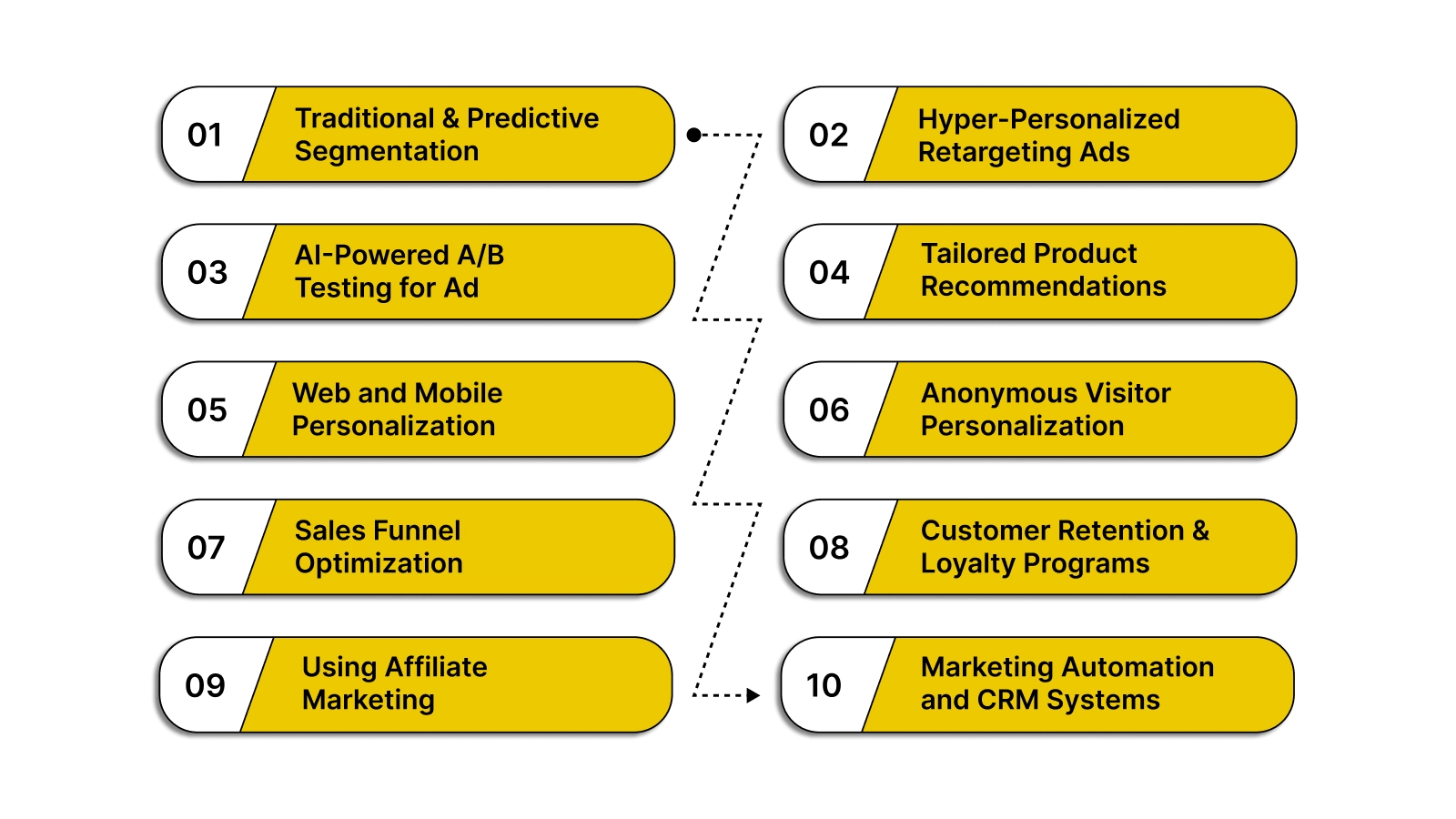
Now that we understand what CAC is and why it’s rising, let’s explore how to decrease customer acquisition cost with these 10 actionable strategies.
1. Traditional & Predictive Segmentation
Segmentation involves grouping customers based on demographics, behavior, and interests. Predictive segmentation goes a step further, using data analytics and machine learning to anticipate future behaviors. This approach helps businesses target customers with higher potential for conversion.
How to Implement It:
- Use customer data (age, location, interests) to divide your audience into distinct groups.
- Apply forecasting models to understand customer needs and actions.
- Target high-value segments with tailored marketing efforts to improve conversion rates.
- Optimize ad spend by focusing on customers most likely to convert, reducing wasted marketing dollars.
- Analyze past behavior to create personalized experiences that drive engagement and lower CAC.
2. Hyper-Personalized Retargeting Ads
Retargeting ads are displayed to users who have previously interacted with your site or product. Hyper-personalization takes this further by tailoring ads based on specific user actions, improving the relevance of the message and boosting conversion rates.
How to Implement It:
- Identify visitors who didn’t convert and segment them by behavior (e.g., abandoned cart, browsed products).
- Use dynamic ad creatives that change based on customer interactions, such as showing the exact product they viewed.
- Set up remarketing campaigns on platforms like Google and Facebook for precise targeting.
- Utilize AI to predict the best timing for retargeting ads.
- Incorporate strong CTAs to entice customers back to your site, reducing CAC by increasing efficiency.
Also Read: How to Increase Customer Loyalty and Recover Lost Sales
3. AI-Powered A/B Testing for Ad and Landing Page Optimization
AI-powered A/B testing involves using artificial intelligence to automatically test and optimize different versions of ads or landing pages. This ensures that only the best-performing versions are used to drive conversions.
How to Implement It:
- Use AI tools to test multiple ad creatives, headlines, and landing page layouts.
- Focus on real-time data analysis to quickly identify top-performing elements and discard underperforming ones.
- Optimize page speed and content for a better user experience.
- Test headlines, images, and CTAs for maximum impact.
- Track conversion rates to ensure your ads and landing pages are cost-effective, directly lowering CAC.
4. Tailored Product Recommendations
Tailored product recommendations use customer behavior data to suggest products that are relevant to each user, increasing the chances of conversion and boosting average order value (AOV).
How to Implement It:
- Implement recommendation engines (like Nector) to display personalized products based on browsing history or past purchases.
- Segment products into categories to make recommendations more relevant to different customer groups.
- Use machine learning to refine recommendations as more data becomes available.
- Offer complementary items through cross-sell and up-sell strategies.
- Highlight personalized deals to increase conversions and drive down CAC by improving efficiency.

5. Web and Mobile Personalization
Web and mobile personalization involves adjusting the user experience on your website or app based on individual customer data, such as location, previous interactions, and preferences.
How to Implement It:
- Use dynamic content to adjust product recommendations, banners, and messaging based on customer behavior.
- Optimize mobile UX by ensuring the mobile experience is just as personalized and seamless as the desktop version.
- Use geo-targeting to offer location-specific promotions and discounts.
- Optimize page layouts based on the customer’s past interactions with your site.
- Ensure fast load times and an intuitive design to improve user engagement and reduce CAC.
6. Anonymous Visitor Personalization
Anonymous visitor personalization involves using data such as IP addresses, browser cookies, or browsing behavior to personalize content for visitors who haven’t signed up or logged in.
How to Implement It:
- Track anonymous visitors’ behavior through tools like cookies and IP tracking to tailor product offerings.
- Show personalized recommendations based on their browsing history (e.g., products they’ve viewed).
- Use exit-intent pop-ups offering discounts or personalized incentives to convert visitors into leads.
- Implement retargeting campaigns to reconnect with visitors after they leave your site.
- Ensure a seamless experience by tailoring the content without requiring a login, lowering the barrier to conversion.
7. Sales Funnel Optimization
Sales funnel optimization involves simplifying the process by which leads convert into paying customers. This way, you ensure minimal friction at each stage of the funnel, from awareness to purchase.
How to Implement It:
- Identify bottlenecks at each stage of the funnel (awareness, interest, decision, action).
- Simplify the checkout process by removing unnecessary steps and offering guest checkout options.
- Use lead nurturing strategies through email automation to guide prospects through the funnel.
- Improve product pages by including customer reviews, high-quality images, and detailed descriptions.
- Optimize the user journey through personalized content and CTAs that match the customer’s intent.
8. Customer Retention & Loyalty Programs
Customer retention and loyalty programs reward existing customers for repeat business. These programs encourage them to keep coming back and reduce the need for expensive customer acquisition efforts.
How to Implement It:
- Create tiered loyalty programs from Nector that reward customers based on their spending and engagement.
- Offer personalized rewards for actions like repeat purchases, referrals, and reviews.
- Engage customers via email and mobile notifications to remind them of loyalty points or upcoming rewards.
- Track behavior to offer tailored rewards that maximize customer satisfaction and repeat purchases.
- Use referral incentives within your loyalty program to generate new customers at a lower cost.
9. Using Affiliate Marketing
Affiliate marketing involves partnering with affiliates who promote your products in exchange for a commission. This performance-based strategy can help reduce customer acquisition costs by paying only for successful referrals.
How to Implement It:
- Identify top-performing affiliates who align with your brand values and target audience.
- Provide affiliates with creative assets like banners, product links, and landing pages to use in their promotions.
- Track affiliate performance and optimize based on results.
- Use tiered commissions to incentivize affiliates to drive higher-quality leads and sales.
- Use influencer partnerships to expand your reach and drive more cost-effective customer acquisition.
10. Marketing Automation and CRM Systems
Marketing automation and CRM systems use technology to automate customer communications and track interactions. This reduces the customer acquisition process and improves lead nurturing without additional human intervention.
How to Implement It:
- Implement automated email workflows that nurture leads based on their behavior, such as abandoned carts or product views.
- Use a CRM system to track customer interactions and personalize outreach based on purchase history and preferences.
- Automate social media interactions using tools like chatbots or automated direct messages to engage potential customers.
- Integrate your CRM with your marketing platform to ensure cohesive messaging across email, ads, and content.
- Use data from automation tools to continuously refine messaging and targeting, reducing CAC by focusing on high-conversion prospects.
To effectively lower CAC, it’s essential to implement these strategies while keeping a close eye on your Customer Lifetime Value. Balancing CAC with LTV ensures that your acquisition efforts are sustainable, driving long-term profitability and business growth.
CAC vs LTV: Why This Balance is Important for Your Bottom Line
Balancing CAC with LTV is essential for ensuring that your customer acquisition costs are sustainable. If your CAC is consistently higher than your LTV, you're spending more on customer acquisition than you’re earning in return.
For example, if your CAC is $50 and your LTV is $150, you're generating a healthy return. However, if your CAC rises to $80 while your LTV remains at $150, your profitability starts to shrink. By regularly tracking both metrics, you can identify when CAC is rising too fast and adjust your strategies to optimize acquisition costs.
This balance ensures that your customer acquisition efforts remain cost-effective, contributing to long-term business growth. Now, let’s dive into some ways to lower CAC in 2026.
3 Ways to Lower Customer Acquisition Costs in 2026

In 2026, businesses must adopt advanced strategies to lower CAC, such as fully adopting AI, optimizing retention efforts, and using data-driven insights. These practices ensure efficient customer acquisition and maximize long-term profitability.
1. Adapting to Changing Market Conditions
The digital world is scaling quickly, and businesses must adapt to new technologies like AI and machine learning. These tools can help you target the right customers, automate processes, and predict buying behavior, ultimately lowering CAC.
2. Scaling Retention Over Acquisition
Retaining existing customers is more cost-effective than constantly acquiring new ones. Loyalty programs, personalized rewards, and referral incentives encourage repeat business, reducing the need for costly marketing campaigns to attract new customers.
3. Importance of Data and Analytics
Data is a powerful tool for lowering CAC. By analyzing customer behavior, businesses can focus on high-performing channels and cut costs in areas that aren’t working. Real-time data allows for fast adjustments, ensuring efficient customer acquisition.
By adapting AI, focusing on retention, and using data to drive decisions, you can significantly decrease customer acquisition costs and boost long-term profitability. These strategies will help you adapt to market changes and ensure a cost-effective growth path in 2026. Let’s now explore how Nector’s solutions can help your acquisition efforts and cut costs.
Also Read: The Most Direct Cause of Customer Loyalty, Backed by 2025 Data
How Nector Helps Reduce CAC Through Retention, Loyalty, and Automation?
When it comes to lowering Customer Acquisition Costs, Nector stands out as the most efficient solution for e-commerce businesses. We offer tailored tools that not only help reduce acquisition costs but also increase customer retention, ensuring long-term profitability. Our platform is designed to simplify customer engagement and drive repeat purchases, making your acquisition efforts more cost-effective.
Here’s how Nector can help you reduce CAC:
- Automated loyalty programs that encourage repeat business.
- Referral systems to use existing customers for new leads.
- Review automation that boosts trust and conversion rates.
- Seamless integration with platforms like Shopify to simplify processes.
- Real-time analytics to monitor and optimize your efforts.
By focusing on customer retention and personalized experiences, Nector ensures you’re spending efficiently to build lasting relationships.
Wrapping Up
Lowering Customer Acquisition Cost is essential for any business looking to scale efficiently and profitably. By understanding the factors that contribute to rising CAC and applying targeted strategies such as segmentation, retention, and data-driven optimization, you can reduce costs and improve your bottom line.
Nector can play an important role in this process by automating customer retention through personalized loyalty programs, referral systems, and review requests. By utilizing its powerful tools, businesses can create customer loyalty, boost engagement, and ultimately reduce customer acquisition costs, all while focusing on strategic growth.
Looking to reduce customer acquisition costs without increasing ad spend? Book a demo with Nector today to see how loyalty, referrals, and retention automation help brands acquire customers more profitably.
Frequently asked questions
What lowers customer acquisition cost?
Lowering customer acquisition cost involves improving targeting accuracy, enhancing personalization, utilizing retargeting ads, optimizing sales funnels, and investing in customer retention. These strategies reduce wasted spend and increase conversion efficiency.
What are common CAC mistakes?
Common CAC mistakes include failing to track and benchmark CAC, relying too heavily on paid ads without optimizing conversion rates, and neglecting customer retention. These errors lead to inflated costs and poor marketing ROI.
Can a customer acquisition strategy be too aggressive?
Yes, an overly aggressive customer acquisition strategy can lead to high CAC, poor customer quality, and diminished returns. It’s essential to balance aggressive tactics with sustainable, cost-effective methods like retention and organic growth.
How do I get new customers at a low cost of acquisition?
To acquire customers at a low cost, focus on organic channels like SEO, use referral programs, optimize paid ads for high conversion rates, and prioritize customer retention strategies, which reduce reliance on expensive new acquisition tactics.
.webp)