
%201.webp)
.avif)
.avif)
Loyalty programs often look healthy on the surface. Signups grow, points are issued, and dashboards show steady activity. But beneath that, many programs quietly lose impact as members stop engaging long before they stop buying.
In fact, around 54% of loyalty program memberships are inactive, meaning more than half of enrolled customers are no longer meaningfully engaging. That hidden disengagement is loyalty churn.
Loyalty churn analytics focuses on detecting those early signals. It helps you understand when loyalty stops influencing customer behavior, where engagement breaks down, and how that eventually affects repeat purchases.
For e-commerce teams, this clarity matters. Without it, retention decisions rely on assumptions instead of evidence.
In this guide, we’ll break down what loyalty churn analytics really means, which metrics matter, how to run the analysis, and how to act on the insights to protect long-term retention.
At a glance:
- Loyalty churn starts before revenue churn. Members usually stop earning, redeeming, or progressing first, and only reduce spend later, making engagement churn the earliest and most actionable warning signal.
- Loyalty churn is not customer churn. Customers can keep assuming they are “loyalty members” while completely ignoring rewards, tiers, and incentives, which means the program has already lost influence.
- Vanity metrics hide real loyalty decline. Enrollment growth and points issued can look healthy even as inactivity, unused points, and tier stagnation rise, masking disengagement.
- Specific metrics reveal where loyalty breaks. Inactivity rate, time to first redemption, earned-but-unused points ratio, redemption-to-repeat gap, and tier stagnation pinpoint exactly which stage of the loyalty journey needs fixing.
- Programs that deliver early value and visible progress churn less. Low-friction first rewards, achievable tiers, and progress visibility tied to buying moments prevent disengagement before it impacts repeat purchases.
What Is Loyalty Churn Analytics?
Loyalty churn analytics focuses on identifying when and why loyalty members stop engaging with a loyalty program, even if they haven’t fully stopped buying from your brand. It helps teams spot silent disengagement inside loyalty programs before it turns into lost revenue.
Rather than tracking surface-level metrics like enrollments or points issued, loyalty churn analytics looks at whether loyalty is still influencing customer behavior.
Loyalty churn usually shows up in two stages:
- Engagement churn: Loyalty members stop earning points, redeeming rewards, or progressing through tiers. The program loses relevance in their buying journey.
- Revenue churn: Disengaged loyalty members reduce purchase frequency or spend over time.
In most cases, engagement churn comes first. Revenue churn follows if nothing changes.
How Loyalty Churn Is Different From Customer Churn
Loyalty churn and customer churn are often confused, but they measure different things.
- Customer churn: Customers stop purchasing from your brand entirely.
- Loyalty churn: Customers remain enrolled but stop engaging with rewards, points, tiers, or referrals.
A customer can still place occasional orders while ignoring the loyalty program altogether. From a loyalty perspective, that customer has already churned.
Also read: How to Calculate and Reduce Ecommerce Churn Rate?
What Loyalty Churn Analytics Helps You See
Loyalty programs don’t usually fail all at once. They lose impact gradually, as members stop engaging long before they stop buying. Loyalty churn analytics helps teams catch that decline early and respond with precision instead of guesswork.
Here’s what tracking loyalty churn actually gives you.
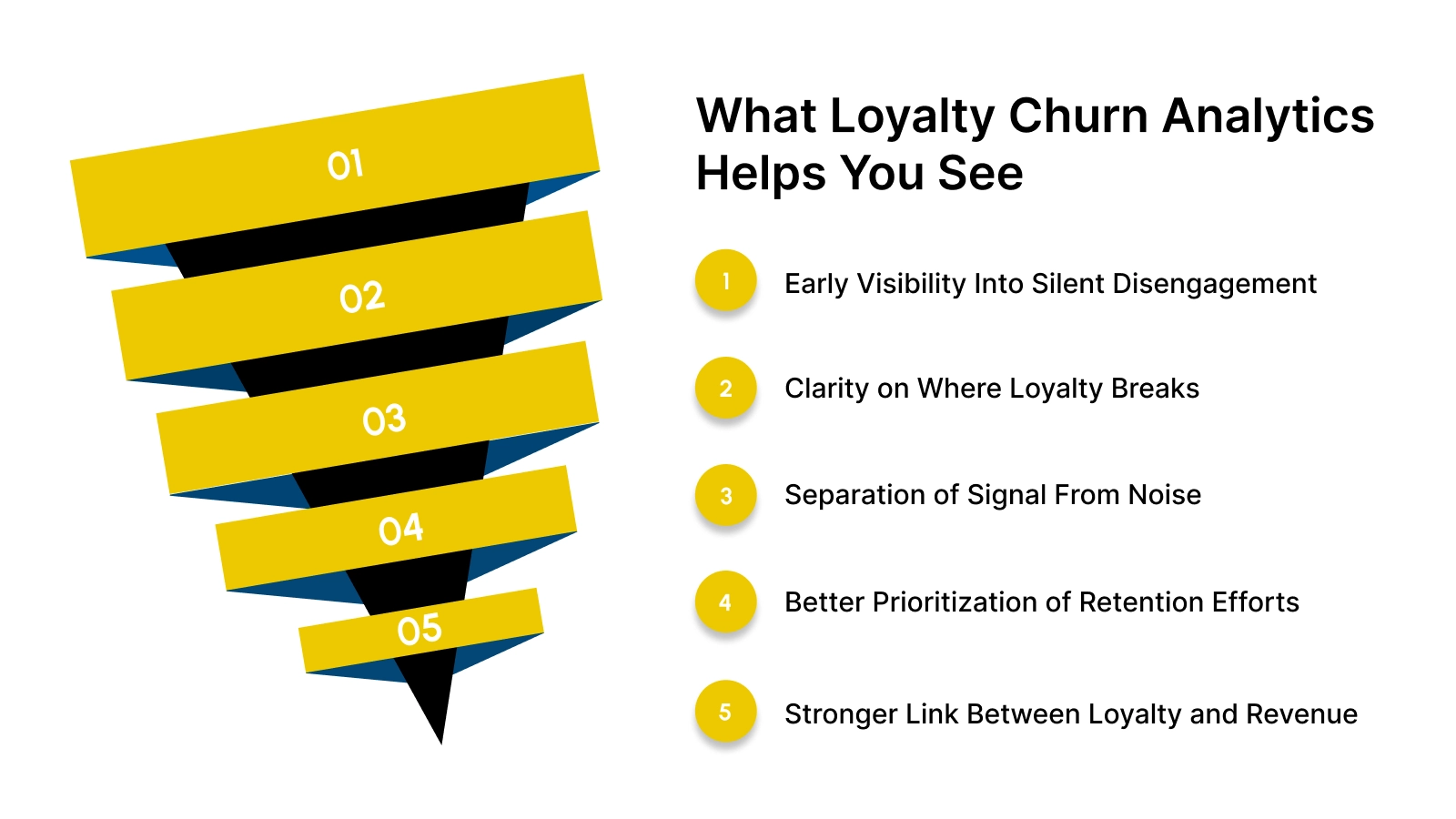
1. Early Visibility Into Silent Disengagement
Loyalty churn analytics surfaces members who are enrolled but no longer earning, redeeming, or progressing. This gives you an early warning before reduced engagement turns into lost revenue.
2. Clarity on Where Loyalty Breaks
By tracking engagement drop-offs, you can see whether churn happens after enrollment, after the first purchase, or after the first redemption. This makes it easier to fix the right part of the loyalty journey instead of making broad changes.
3. Separation of Signal From Noise
Enrollment growth and points issued can look healthy while engagement declines. Loyalty churn analytics helps distinguish real loyalty impact from vanity metrics that mask underlying problems.
4. Better Prioritization of Retention Efforts
Not all churn needs the same response. Loyalty churn analytics helps you focus on high-risk segments, such as inactive members or stalled tiers, instead of spreading effort across your entire customer base.
5. Stronger Link Between Loyalty and Revenue
By connecting engagement data to repeat purchases, you can see whether loyalty is actually influencing buying behavior. This makes it easier to justify program changes and measure their impact.

The Loyalty Churn Metrics You Should Track
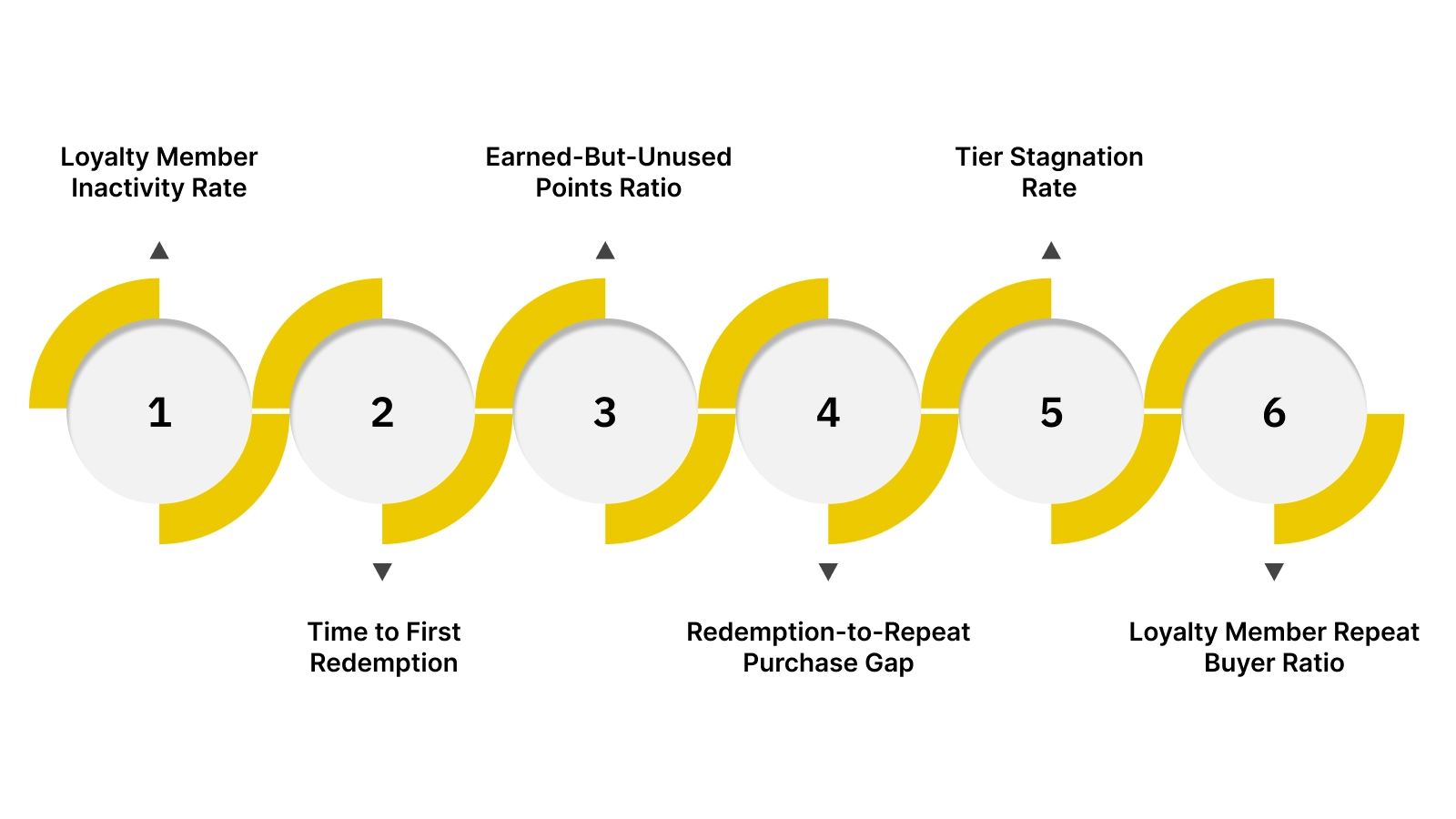
Loyalty churn becomes visible when you track the right signals. The metrics below show where loyalty engagement breaks, how early it happens, and whether it affects repeat purchasing.
The table below summarizes the core loyalty churn metrics and what they reveal:
To understand what’s driving these signals, here’s how to interpret and calculate each metric.
1. Loyalty Member Inactivity Rate
This measures how many loyalty members are enrolled but not actively earning or redeeming points within a defined period. High inactivity usually points to poor onboarding or low reward visibility.
How to calculate: Count loyalty members with no earning or redemption activity during the period.
Formula:
Inactive loyalty members ÷ Total loyalty members × 100
2. Time to First Redemption
This shows how long it takes a member to redeem a reward after joining. Long delays often mean rewards feel hard to reach or not worth the effort.
How to calculate: Measure the number of days between signup and first redemption for each member.
Formula:
Sum of (First redemption date − Join date) ÷ Total redeeming members
3. Earned-But-Unused Points Ratio
This highlights how many points are issued but never redeemed. A high ratio signals low perceived value or unclear redemption paths.
How to calculate: Compare total points issued with points redeemed.
Formula:
Unredeemed points ÷ Total points issued × 100
4. Redemption-to-Repeat Purchase Gap
This measures whether redemptions actually pull customers back for another purchase. Large gaps suggest rewards are not well tied to future buying behavior.
How to calculate: Track the time between a reward redemption and the next completed order.
Formula:
Average days between the redemption date and the next purchase date
5. Tier Stagnation Rate
This shows how many members remain stuck in the same tier without progressing. Stagnation often indicates tier thresholds that feel unrealistic.
How to calculate: Identify members with no tier movement over a defined period.
Formula:
Members with no tier change ÷ Total tiered members × 100
6. Loyalty Member Repeat Buyer Ratio
This measures how many loyalty members actually become repeat buyers. It’s the clearest indicator of whether loyalty is influencing revenue.
How to calculate: Count loyalty members with two or more purchases.
Formula:
Loyalty members with 2+ purchases ÷ Total loyalty members × 100
Tracking the right metrics is only the first step. To turn these numbers into insight, you need a consistent way to review, segment, and interpret them over time.
How to Conduct Loyalty Churn Analytics
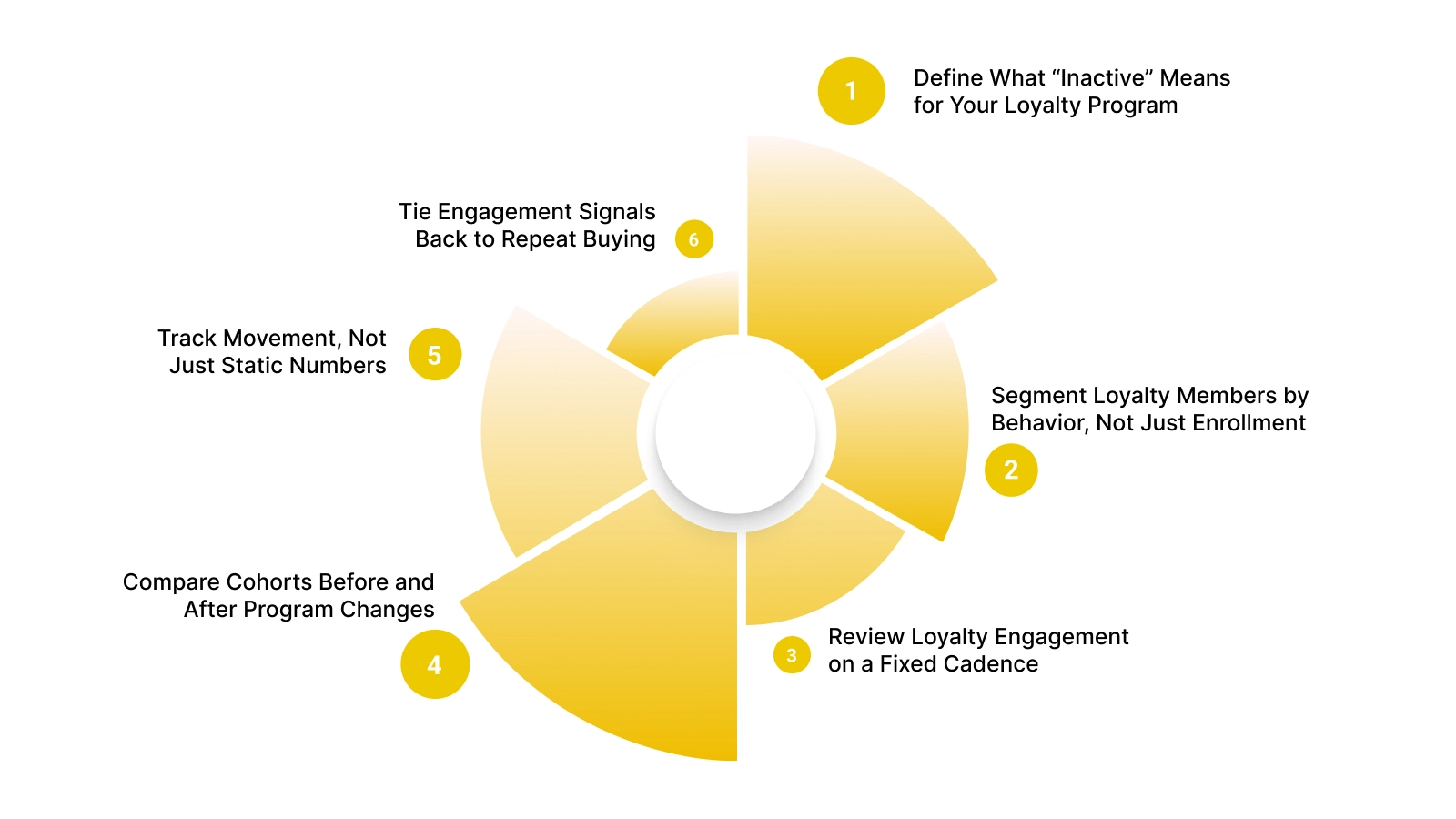
Loyalty churn analytics doesn’t require complex tools or advanced modeling. It requires a consistent process for reviewing loyalty engagement data and spotting where participation drops before it affects repeat purchases.
Here’s a simple way to run loyalty churn analytics without overcomplicating it.
1. Define What “Inactive” Means for Your Loyalty Program
Start by setting clear rules for inactivity. This could mean a loyalty member who hasn’t earned or redeemed points within a defined period, such as 30, 60, or 90 days. Without a clear definition, churn signals become inconsistent and hard to compare over time.
2. Segment Loyalty Members by Behavior, Not Just Enrollment
Avoid analyzing all loyalty members as one group. Break them into meaningful segments, such as:
- Newly enrolled members
- Members who have redeemed at least once
- Members who have never redeemed
- High-frequency buyers vs occasional buyers
Behavior-based segmentation makes churn patterns easier to spot and act on.
3. Review Loyalty Engagement on a Fixed Cadence
Run loyalty churn analysis on a regular schedule, typically monthly or quarterly. This helps you identify trends early instead of reacting after revenue declines. Consistency matters more than frequency.
4. Compare Cohorts Before and After Program Changes
Whenever you adjust rewards, thresholds, or messaging, compare cohorts before and after the change. This shows whether engagement improves or churn signals persist, helping you separate effective changes from noise.
5. Track Movement, Not Just Static Numbers
Look for changes over time rather than isolated values. Rising inactivity, longer redemption gaps, or growing tier stagnation are more meaningful than one-off snapshots. Loyalty churn analytics is about direction, not single data points.
6. Tie Engagement Signals Back to Repeat Buying
Finally, connect loyalty engagement trends with repeat purchase behavior. If disengaged members are also slowing down or stopping purchases, loyalty churn is already affecting revenue. This link helps prioritize which issues need immediate attention.
Running loyalty churn analytics gives you the signals, but the real value comes from knowing how to read them. Once patterns start to emerge across inactivity, redemption behavior, and repeat purchases, the next step is diagnosis.
How to Diagnose and Reduce Loyalty Churn Using Analytics
Below, we break down loyalty churn signals and how to adjust your loyalty program to reduce churn before it impacts revenue.
1. When Loyalty Members Go Inactive Soon After Joining
What the data shows: A high loyalty member inactivity rate within the first 30–60 days.
What’s likely happening: Members don’t understand how the program works or don’t see immediate value after enrolling.
How to fix:
- Simplify loyalty onboarding and explain how points are earned and redeemed
- Highlight early, easy-to-reach rewards instead of long-term goals
- Reinforce progress visibility immediately after the first purchase
2. When Members Earn Points but Don’t Redeem
What the data shows: A high earned-but-unused points ratio.
What’s likely happening: Rewards feel unclear, inaccessible, or not worth the effort.
How to fix:
- Reduce redemption thresholds for entry-level rewards
- Surface redemption options at checkout and in post-purchase communication
- Align rewards with what customers actually buy
3. When Time to First Redemption Is Too Long
What the data shows: Long gaps between enrollment and first redemption.
What’s likely happening: The perceived effort outweighs the perceived reward.
How to fix:
- Introduce low-friction starter rewards
- Add milestone nudges when members are close to redeeming
- Make reward value explicit instead of abstract
4. When Redemptions Don’t Lead to Repeat Purchases
What the data shows: A large redemption-to-repeat purchase gap.
What’s likely happening: Rewards are treated as a one-time benefit rather than a return trigger.
How to fix:
- Tie redemptions to future purchases (credits, discounts with expiry)
- Follow redemptions with relevant product recommendations
- Reinforce progress toward the next reward immediately after redemption
5. When Loyalty Members Get Stuck in the Same Tier
What the data shows: High-tier stagnation rates across loyalty members.
What’s likely happening: Tier thresholds feel unrealistic, or progression feels invisible.
How to fix:
- Rebalance tier requirements based on real purchase behavior
- Introduce interim milestones to maintain momentum
- Make tier benefits clearer and more differentiated
6. When Loyalty Members Don’t Become Repeat Buyers
What the data shows: Low loyalty member repeat buyer ratio.
What’s likely happening: Loyalty is operating in isolation and not influencing purchase decisions.
How to fix:
- Anchor loyalty rewards to second and third purchases
- Align post-purchase flows with loyalty milestones
- Connect loyalty engagement directly to buying moments
Start with metrics that signal early disengagement, such as inactivity and time to first redemption. These are easier to fix and prevent downstream revenue churn. Metrics tied to revenue impact, like repeat buyer ratio, should guide longer-term program changes.
When loyalty churn is addressed at the engagement stage, retention improves before customers are at risk of leaving entirely.
Also read: Customer Churn vs Retention: Key Differences Explained
Strategies for Preventing Loyalty Churn Before It Starts
Loyalty churn rarely begins with a sudden drop in purchases. In most cases, it is designed into the program through unclear value, slow momentum, or invisible progress. Programs that retain engagement are built to deliver value early, reinforce progress consistently, and make continued participation feel worthwhile.
The principles below focus on preventing disengagement before it appears in your metrics.
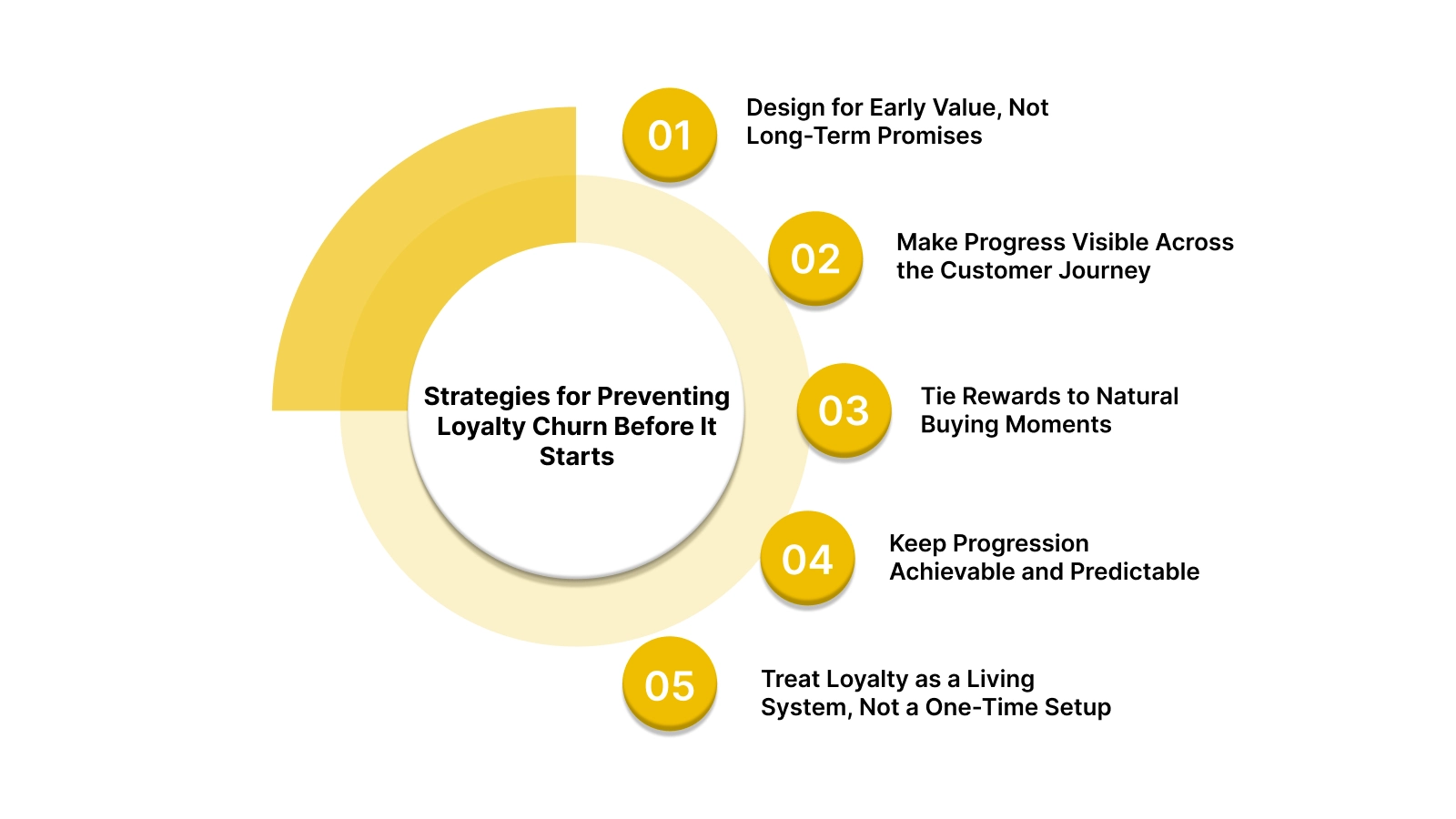
1. Design for Early Value, Not Long-Term Promises
Many loyalty programs ask customers to stay engaged for too long before seeing tangible benefits. When early rewards feel distant, motivation drops quickly.
Design your program so new members can unlock something meaningful within their first few interactions. Early wins establish momentum and reduce the risk of inactivity soon after enrollment.
2. Make Progress Visible Across the Customer Journey
Loyalty engagement weakens when customers lose track of where they stand. Points and tiers only work when progress is easy to see and understand.
Ensure customers can always tell how close they are to their next reward or milestone. Visible progress turns repeat purchases into forward movement rather than isolated transactions.
3. Tie Rewards to Natural Buying Moments
Rewards that feel detached from purchasing behavior often fail to bring customers back. When loyalty benefits are disconnected from checkout, redemption becomes an afterthought.
Design rewards that naturally support the next purchase, such as credits, benefits with expiry, or incentives that feel immediately usable. This keeps loyalty embedded in the buying decision instead of sitting on the sidelines.
4. Keep Progression Achievable and Predictable
Tiered programs lose effectiveness when progression feels unrealistic or arbitrary. If customers don’t believe they can move forward, engagement stalls.
Base tier thresholds and milestones on real purchasing patterns, not aspirational spending. Predictable progression encourages consistent engagement and reduces tier stagnation.
5. Treat Loyalty as a Living System, Not a One-Time Setup
Loyalty programs that go unchecked slowly lose relevance as customer behavior changes. Preventing churn requires ongoing review, not just reactive fixes.
Regularly assess engagement trends, reward performance, and progression rates. Small adjustments made early prevent disengagement from becoming a structural problem later.
Preventing loyalty churn starts with intentional program design. When value is clear, progress is visible, and rewards align with buying behavior, loyalty remains an active driver of repeat purchases rather than a passive feature.
How Nector Helps Reduce Loyalty Churn and Improve Retention
Nector is built for e-commerce teams that want loyalty programs to actively drive repeat purchases, not just collect signups. By combining loyalty, referrals, reviews, and analytics in one platform, Nector helps brands spot disengagement early and fix it before it turns into revenue churn.
Here’s how Nector helps:
- Loyalty engagement analytics: Track earning, redemption, inactivity, and repeat purchase behavior in one dashboard to identify early churn signals.
- Progress visibility for customers: Show points, milestones, and tier progression clearly through widgets, reward pages, and checkout placements to reduce disengagement.
- Flexible reward and tier design: Adjust reward thresholds, progression logic, and incentives based on real customer behavior, not assumptions.
- Automated post-purchase engagement: Trigger reminders, milestone nudges, and reward notifications at the right moments to encourage timely repeat purchases.
- Referral programs that drive return visits: Use in-store redeemable referral rewards and two-sided incentives to turn advocacy into repeat buying loops.
- Reviews that reinforce trust: Collect and surface reviews after delivery, rewarding participation without over-relying on discounts and reducing second-purchase hesitation.
- Seamless integrations across your stack: Connect Nector with Shopify, email tools, WhatsApp platforms, and other systems to keep loyalty data consistent across channels.
Nector makes loyalty engagement easier to track, easier to adjust, and easier to scale. Sign up to see how it supports long-term retention.
Wrapping Up
Loyalty churn doesn’t happen all at once. It shows up quietly through declining engagement, stalled progress, and rewards that stop influencing buying decisions. When you track the right signals and review them consistently, loyalty churn becomes visible early and manageable.
The real advantage comes from acting on those insights. Programs that deliver early value, make progress visible, and adapt based on engagement data are far more likely to turn loyalty members into repeat buyers.
Nector helps bring this approach together by giving teams the visibility and control needed to manage loyalty proactively.
Book a demo or start a free trial to see how Nector can support long-term retention.
FAQs
What is the loyalty churn rate?
The loyalty churn rate measures the percentage of loyalty members who stop engaging with a loyalty program, such as earning or redeeming rewards, within a defined period.
How do you measure customer loyalty through data analytics?
Customer loyalty is measured by analyzing repeat purchases, engagement with loyalty programs, reward redemptions, tier progression, and referral activity over time to understand sustained customer preference.
What is churn in analytics?
In analytics, churn refers to users or customers reducing or stopping engagement with a product, service, or program, often analyzed to identify patterns that lead to disengagement.
What are the 3 R’s of customer loyalty?
The 3 R’s of customer loyalty are Rewards, Recognition, and Relationship, which together encourage repeat purchases, emotional connection, and long-term customer engagement.

Related Blogs


%201%20(1).webp)
%201.webp)

Start Building Customer Retention That Lasts