





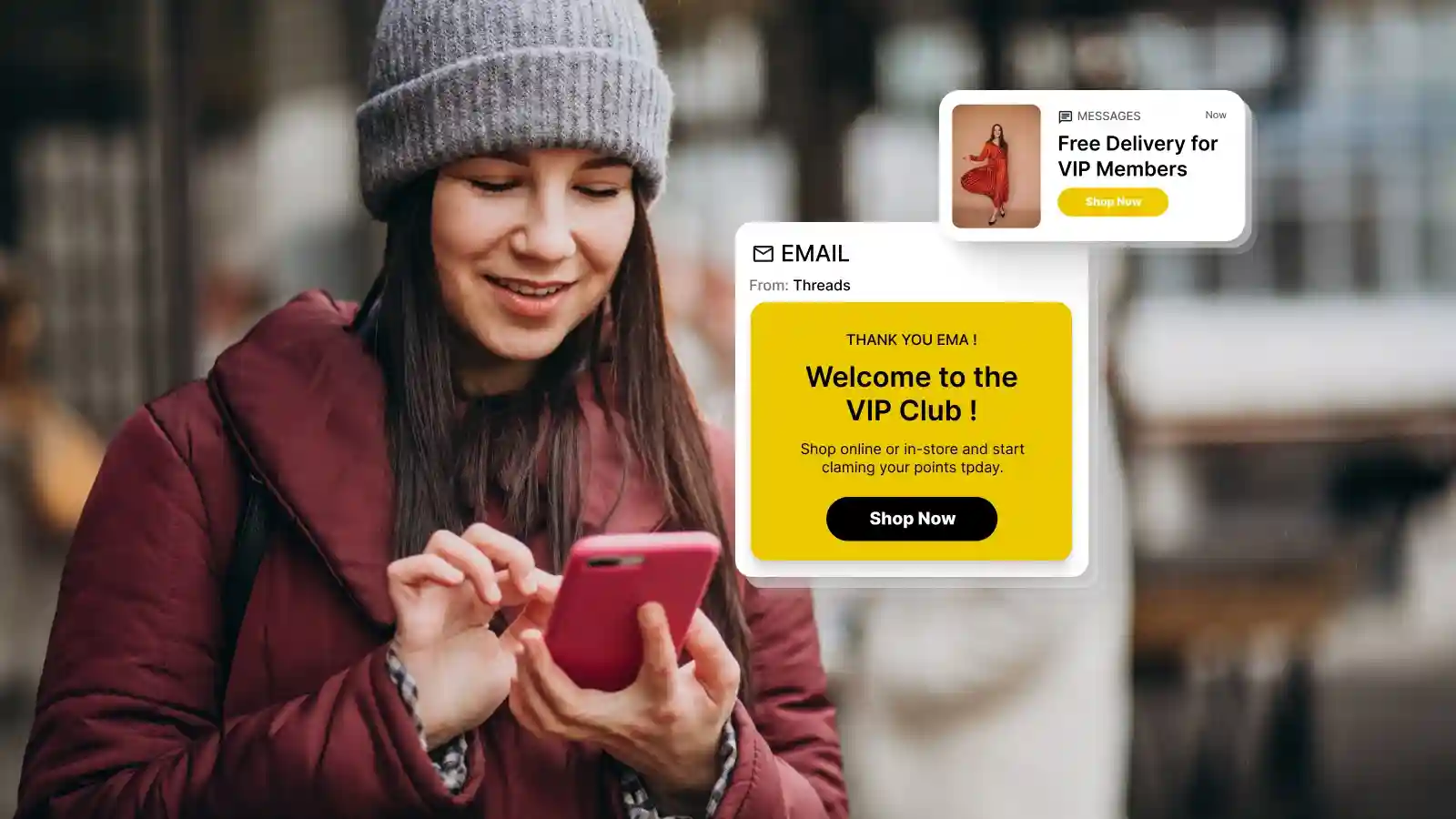
.avif)
.avif)
Most e-commerce brands today don’t struggle with traffic. They struggle with retention across channels.
A customer might discover your brand on Instagram, place their first order on your Shopify store, receive updates on WhatsApp, and leave a review on Google. Yet, in many businesses, these touchpoints still operate in silos. Loyalty points earned on the website don’t reflect in emails. Referral rewards aren’t visible in-app. Review incentives don’t connect back to customer profiles.
Companies that excel at omnichannel customer engagement retain customers at 1.7x higher rates than those that don’t. That’s not because they offer more discounts, but because the experience feels continuous.
This guide is written for e-commerce founders, small teams, growth-stage brands, agencies, and enterprises who want to build a future-ready omnichannel loyalty program, one that works across touchpoints, scales without manual effort, and still feels personal in 2026.
Core takeaways:
- An omnichannel loyalty program connects rewards across all customer touchpoints
- Single-channel loyalty breaks down as brands scale
- A strong framework requires unified data, action-based rewards, and automation
- Readiness matters more than feature count
- Nector enables loyalty, referrals, and reviews to work as one system
What Is an Omnichannel Loyalty Program?
An omnichannel loyalty program is a customer rewards system that operates seamlessly across all customer touchpoints, online store, email, SMS, WhatsApp, reviews, referrals, and even offline interactions using a single source of truth for customer data.
Unlike traditional loyalty programs that function only on one channel (usually the website), omnichannel loyalty ensures that:
- Points earned on one channel are visible everywhere
- Rewards, tiers, and incentives stay consistent
- Customer actions across platforms contribute to one unified loyalty profile
This creates omnichannel customer loyalty, where customers don’t feel like they’re interacting with different systems; they feel like they’re engaging with one brand.
Learn more about: Why Customer Loyalty Is Important for Your Business?
How Omnichannel Loyalty Differs from Multichannel Loyalty Programs
Multichannel and omnichannel loyalty are often used interchangeably, but they represent very different operating models. The distinction isn’t about how many channels are used, it’s about how those channels are connected.
What This Means in Practice
In a multichannel loyalty program, a customer might earn points online, receive unrelated messaging via email, and see no loyalty context during checkout or post-purchase interactions. Each channel functions correctly, but in isolation.
In an omnichannel loyalty program, the same customer sees:
- Reward progress reflected consistently across channels
- Personalized nudges triggered by behaviour, not campaigns
- The ability to earn and redeem rewards at moments of intent, regardless of channel
The difference isn’t cosmetic, it’s structural. Omnichannel loyalty creates a single source of truth for customer value and behaviour, enabling automation, personalization, and attribution that multichannel programs cannot support.
In short, multichannel loyalty adds reach. Omnichannel loyalty adds continuity, intelligence, and scale.

7 Core Benefits of Building an Omnichannel Loyalty Program

Omnichannel loyalty programs create value by connecting with how customers actually interact with a brand. Instead of treating each touchpoint as a separate experience, loyalty becomes a continuous thread that follows the customer across channels, devices, and moments of intent.
1. Seamless Loyalty Across the Customer Journey
Customers no longer move through a single, linear path. They browse on mobile, compare on desktop, engage through messaging apps, and often return days later to complete a purchase. An omnichannel loyalty program ensures that rewards, points, and progress remain visible and consistent throughout this journey.
When customers don’t have to remember where points were earned or how to redeem them, loyalty feels dependable rather than confusing. This consistency removes friction at critical moments, particularly during checkout or repeat visits, where loyalty often influences the final decision.
2. More Meaningful Personalization (Without Manual Effort)
Personalization works best when it’s grounded in real behavior, not assumptions. Omnichannel loyalty programs allow brands to respond to what customers actually do, how often they return, which channels they prefer, and which actions signal long-term intent.
Instead of pushing the same offer everywhere, brands can adjust rewards and messaging based on engagement patterns. This creates relevance without forcing teams to manage endless segments or campaigns, making personalization sustainable even for lean teams.
3. Clearer Visibility Into Customer Behaviour
When loyalty data is spread across tools, insights are fragmented. Omnichannel loyalty programs centralize information from purchases, referrals, reviews, and redemptions into one system, making it easier to see how customers engage over time.
This visibility helps teams understand which behaviors correlate with retention, which rewards actually drive action, and where customers disengage. Decisions become informed by patterns, not isolated metrics or gut instinct.
4. Stronger Customer Lifetime Value Over Time
Loyalty programs that operate across channels reward customers throughout their relationship with the brand, not just at the point of sale. Customers who feel consistently recognized, whether for purchases, reviews, or referrals, are more likely to return and spend more over time.
Tiered structures and milestone-based rewards further reinforce this behavior by giving customers a clear reason to stay engaged beyond a single transaction. Over time, this steady reinforcement compounds into a higher lifetime value.
5. More Efficient Customer Acquisition Through Advocacy
Positive experiences travel across channels just as quickly as purchases do. Omnichannel loyalty programs strengthen referrals by making it easy for customers to share rewards and incentives wherever they communicate, email, messaging apps, or social platforms.
When advocacy is rewarded consistently and tracked centrally, referrals become a reliable acquisition channel rather than an occasional bonus. New customers arrive with built-in trust, and acquisition costs decrease as loyalty-driven growth takes hold.
6. Reduced Operational Complexity
Managing loyalty across channels often increases operational burden when systems aren’t connected. Omnichannel loyalty programs reduce this complexity by consolidating rules, automation, and tracking into a single framework.
With fewer manual approvals, fewer edge cases, and clearer visibility, teams can manage loyalty programs more efficiently. This allows brands to scale engagement without adding proportional overhead or increasing dependency on engineering teams.
7. True Cross-Channel Continuity
The most valuable benefit of omnichannel loyalty is continuity. Customers can start interacting with a brand in one channel and continue in another without losing context, whether they’re checking rewards, redeeming points, or completing a purchase.
This continuity builds confidence. Customers trust that the brand recognizes them wherever they show up, which strengthens engagement and reduces drop-off across the journey.
In 2026, loyalty programs that operate in isolation will struggle to keep pace with how customers shop. Omnichannel loyalty programs succeed because they align with real behavior, reduce friction, and create experiences that feel connected rather than constructed.
The Real Problem: Why Single-Channel Loyalty Fails at Scale
For many founder-led and early-stage e-commerce stores, loyalty often starts as a simple points-for-purchase setup. It works initially, but breaks down as the business grows.
Here’s what usually happens:
- Loyalty runs on the website, but email tools can’t reference loyalty data
- Referral rewards are tracked separately
- Review incentives feel transactional, not connected to long-term value
- Customers get inconsistent messages across channels
The result isn’t just poor engagement; it’s lost trust. Customers don’t understand where their points went or why rewards feel disconnected.
In contrast, the possibility is clear: a loyalty system that connects behavior across channels, updates in real time, and reduces manual work for lean teams.
6 Steps to Designing an Omnichannel Loyalty Program That Works Across Every Channel
Creating an omnichannel loyalty program isn’t about ticking boxes or adding more touchpoints. It’s about making sure your loyalty experience behaves the same way your customers do, fluidly moving between online and offline devices and channels without friction.
Most programs fail because they’re built in isolation. The ones that work are built with continuity in mind from day one.
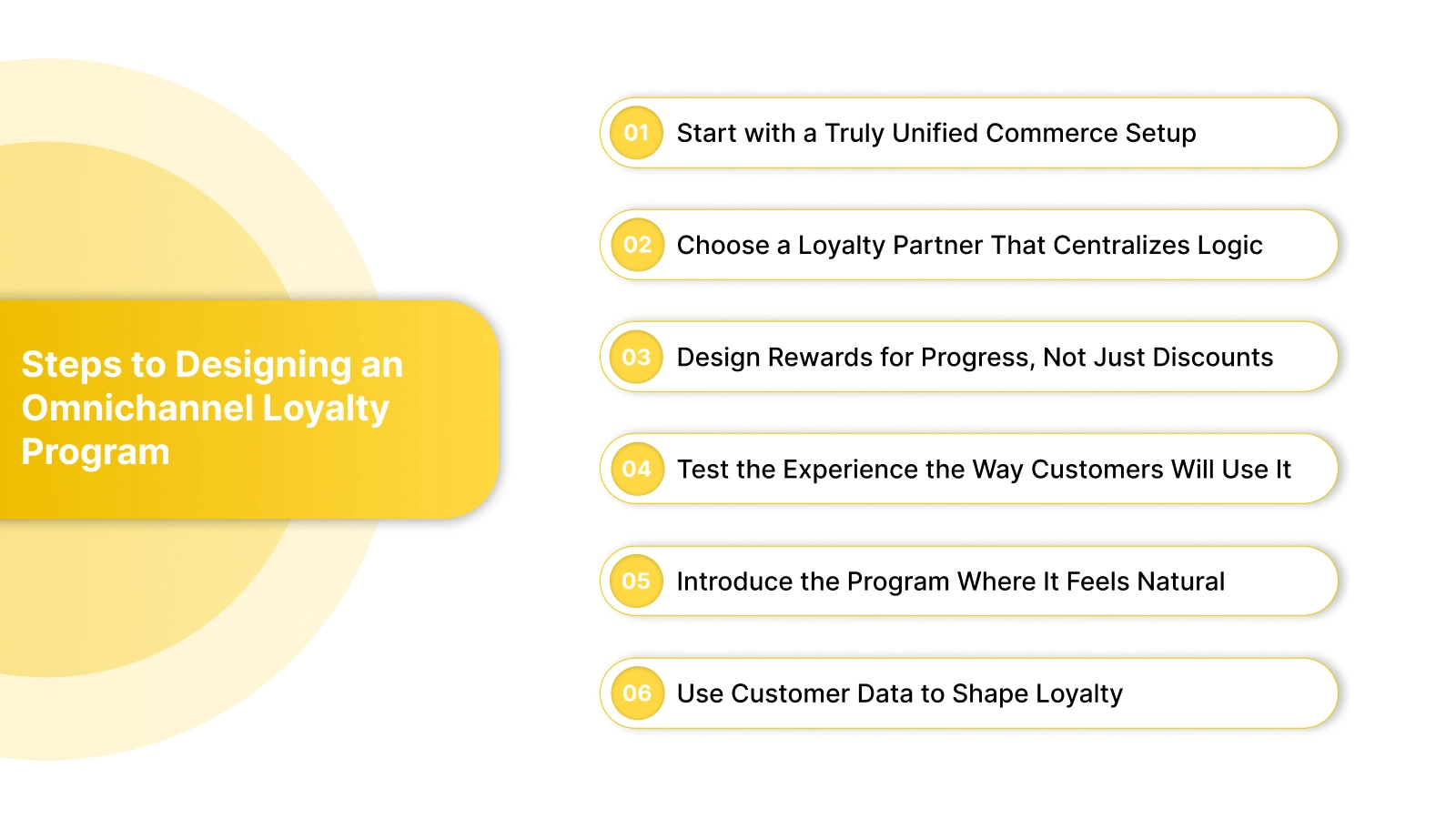
1. Start with a Truly Unified Commerce Setup
Omnichannel loyalty breaks down immediately if your commerce systems don’t talk to each other in real time. In many retail setups, online purchases, in-store transactions, and customer profiles still live in separate systems. That’s where problems begin.
Customers earn rewards online but can’t see them in-store. Cashiers don’t know what benefits a shopper is eligible for. Tier upgrades lag behind actual spending. All of this quietly erodes trust.
A unified commerce foundation solves this by ensuring every transaction, regardless of where it happens, updates the same customer record instantly. Loyalty balances, tier status, and reward eligibility stay accurate everywhere, which is non-negotiable for omnichannel execution.
When customers don’t have to ask, “Will this work here too?”, your loyalty program is on the right track.
2. Choose a Loyalty Partner That Centralizes Logic (Not Just Displays Points)
Many brands underestimate this part. It’s easy to add a loyalty app that tracks points. It’s much harder to run loyalty as a central system that governs rewards across channels.
Your loyalty partner should act as the brain of the program, deciding how points are earned, when rewards unlock, and how tiers progress, while letting every channel simply reflect that logic.
When loyalty rules are scattered across tools (one set in email, another at checkout, another in-store), inconsistencies creep in fast. Teams start relying on manual fixes, and the program becomes fragile.
A centralized loyalty engine keeps the experience consistent while still allowing flexibility in how rewards are shown or promoted across channels.
3. Design Rewards for Progress, Not Just Discounts
The fastest way to cheapen a loyalty program is to make it all about discounts. While points that convert directly into money are easy for customers to understand, they can quickly eat into margins, especially in omnichannel setups where customers engage more frequently.
Stronger programs focus on progression. Customers should feel like they’re moving toward something meaningful, not just collecting coupons.
This often means mixing reward types:
- Early access to launches
- Free shipping or service-based perks
- Exclusive bundles or gifts
- Tier-based benefits that unlock gradually
Tiered structures work especially well in omnichannel loyalty because they encourage sustained engagement across channels, not just one-off purchases.
Reminder: If customers can’t immediately tell what they’ll unlock next, the reward structure needs simplification.
4. Test the Experience the Way Customers Will Use It
Before promoting your omnichannel loyalty program, use it exactly the way a customer would.
Place an online order. Check the loyalty balance. Walk through an in-store redemption. Leave a review. Refer a friend. Then see where things break.
Most issues don’t show up in dashboards; they show up at handoff points. A reward that appears online but not in-store. A tier upgrade that triggers an email but not a checkout benefit. These small gaps add up quickly once real customers are involved.
Fixing these before launch saves far more time than trying to explain inconsistencies later.
5. Introduce the Program Where It Feels Natural
Omnichannel loyalty works best when enrollment happens as part of an existing interaction, not as a standalone promotion.
Customers are far more likely to join when:
- They’ve just completed a purchase
- They’re receiving a receipt or order confirmation
- They’ve left a review or completed a referral
- They’re interacting with staff at checkout
In these moments, loyalty feels like an extension of the experience, not an interruption.
6. Use Customer Data to Shape Loyalty, Not Just Measure It
Collecting omnichannel data is only half the job. The real value comes from using it to change how loyalty behaves.
Patterns emerge quickly:
- Some customers consistently buy online but pick up in-store
- Others engage heavily with reviews but purchase less frequently
- Some redeem points often; others save for larger rewards
A mature omnichannel loyalty program adapts to these behaviors. Rewards, reminders, and messaging evolve based on how customers actually interact with your brand, not how you assume they will.
That’s when loyalty stops being transactional and starts reinforcing real habits.
Programs that scale are built around systems, not campaigns. They prioritize consistency, automation, and clarity, both for customers and internal teams.
Programs that stall usually work “well enough” at first, then break under growth. More channels, more customers, more exceptions, and suddenly loyalty becomes harder to manage than it’s worth. The difference is rarely ambition. It’s architecture.
Loyalty Program Readiness Assessment: Are You Actually Ready?
Before jumping into omnichannel loyalty implementation, brands should assess readiness across three areas.
Customer Data Readiness
- Can you track purchases, referrals, and reviews in one system?
- Are customer profiles consistent across tools?
Operational Readiness
- Can your team manage rewards without manual approval?
- Do you have clear reward limits tied to margins?
Experience Readiness
- Do customers understand how to earn and redeem rewards?
- Is the loyalty experience visible across channels?
Many brands fail not because loyalty doesn’t work, but because they launch without alignment.
Also Read: Why Loyalty Programs Are Key to Scaling Your Shopify DTC Store in 2025
Omnichannel Loyalty Implementation: How It Actually Works
A practical omnichannel loyalty implementation doesn’t begin with features; it begins with flows.
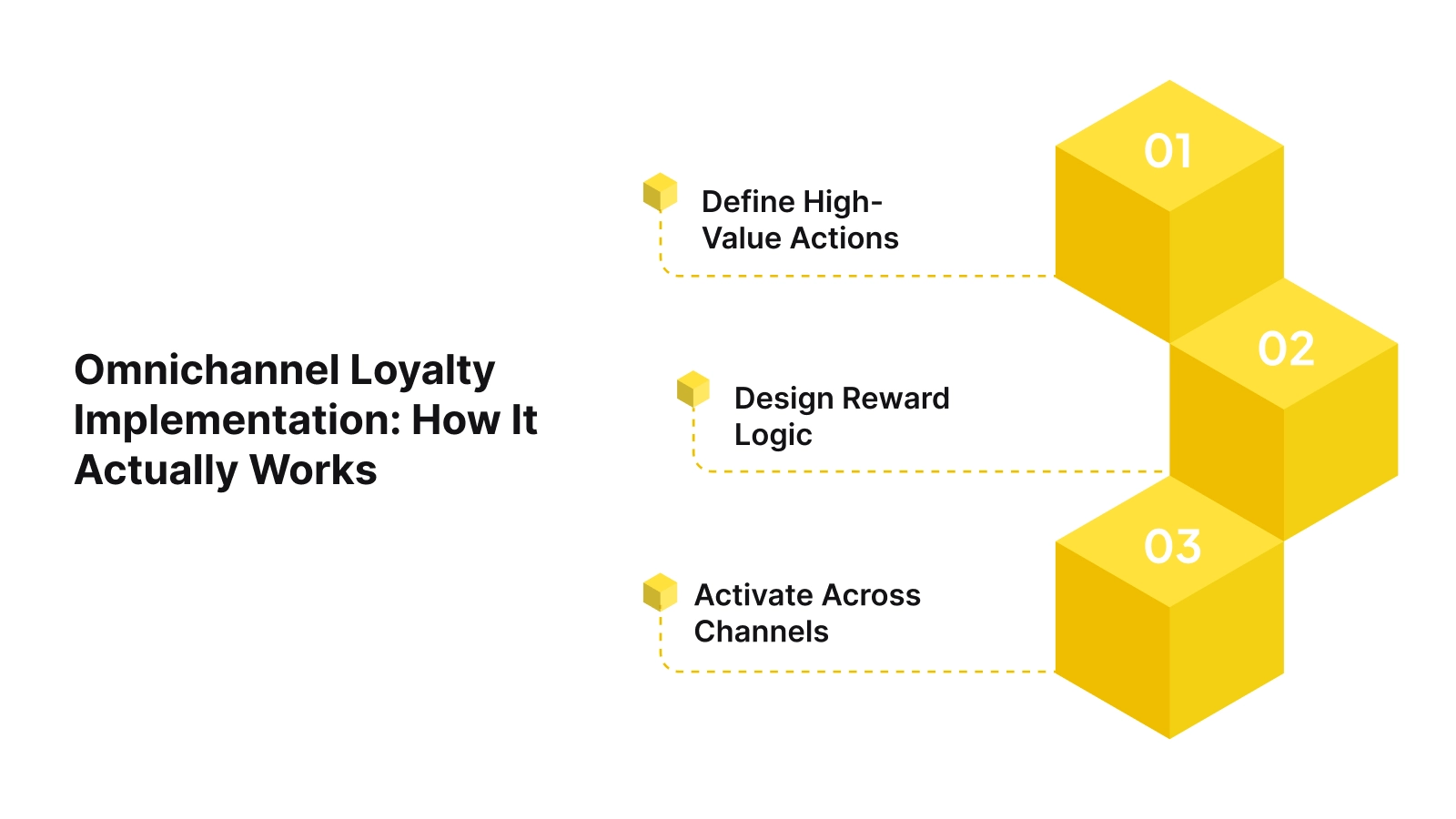
Step 1: Define High-Value Actions
Instead of rewarding everything, focus on behaviors that correlate with retention:
- Second purchase within 30 days
- Verified product reviews
- Successful referrals
Step 2: Design Reward Logic
Tie rewards to profitability:
- Points instead of flat discounts
- Tiered benefits instead of one-time coupons
Step 3: Activate Across Channels
Rewards should surface where customers already engage:
- On-site loyalty widgets
- Email summaries of points and tier progress
- WhatsApp nudges when customers are close to redemption
This is where platforms like Nector fit naturally, because loyalty, referral, and review programs operate from the same system, rather than as disconnected tools.
How to Measure the ROI of an Omnichannel Loyalty Program
Measuring the ROI of an omnichannel loyalty program goes beyond tracking redemptions or sign-ups. Because loyalty operates across multiple touchpoints, website, email, messaging, referrals, and reviews, ROI measurement must account for both revenue impact and cross-channel behaviour.
The goal isn’t just to prove that loyalty “works,” but to understand where it drives value, how it influences customer decisions, and which parts of the program deserve further investment.
Key Metrics That Indicate Loyalty ROI
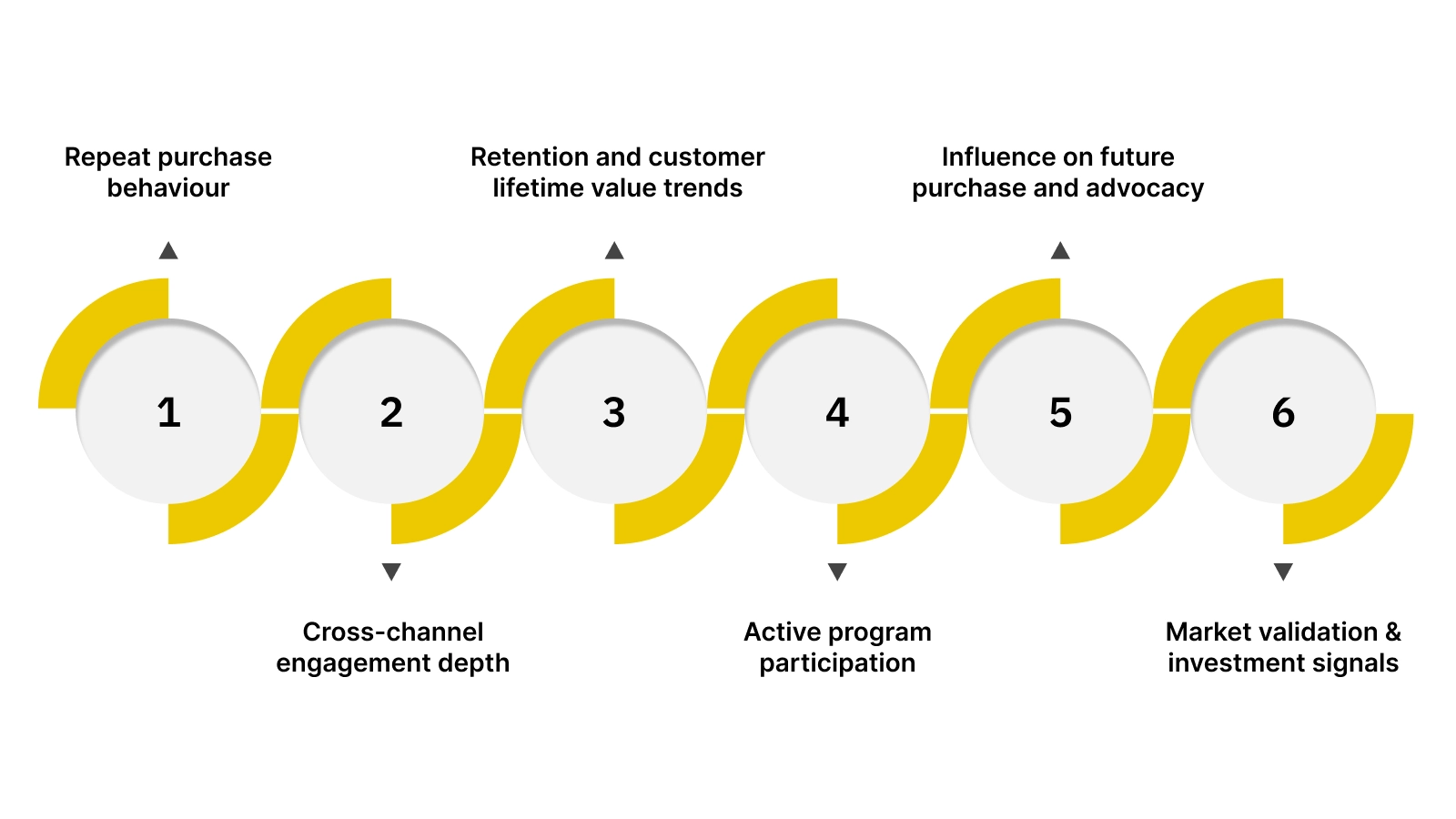
A strong omnichannel loyalty measurement framework focuses on a mix of revenue, engagement, and behavioral indicators.
Repeat purchase behaviour
A strong loyalty program should increase how often customers return, not just whether they return once. Recent e-commerce benchmarks show repeat purchase rates typically range between 15–30%, with higher performance often linked to retention and loyalty initiatives, especially in beauty, fashion, and consumables.
A consistent upward trend here signals that loyalty incentives are encouraging habitual buying, not one-off redemptions.
Cross-channel engagement depth
Omnichannel loyalty should increase customer activity across multiple touchpoints. In 2025, 73% of retail shoppers interact with brands across more than one channel during their purchase journey, making cross-channel engagement a baseline expectation rather than a differentiator.
When loyalty members engage across email, on-site experiences, messaging, referrals, and reviews, it shows the program is embedded into the broader customer journey.
Retention and customer lifetime value trends
Brands with strong omnichannel engagement strategies retain significantly more customers over time. Studies indicate that companies with mature omnichannel approaches retain up to 89% of their customers, compared to much lower retention among single-channel strategies.
Higher retention directly translates into stronger CLV, making this one of the clearest long-term ROI indicators for loyalty programs.
Active program participation (not just enrollment)
While most brands now run loyalty programs, performance depends on active usage. Over 90% of companies offer some form of loyalty program, but only those with strong participation see meaningful revenue impact.
Tracking how many customers actively earn or redeem rewards shows whether the program is actually influencing behavior or just sitting in the background.
Influence on future purchase and advocacy
In 2025, 83% of consumers say loyalty programs make them more likely to repurchase, and 79% say they’re more likely to recommend brands with strong loyalty programs.
This metric connects loyalty directly to purchase intent and word-of-mouth growth, two outcomes that are often undervalued in ROI calculations.
Market validation and investment signals
The global loyalty management market continues to grow, reaching $5.5B+ in 2025, reflecting increased brand investment in retention-focused strategies.
Market growth reinforces that loyalty ROI is no longer theoretical; brands are investing because results are measurable and compounding.
When the market itself grows, it signals rising demand and increasing sophistication in measuring loyalty ROI.
Tracking metrics in isolation only tells part of the story. A true omnichannel loyalty ROI framework connects:
- Behavioral changes (repeat purchases, cross-channel engagement)
- Financial impact (CLV, revenue influenced by loyalty touches)
- Program health (participation and redemption activity)
Together, they show whether loyalty is just present or genuinely driving repeat revenue and long-term engagement across channels.
Additional Tip for ROI Measurement: Use cohorts (e.g., loyalty members vs non-members) and time-based comparisons (pre- vs post-loyalty launch) to isolate loyalty’s impact. Also, tie your tracking to key business goals such as reducing churn, improving retention, and boosting average transaction values over time.
Common Omnichannel Loyalty Implementation Challenges
Omnichannel loyalty programs can deliver strong retention gains, but getting them right isn’t always straightforward. Most challenges don’t come from the idea of loyalty itself; they come from execution across systems, teams, and channels.
Below are the most common hurdles brands face when implementing omnichannel loyalty and why they happen.
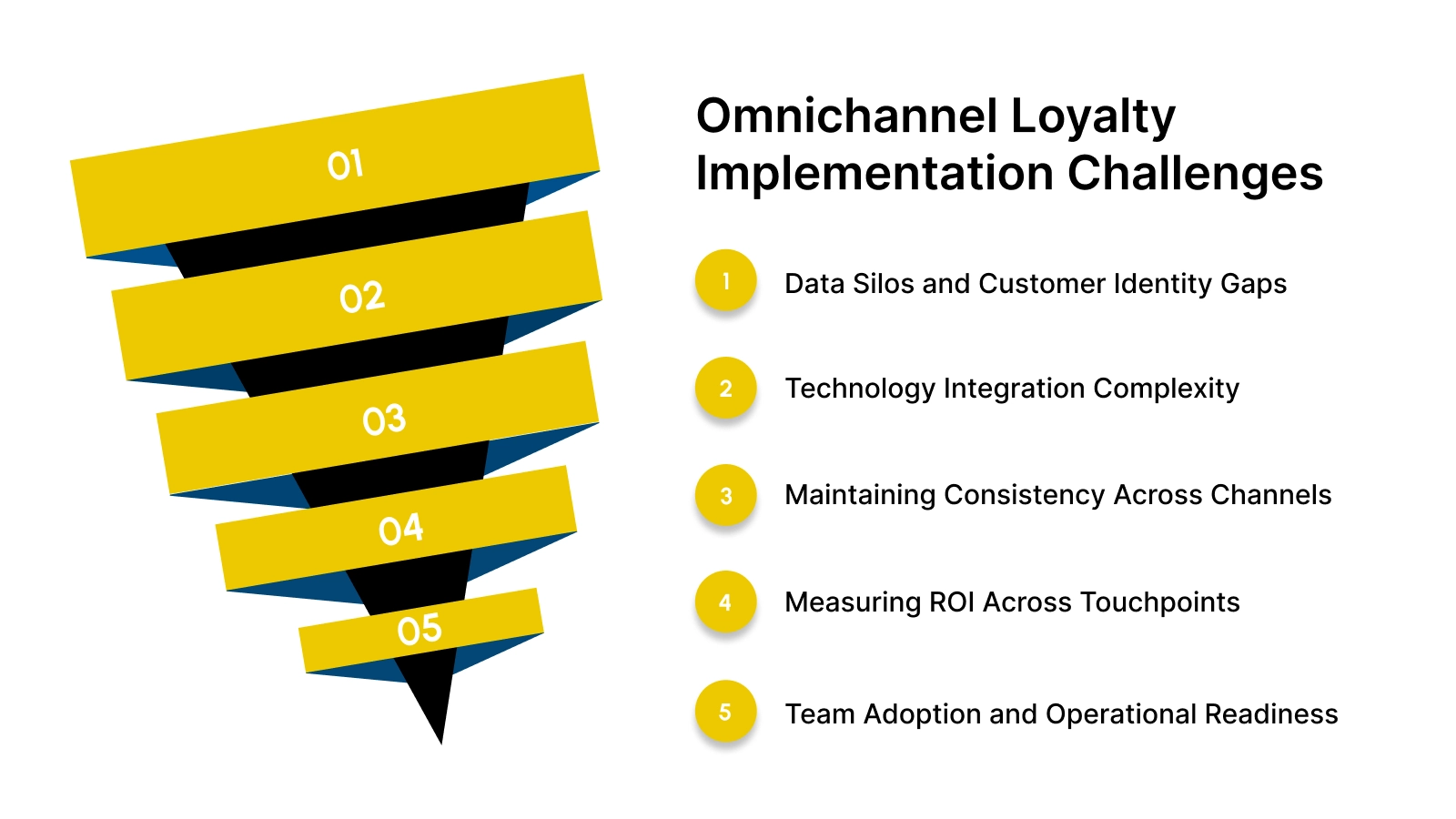
1. Data Silos and Customer Identity Gaps
Many businesses store customer data across multiple tools, e-commerce platforms, email software, CRM systems, review tools, and messaging channels. When these systems don’t talk to each other, loyalty data becomes fragmented.
The result is incomplete customer profiles, duplicated records, and rewards that don’t reflect the full customer journey. This makes it difficult to recognize the same customer across channels or personalize rewards accurately. Modern loyalty setups focus on unifying customer activity into a single profile to avoid these gaps.
2. Technology Integration Complexity
Connecting loyalty programs with existing systems like Shopify, POS tools, mobile apps, and marketing platforms can feel overwhelming, especially for small or fast-growing teams. Each integration adds technical overhead and potential points of failure.
Brands often address this by using a central system that connects and syncs data across tools, reducing the need for custom integrations and ongoing maintenance.
3. Maintaining Consistency Across Channels
Customers expect the same loyalty experience whether they’re browsing your website, opening an email, or receiving a WhatsApp message. In reality, maintaining that consistency across channels is difficult when messaging, rewards, and triggers are managed separately.
Without automation, teams often rely on manual updates and ad-hoc campaigns, which leads to mismatched communication. Behavior-based automation helps maintain consistency by triggering loyalty actions from the same logic, regardless of channel.
4. Measuring ROI Across Touchpoints
Omnichannel loyalty programs influence customer behavior over time and across channels, which makes attribution more complex. A purchase might be influenced by a reward reminder sent days earlier on a different platform.
Without cross-channel visibility, loyalty impact is often undervalued or misattributed. Clear measurement requires analytics that connect loyalty actions to downstream revenue and engagement, not just last-click conversions.
5. Team Adoption and Operational Readiness
Even the best loyalty strategy can stall if teams aren’t comfortable using the system. Training customer support, marketing, and operations teams to work with new workflows takes time.
This challenge is reduced when loyalty platforms are intuitive, role-based, and designed to minimize manual effort, allowing teams to focus on strategy rather than system management.
None of these challenges are permanent blockers. With the right loyalty technology stack and a structured implementation approach, brands can gradually eliminate friction, improve visibility, and scale loyalty without adding operational complexity.
The key is recognizing these challenges early and designing the program to address them from day one, rather than retrofitting solutions later
Real-World Omnichannel Loyalty Programs Examples
Omnichannel loyalty becomes easier to understand when you look at how brands connect customer actions across touchpoints, rather than treating loyalty as a standalone feature. The examples below highlight different omnichannel problems and how brands solved them by unifying data, channels, and reward visibility.
Revolution Beauty
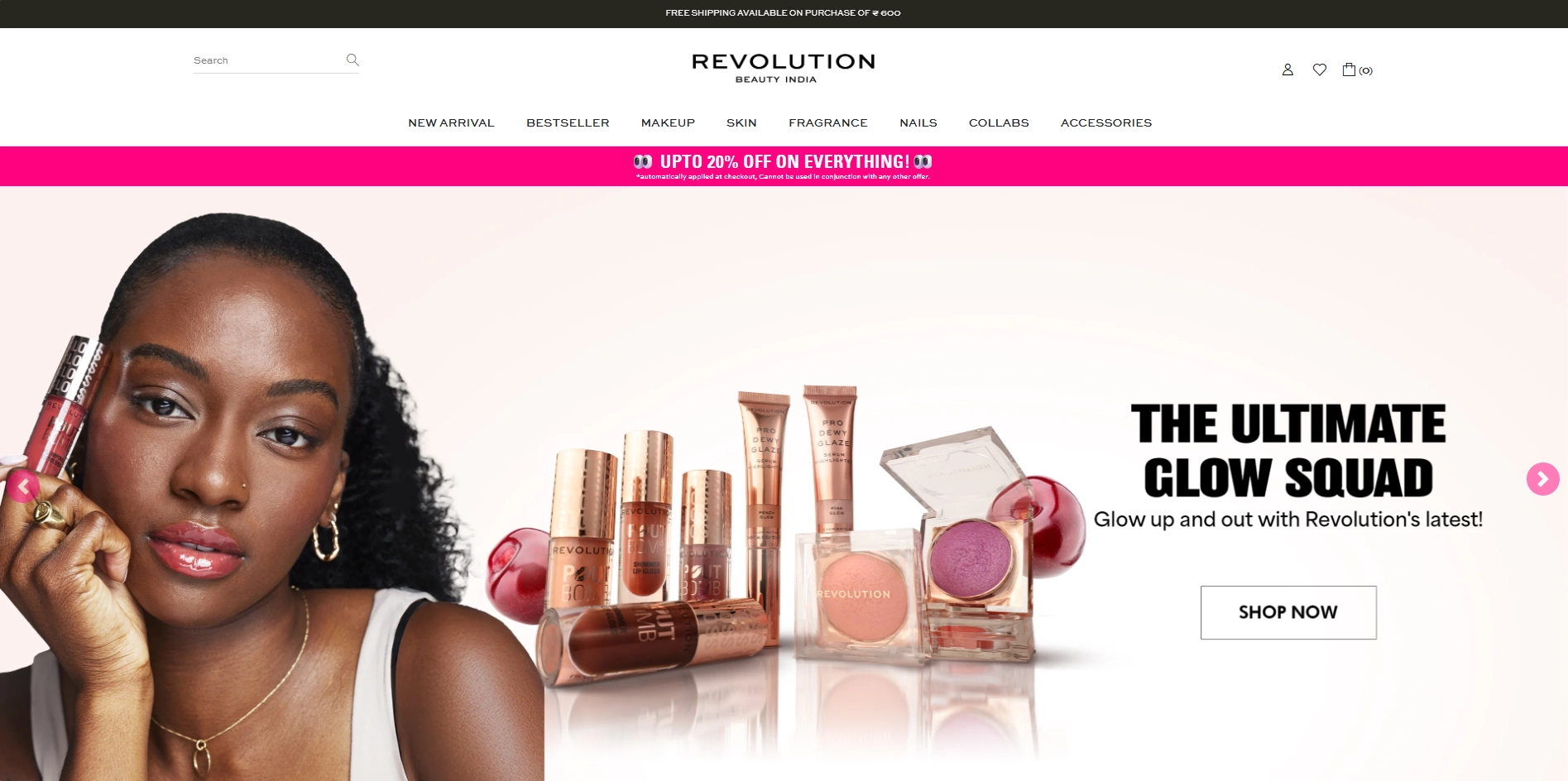
Revolution Beauty already had an established loyalty program, but engagement had started to plateau. Instead of adding new incentives, the brand focused on where loyalty context was missing.
Customers received physical mail during the holiday season reminding them of their existing points balance. When those customers later visited the website, they didn’t see a generic promotion, they saw a message tied directly to the points referenced in the mail.
The key omnichannel insight here wasn’t the channel mix, but continuity. Offline messaging and online experience reflected the same loyalty state. Because customers were reminded of value they already owned, redemptions increased without increasing discount pressure.
This example shows that omnichannel loyalty doesn’t require more rewards, it requires making rewards visible at the right moments.
Popeyes UK
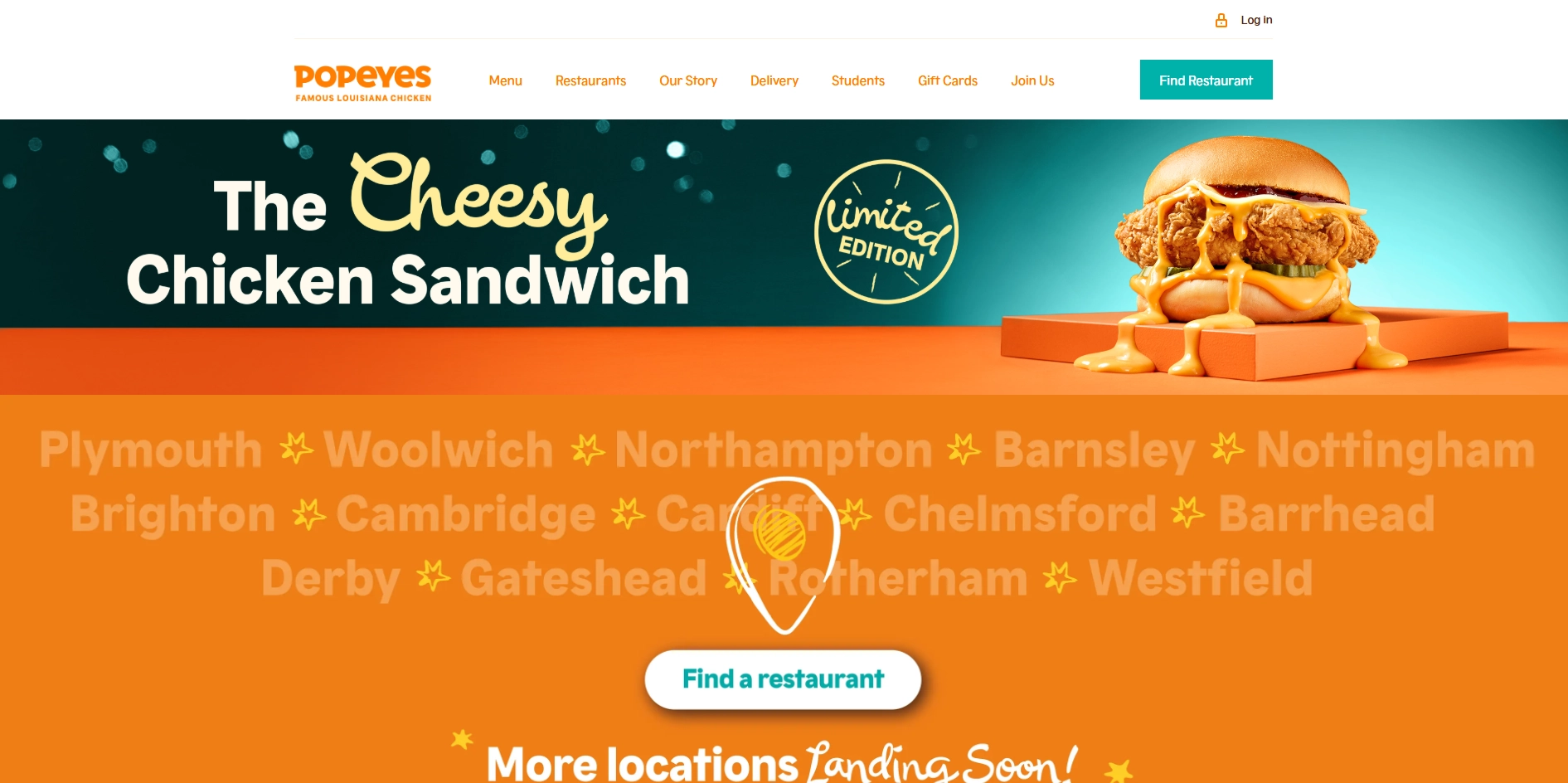
Popeyes UK faced a common omnichannel issue: most customer activity happened offline, but loyalty engagement lived online. Orders placed at kiosks or tills were invisible to digital loyalty workflows.
By connecting offline order data into a unified customer view, Popeyes enabled customers to participate in loyalty regardless of how they ordered. Scanning a QR code after purchase allowed customers to engage digitally, while rewards were still tied to offline behavior.
What makes this a true omnichannel example is that channel choice didn’t limit loyalty participation. Customers could order anywhere, but loyalty logic remained consistent.
The result was a measurable increase in repeat visits, driven not by gamification alone, but by removing the online–offline disconnect.
Mizzen+Main
For Mizzen+Main, the omnichannel challenge wasn’t acquisition; it was conversion after the first in-store visit. Nearly half of retail shoppers were new customers, and loyalty value was often locked inside the e-commerce system.
By unifying online and in-store customer profiles, retail associates could see loyalty balances in real time and apply rewards directly at checkout. This removed a common friction point where customers earn points online but can’t use them offline.
The lesson here is simple but important: loyalty only works when frontline teams can access it. Omnichannel loyalty isn’t just customer-facing, it has to be operationally accessible.
Lola’s Cupcakes
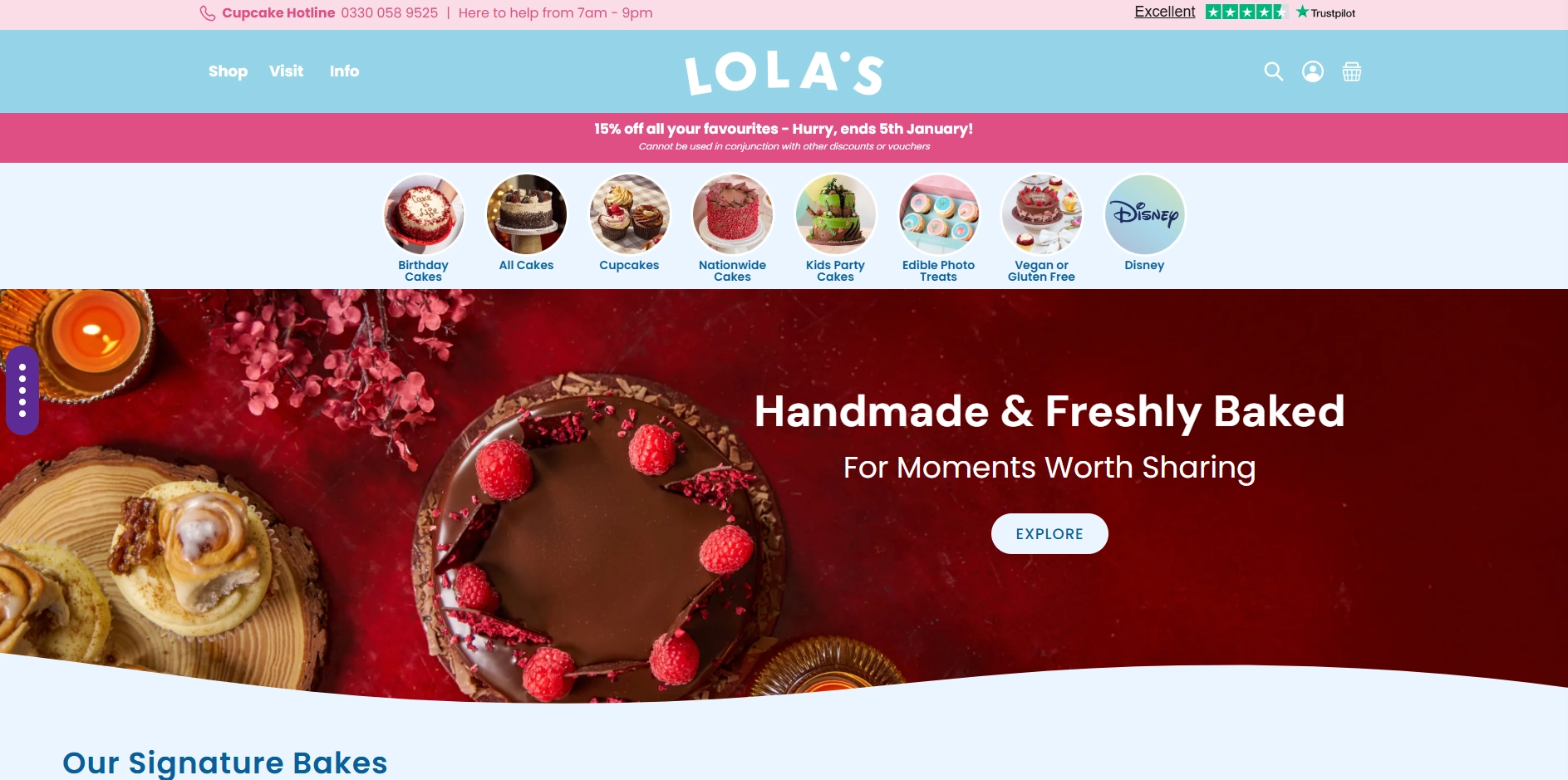
Lola’s Cupcakes struggled not because loyalty didn’t work, but because it lived across too many systems. Separate tools for e-commerce, in-store sales, and rewards created operational drag and customer confusion.
By unifying loyalty across online and offline purchases, customers could earn and redeem rewards anywhere, including birthday incentives and in-store redemptions. Internally, the team reduced technical overhead and complexity.
This example highlights a less-discussed omnichannel benefit: simplification. When loyalty becomes centralized, both customers and teams experience less friction.
BYLT Basics

BYLT Basics focused on one core omnichannel question: Can customers use their rewards wherever they shop?
By enabling loyalty redemption across the website, mobile app, and retail POS, the brand ensured that rewards didn’t feel conditional on channel choice. Retail staff could apply rewards instantly, and customers didn’t need to remember where points were earned.
This example reinforces a critical principle: omnichannel loyalty succeeds when redemption is frictionless and location-agnostic.
What these examples show is simple: omnichannel loyalty works when brands stop treating channels as separate and start treating loyalty as a shared system. When customer identity, reward logic, and visibility are unified, loyalty moves from a marketing tactic to a reliable driver of repeat revenue and long-term retention.
That’s the real benchmark for omnichannel loyalty in 2026.
How Nector Enables True Omnichannel Loyalty
Rather than positioning loyalty as a standalone feature, Nector supports end-to-end omnichannel loyalty execution.
Loyalty Programs
With Nector’s points-based and tiered loyalty systems, customers can:
- See progress toward rewards
- Understand how close they are to the next tier
- Stay motivated through visible milestones
Referral Programs
Referral rewards adapt to omnichannel sharing:
- Links shared via WhatsApp, SMS, or email
- Fraud checks prevent self-referrals and abuse
- Rewards sync directly into loyalty balances
Review Programs
Reviews are no longer isolated:
- Automated review requests trigger post-purchase
- Customers earn points for verified feedback
- Reviews contribute to long-term loyalty value
All of this runs through integrations with Shopify, CRM, email, and messaging tools, allowing lean teams to execute omnichannel loyalty without operational overload.
Building Loyalty That Works Across Every Touchpoint
Omnichannel loyalty programs aren’t about adding more rewards or running louder campaigns. They’re about creating consistency, where every purchase, referral, review, and interaction contributes to a single, connected customer experience. As customer journeys become more fragmented across platforms, loyalty systems must do the opposite: bring everything together.
For e-commerce teams in 2026, the real advantage lies in loyalty programs that are automated, measurable, and adaptable across channels, without increasing operational effort. When loyalty, referrals, and reviews work from the same framework, brands gain clearer insights, stronger retention, and more predictable growth.
If you’re looking to move beyond one-off discounts and build long-term customer relationships at scale, Nector gives you the structure to do it, from unified loyalty programs to referral and review automation, all managed from one place.
Frequently asked questions
What is an omnichannel loyalty program?
An omnichannel loyalty program connects customer rewards and engagement across every touchpoint, online store, email, SMS, WhatsApp, reviews, referrals, and in-store (if applicable). Instead of running isolated campaigns, all customer actions feed into one unified loyalty system, giving brands a complete view of engagement and lifetime value.
How is omnichannel loyalty different from traditional loyalty programs?
Traditional loyalty programs operate in silos, points earned on one channel often can’t be used on another. Omnichannel loyalty removes these gaps. Customers can earn and redeem rewards seamlessly, whether they’re purchasing online, referring friends, leaving reviews, or engaging with brand communications across platforms.
Do small or founder-led e-commerce teams need omnichannel loyalty?
Yes, especially small teams. Omnichannel loyalty reduces manual effort by automating engagement across channels. Instead of managing separate tools for reviews, referrals, and rewards, small teams can run a unified program that scales without requiring additional headcount.
What channels should be included in an omnichannel loyalty strategy?
At minimum, an effective omnichannel loyalty framework includes:
- Website and checkout
- Email and SMS
- WhatsApp or messaging platforms
- Product reviews
- Referral sharing
- Post-purchase engagement
The goal is to reward customers wherever they already interact with your brand, not force them into a single channel.
How do you measure success in an omnichannel loyalty program?
Key metrics include repeat purchase rate, loyalty-driven revenue, referral contribution, review volume, and customer lifetime value. Long-term success is best measured over 6–12 months to understand how loyalty influences retention rather than short-term conversions.


.webp)