




.webp)
.avif)
.avif)
Nearly 90% of consumers worldwide now belong to at least one loyalty program, and many hold memberships in multiple programs simultaneously. This shows just how competitive the loyalty market has become in 2026.
With so many options vying for attention to achieve customer loyalty and customer loyalty program effectiveness, brands must move beyond generic discounts and build systems that reward meaningful engagement.
In this blog, we will discuss 24 of the best customer loyalty programs you can model in 2026. You will discover actionable tips, proven strategies, and practical examples that can help you design a program that strengthens relationships, increases lifetime value, and turns your customers into brand advocates.
By following these insights, you’ll be equipped to create a loyalty program that drives real engagement and sustainable growth for your business.
Quick Look
- Choose your program type strategically: points for frequency, tiers for high-value customers, paid for exclusivity, and value-based for emotional connection.
- The best programs create "competitive immunity" by building both emotional and practical switching costs for customers.
- Use customer insights to deliver relevant rewards and communications that increase engagement and redemption rates.
- Align your program with customer purchase cycles and your data capabilities; don't overcomplicate what you can't sustain.
What Is a Customer Loyalty Program?
A customer loyalty program is a structured rewards system that encourages customers to buy from a brand more often. Instead of treating every purchase as a one-time transaction, these programs create long-term relationships by offering points, discounts, exclusive perks, or personalized rewards.
The purpose of loyalty programs is to turn repeat behavior into a habit, giving customers a reason to choose the same brand consistently instead of switching based on price alone.
Unlike basic promotions or one-off discounts, a well-designed loyalty program becomes a long-term value exchange:
- Customers get meaningful rewards (points, free products, VIP access).
- Brands gain predictable revenue and repeat purchases.
These programs are widely used across industries, from Starbucks Rewards and Sephora Beauty Insider to Amazon Prime, showing how effective incentives can turn occasional buyers into loyal advocates.
A strong customer loyalty program strategy also leverages data to personalize experiences, segment members, and deliver offers that match individual preferences. This combination of emotional connection + practical benefits is what makes loyalty programs one of the most powerful tools for sustainable business growth.
Also read: CRM Strategies for Improved Customer Retention
Why Are Customer Loyalty Programs Important?
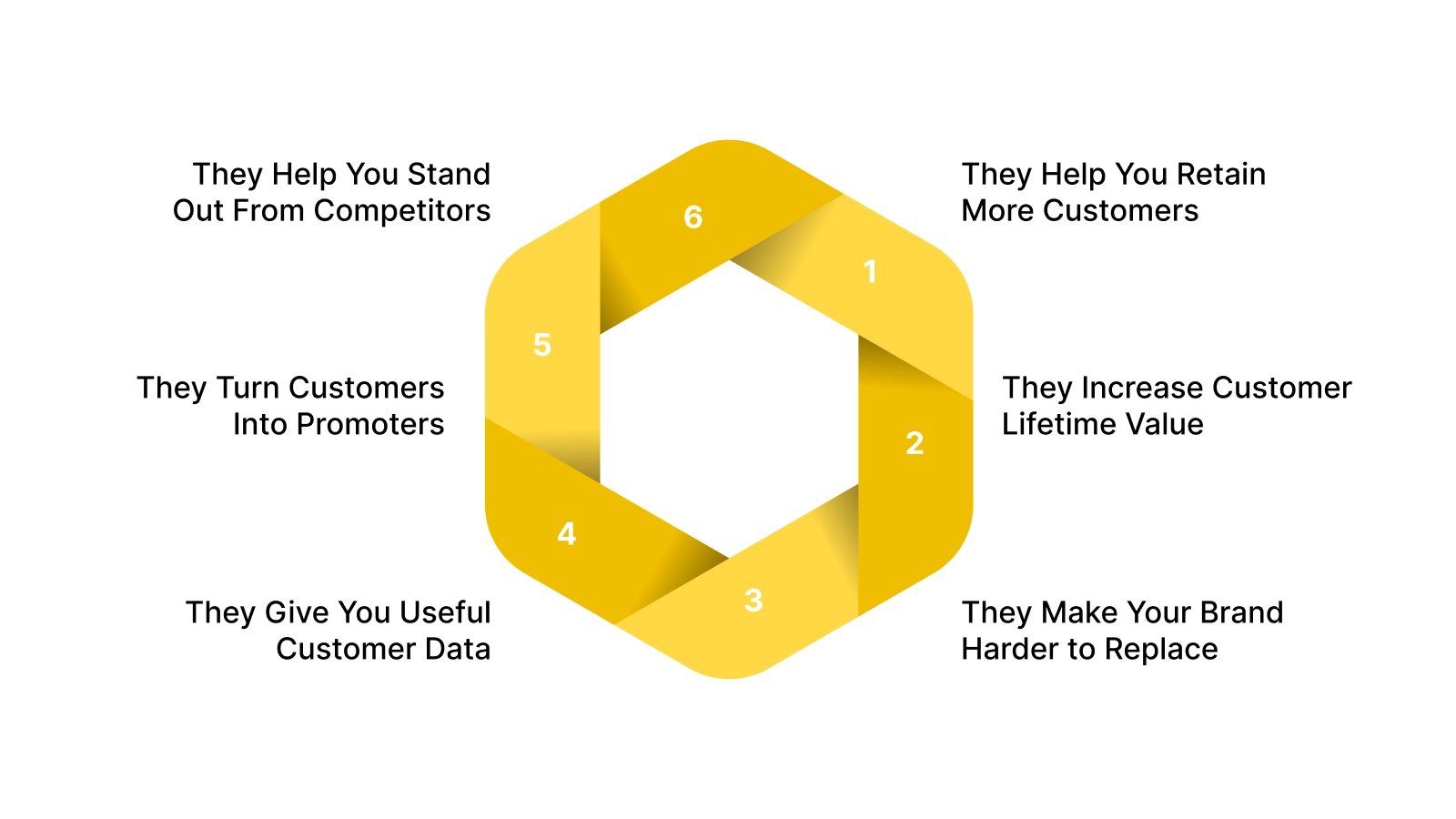
Loyalty programs deliver measurable advantages beyond simple customer retention. By implementing strong customer loyalty and customer loyalty program strategies, brands can boost retention, increase lifetime value, and strengthen their competitive position.
A strategic loyalty program provides these distinct advantages:
1. They Help You Retain More Customers
Retaining a customer is always cheaper than acquiring a new one. Customer loyalty is a byproduct of a customer loyalty program that gives shoppers a reason to stay active with your brand. Simple rewards, such as points or cashback, encourage repeat purchases and reduce churn.
2. They Increase Customer Lifetime Value
Members of loyalty programs usually spend more and buy more often. Even small incentives can motivate customers to add extra items, spend a little more, or choose your brand during their next purchase cycle. This directly improves overall customer lifetime value.
3. They Make Your Brand Harder to Replace
When customers earn points, build tier status, or unlock rewards, they feel like they have something to lose if they switch to another brand. This creates a natural habit of returning, strengthening customer loyalty, and reducing competitors’ influence.
4. They Give You Useful Customer Data
Loyalty programs show you what customers like, how often they purchase, and which products they prefer. This information helps you offer better recommendations and promotions that customers actually want.
5. They Turn Customers Into Promoters
Happy loyalty members often talk about their rewards or share referral links with friends. Rewarding reviews, referrals, or social engagement can help your brand reach more people without paying for expensive ads.
6. They Help You Stand Out From Competitors
Many customers compare brands based on the rewards they offer. Well-known programs such as Starbucks Rewards, Sephora Beauty Insider, and Target Circle have shown that strong perks can be a significant factor in why someone chooses one brand over another.
Also read: What Is Loyalty Management? Benefits & Tips for D2C Brands in 2025
These compelling benefits are achieved through various program structures that suit different business models.
Types of Customer Loyalty Programs
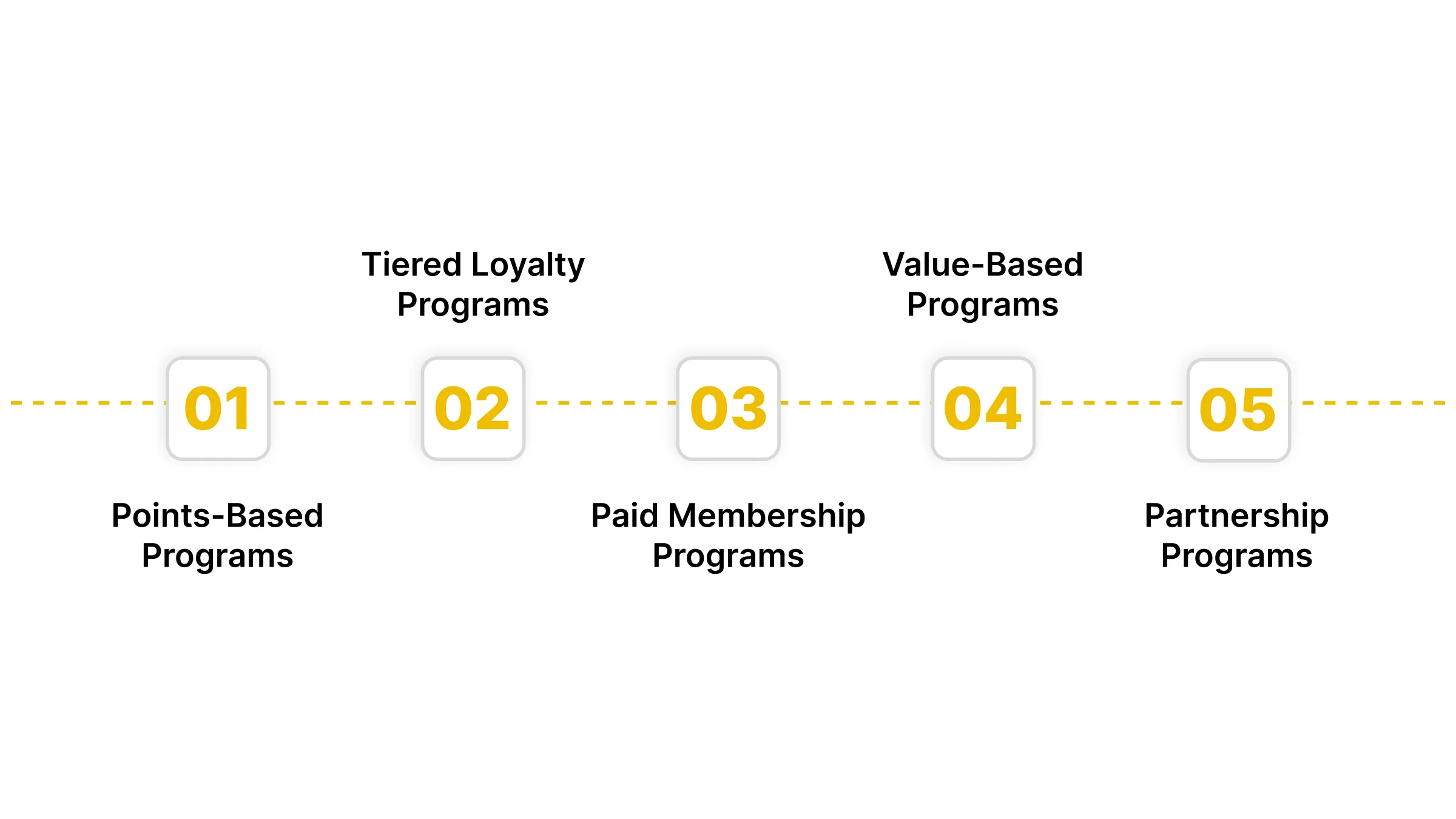
Selecting the right program structure is crucial for aligning with your business model and customer expectations. Different programs leverage distinct psychological triggers and operational requirements.
Your choice should reflect your brand identity and customer engagement goals. The optimal model creates mutual value for both your business and your members.
Here are the five main types:
Also read: Loyalty Pricing: How to Apply and Understand Its Importance
Knowing the options available helps you choose the optimal structure for your brand while staying aligned with the core purpose of a loyalty program.
20+ Examples of Highly Successful Customer Loyalty Programs
The best customer loyalty programs don’t rely solely on discounts. They build emotional connection, repeat engagement, and long-term trust. Below are 20 strong examples across beauty, food, fashion, outdoor, and lifestyle. Each includes a clear explanation of how the program works and what you can learn from it.
1. Sephora Beauty Insider (Points + Tiered)
Sephora’s Beauty Insider program is often considered the gold standard in beauty retail. Customers earn points with every purchase, redeem them for samples or full-size products, and move through Insider → VIB → Rouge tiers. Rewards include exclusive launches, early access, and members-only offers.
What Sephora gets right
- Rewards mirror natural beauty behavior. Sampling, discovery, and early access align with how customers already shop.
- Tier progression creates forward momentum. Movement from Insider to Rouge feels earned, not transactional.
- Loyalty reinforces experimentation. Customers return to try new products, not just restock favorites.
Even without public “members count,” Beauty Insider shows how aligning rewards with customer motivations (trying, experimenting, upgrading) drives long-term loyalty.
2. Starbucks Rewards (Points + Tiered)
Coffee is a daily ritual, and Starbucks turned that ritual into a loyalty goldmine. As of early 2025, Starbucks has 34.6 million active U.S. Rewards members. Those members account for about 59-60% of U.S. transactions, and loyalty customers spend significantly more than non-members.
How Starbucks turns habit into loyalty
- Mobile-first design removes friction entirely. Ordering, tracking, and redeeming happen in one flow.
- High-frequency purchases accelerate reward gratification, keeping engagement constant.
- Personalized offers reinforce relevance rather than pushing volume.
For many businesses, a similar system, frequent, low-cost purchases + easy mobile integration, could seriously boost customer lifetime value.
3. Amazon Prime (Subscription + Ecosystem Loyalty)
Amazon Prime isn’t just a loyalty program; it’s a whole ecosystem. U.S. Prime membership reportedly hit 197 million in early 2025. Prime members spend around $1,170 per year, more than twice the $570 spent by non-Prime members.
Why it works:
- Prime doesn't ask customers to choose between perks. It bundles everything: fast shipping, exclusive deals, streaming, grocery delivery, and photo storage.
- The subscription model locks customers into a relationship that feels less like a membership and more like a necessity.
- Once you're in, the friction of leaving is enormous. Prime members shop more often, spend more per order, and rarely consider alternatives.
If you can create a subscription that delivers recurring, compounding value, you're not just building customer loyalty. You're building dependency, the good kind.
4. LEGO Insiders (Value-Based)
LEGO could have built a simple spend-and-earn program. Instead, they built something that reflects what their customers actually love: creativity and community. Members earn points not just from purchases but also from registering new sets, completing building challenges, and engaging with LEGO storytelling content.
Where LEGO shifts the relationship
- Engagement is rewarded beyond spending, including creativity and participation.
- Customers interact with the brand even when they are not buying.
- Loyalty reinforces identity as builders, collectors, and fans.

5. Nicce Rewards (Points-Based)
Nicce’s loyalty setup might look simple, but it’s built with brand coherence and customer psychology in mind. Instead of an overly complex tier ladder, Nicce uses a branded point currency called “N Coin” that aligns with its minimalist, streetwear identity, making the program feel like an extension of the brand.
This strategic choice does a few bright things:
- Brand reinforcement over mechanics: The way points are named and presented remains consistent with Nicce’s contemporary aesthetic, helping members feel like they’re part of the brand culture.
- Clarity drives participation: Because the system is straightforward (“earn as you shop or engage, redeem for discounts later”), customers don’t need a manual to understand the value, which is crucial in a category where buying decisions are often quick and emotional.
- Low friction, high feel-good: Nicce rewards social actions (like referrals and engagement) alongside purchases, turning routine interactions into small wins that feel rewarding without requiring heavy spending.
In streetwear specifically, where community and culture matter as much as the clothes themselves, this approach keeps the loyalty program closer to identity formation and social validation than to discounts alone.
6. MoxieLash Rewards (Points + Value-Based)
MoxieLash built loyalty around contribution, not consumption. Instead of limiting rewards to spending, the program assigns value to actions that expand brand reach, such as reviews, referrals, and social sharing. This reframes loyalty from a retention tool into a customer-powered growth channel.
Early access and VIP drops are used selectively, giving members a reason to stay engaged without conditioning them to wait for discounts. Because rewards are reachable even for first-time buyers, customers quickly experience progress and understand how participation benefits them.
Over time, this created a shift in behavior. Members stop interacting only when they want to buy and start engaging because they feel invested in the brand’s success.
7. Astrid & Miyu (Tiered)
Astrid & Miyu’s “Astrid & You” loyalty system goes far beyond simple points; it’s a hybrid program that blends transactional rewards with experiential, emotional, and sustainability‑driven elements. After restructuring the program to include four tiers and non‑purchase activities like jewelry recycling, the brand saw a 40% boost in total revenue, and members who redeemed rewards were 6× more likely to make a second purchase.
Furthermore, the program integrates brand values, for example, the “Astrid & Renew” jewelry recycling initiative rewards members for sustainable behavior, strengthening emotional connection.
Why it resonates:
- Tier progression taps into aspiration; moving up feels like recognition, not obligation.
- Sustainability rewards give customers a way to express values through participation, deepening emotional trust.
- The structure encourages repeat engagement while preserving the brand’s premium positioning.
8. TheCHIVE Rewards (Gamified)
TheCHIVE took loyalty into entertainment territory by gamifying engagement. Members earn points for watching content, completing challenges, and buying merchandise. The program feels less like a shopping incentive and more like a game you want to keep playing.
Why it sticks:
- Gamified interactions extend time spent with the brand, strengthening familiarity and attachment.
- Community‑driven challenges foster a sense of shared momentum rather than individual consumption.
- Earning points through content exploration keeps the brand relevant even between purchases.
9. Target Circle (Points + Tiered)
Target Circle has over 100 million members who earn 1% back on purchases, redeemable instantly in the app. Members also get personalized deals, birthday rewards, and access to the premium Circle 360 tier with same-day delivery services. Members account for nearly half of major shopping events, driving repeat visits and larger basket sizes.
Why it works:
- The tiered structure keeps customers engaged, while features like community voting on charitable donations create emotional investment beyond discounts.
- Mobile redemption is smooth, turning casual shoppers into habitual loyalists.
- Target built a program that feels personal, convenient, and generous without relying on steep discounts.
10. Annmarie Skin Care Collective (Points-Based)
Annmarie integrated education into loyalty in a way that makes total sense for skincare. Members earn points for purchases, as well as for watching educational videos and learning about ingredients. Skincare customers are research-driven. They want to understand what they're putting on their skin and why it works.
Why education outperforms discounts here
- Skincare buyers seek confidence before commitment, and educational rewards meet that need directly.
- Incentivizing learning builds trust while quietly increasing product literacy.
- Trial-size rewards reduce risk, encouraging exploration in a category where hesitation is common.
Instead of pushing faster purchases, the program helps customers make better ones.
11. Two Brothers Organic Farms (Points + Gamified Loyalty)
Two Brothers Organic Farms strengthened customer loyalty and boosted long-term revenue by integrating Nector’s rewards ecosystem. Their program leveraged personalized rewards, gamified engagement, and automated reminders to turn occasional buyers into long-term advocates.
The loyalty moves that actually worked for MoxieLash:
- Personalized rewards make each customer feel recognized and valued.
- Gamified engagement keeps customers motivated to participate frequently.
- Automated reminders maintain consistent interaction without manual effort.
- Focusing on repeat behavior rather than discounts builds genuine loyalty.
Key Metrics:
- 31% Repeat Purchase Rate.
- +5.34% AOV Uplift.
- 7% of Orders from Loyalty Members.
12. Pacifica Perks (Points + Value-Based)
Pacifica’s loyalty program answers a question most brands avoid: what kind of customer do we actually want more of?
By rewarding recycling, reviews, and education-driven engagement, Pacifica quietly pushed out discount-only buyers and pulled in customers who cared about impact. These customers defended the brand, spoke publicly about it, and stayed even when prices weren’t the lowest.
The loyalty program didn’t create behavior. It revealed alignment. And once alignment exists, retention takes care of itself.
13. Barnes & Noble Membership (Subscription)
Barnes & Noble's subscription model works because books are predictable. Avid readers know they'll buy 10-20 books annually, so a $39.99 membership that saves 10% on everything pays for itself in 4 books. But the real retention driver is the psychological commitment. Once you've paid for membership, every book purchased outside Barnes & Noble feels like wasted value.
Key Insights:
- Predictable revenue from annual renewals. Over hundreds of members renew, creating a stable recurring income.
- Higher purchase frequency. Members shop 4x more often because they want to maximize membership value.
- Competitive insulation. Even when Amazon prices are lower, members default to Barnes & Noble to "get their money's worth."
How you can apply this:
- Subscription loyalty works best with passionate, committed customers who have predictable needs.
- Price your membership so it pays for itself in 3-5 typical purchases. Quick ROI drives sign-ups and renewals.
- Add exclusive access or early releases to make membership feel premium beyond just discounts.
14. Pulse Boutique (Points + Value-Based)
Fashion's challenge is staying relevant between drops. Pulse Boutique solved this by creating earning opportunities that don't require purchases. App downloads, social follows, and daily check-ins all generate points. This keeps the brand top of mind during the 2-3 week gap between new arrivals, which directly impacts conversion when new products drop.
What they gained:
- Higher conversion on new drops from loyalty members who've been engaged between releases.
- Daily engagement through non-purchase actions. Members open the app 3-4x per week, even when not buying.
- Social reach amplified. Earning points for social follows turned customers into a distribution channel for launch announcements.
15. Mirenesse Glamm Points (Points + Tiered)
Mirenesse kept their tier structure deliberately simple: three tiers, clear point thresholds, and benefits that directly drive purchases. The top tier offers early access to new launches, which, in beauty, translates into direct revenue. Products that would have sold out in 48 hours now sell to top-tier members in 24 hours, creating urgency for others to reach that tier.
How you can apply this:
- Simplicity scales. Complex tier structures create confusion and reduce participation.
- Early access creates urgency. If your products are scarce or have limited availability, use access as the primary tier benefit.
- Make tier thresholds visible and achievable. Customers need to see a clear path to the next level.
16. REI Co-op Membership (Subscription)
REI's $30 lifetime membership turns customers into owners. Members receive annual dividends (typically 10% of purchases), access to member-only sales, and invitations to classes and events. The psychological shift is profound because members aren’t just buying from REI, they’re buying from their co-op. This ownership mindset changes the conversation around price. Members don’t ask whether something is the cheapest; they ask whether it’s the best for their co-op.
The real outcome
- A base of 25 million members who consistently outspend non-members.
- Strong insulation from price competition, even when cheaper online options exist.
- A values-led community, reinforced through classes and shared experiences rather than promotions.
Why this works for them: Ownership changes the emotional contract. When customers feel like stakeholders, loyalty becomes principled rather than transactional. The brand stops competing purely on price and starts competing on belonging.
17. Lucy & Yak Yak Perks (Points + Tiered)
Lucy & Yak built loyalty around identity. The brand stands for sustainability and self-expression, and the loyalty program reinforces both. Members earn through purchases, reviews, and social sharing, but tier names and benefits feel like joining a movement. Top-tier members are invited to sustainability workshops and receive exclusive behind-the-scenes content on ethical production.
What changed for the business
- Customers aligned with the brand’s values show 3x higher lifetime value.
- Organic advocacy has reduced reliance on paid marketing, driving new customer acquisition.
When loyalty reinforces identity, customers don’t just return; they represent the brand. Advocacy becomes a form of self-expression rather than a prompted behavior.
How can you translate this elsewhere?
- If your brand stands for something, let loyalty feel like belonging to that worldview.
- Reward behaviors that signal alignment, not just spending.
- Design top-tier benefits that deepen understanding of your mission, not just access to more products.
18. Lively Rewards (Points + Value-Based)
Lively builds loyalty around community and self-expression. Members earn points for purchases, reviews, and referrals while also joining a community-driven brand experience.
Why it works:
- Rewards support identity-based purchasing.
- Social sharing boosts organic reach.
- Multiple earning paths increase engagement.
19. Bobo’s Love Rewards (Points-Based)
Oat bars are a repeat-purchase business, or they fail. Bobo’s understands this, so Love Rewards focuses less on mechanics and more on emotional familiarity. Birthday rewards, surprise bonuses, and personalized messages turn a habitual snack into something that feels chosen rather than interchangeable.
That emotional layer changes behavior. Loyalty members buy far more frequently, build larger baskets through variety packs, and remain loyal even when cheaper alternatives exist. In a commodity category, warmth becomes a competitive advantage.
20. Dr. Axe Rewards (Points + Value-Based)
Supplements are trust-driven products. Dr. Axe built its loyalty program around that reality. Customers earn rewards for learning, tracking progress, and completing wellness challenges, not just for placing orders.
This keeps the brand top of mind between purchases. Customers form routines, and the loyalty program reinforces them instead of interrupting them.
21. Waterdrop Club (Points + Value-Based)
Waterdrop turned hydration into a challenge. Members earn points for purchases, completing daily hydration goals, referring friends, and engaging with wellness content. Limited-edition flavor drops serve as rewards, fostering collectible behavior. This transformed a simple drink product into a wellness routine with built-in gamification.
What changed
- Daily engagement increased as members returned to log hydration, keeping the brand top of mind.
- Referral-led growth accelerated, supported by the natural sharing behavior of wellness communities.
- Completionist behavior emerged, with limited editions driving higher SKU diversity per customer.
22. The North Face XPLR Pass (Points + Value-Based)
XPLR Pass feels like an extension of the outdoor lifestyle, not a rewards overlay. Members earn through purchases and reviews, as well as by taking part in environmental initiatives. The rewards follow the same logic. Free gear, early product access, and real outdoor experiences matter more to this audience than abstract discounts.
The program works because it respects context. People who buy from The North Face already see themselves as outdoorsy and values-driven. Early drops create momentum around new collections, while mission-based actions give customers a reason to stay involved even when they are not shopping.
This is loyalty that stays aligned with how customers actually use the brand in their lives.
23. Sam’s Club Membership (Subscription)
Sam’s Club’s membership program offers shoppers tiered access to perks such as 2% cash back on executive memberships, exclusive savings, and fuel discounts. With millions of U.S. members, the program drives consistent high-volume purchases and annual renewals while encouraging loyalty through member-only events.
Why it works:
- Subscription fees create predictable revenue and strengthen long-term retention.
- Rewards align perfectly with bulk-buying behavior, boosting average transaction value.
- Exclusive access and benefits turn members into advocates, especially families and small businesses.
24. CVS ExtraCare (Points + Value-Based)
CVS ExtraCare is built around frequency. Members earn through personalized coupons, ExtraBucks tied to prescriptions, and quarterly wellness rewards. The scale is massive, with close to 74 million members receiving tailored offers across pharmacy, health, and beauty.
The loyalty program keeps CVS relevant between doctor visits and prescription refills. Personalized offers nudge replenishment purchases and encourage routine store visits. App and email communication do most of the work quietly, driving engagement and spend without the need for constant promotions.
In a category where trust and habit matter more than brand love, consistency wins.
By looking at these loyalty program business model examples, you can see one thing: when you reward the right behaviors and keep customers genuinely engaged, loyalty stops being a tactic and becomes a long-term growth engine.
Confused about which loyalty model will actually work for your brand? Book a demo and let Nector help you design and launch the right loyalty program.
Also Read: Customer Loyalty Programs and Their Benefits
How to Set Up a Rewards Program to Boost Customer Loyalty?
Launching a loyalty program is all about creating a system that genuinely motivates customers to engage repeatedly and deepens their emotional connection with your brand. A successful program turns one-time buyers into advocates while reinforcing your brand’s value in every interaction.
To help you set up a rewards programme for your customers, here are actionable steps you need to follow to make it a success:
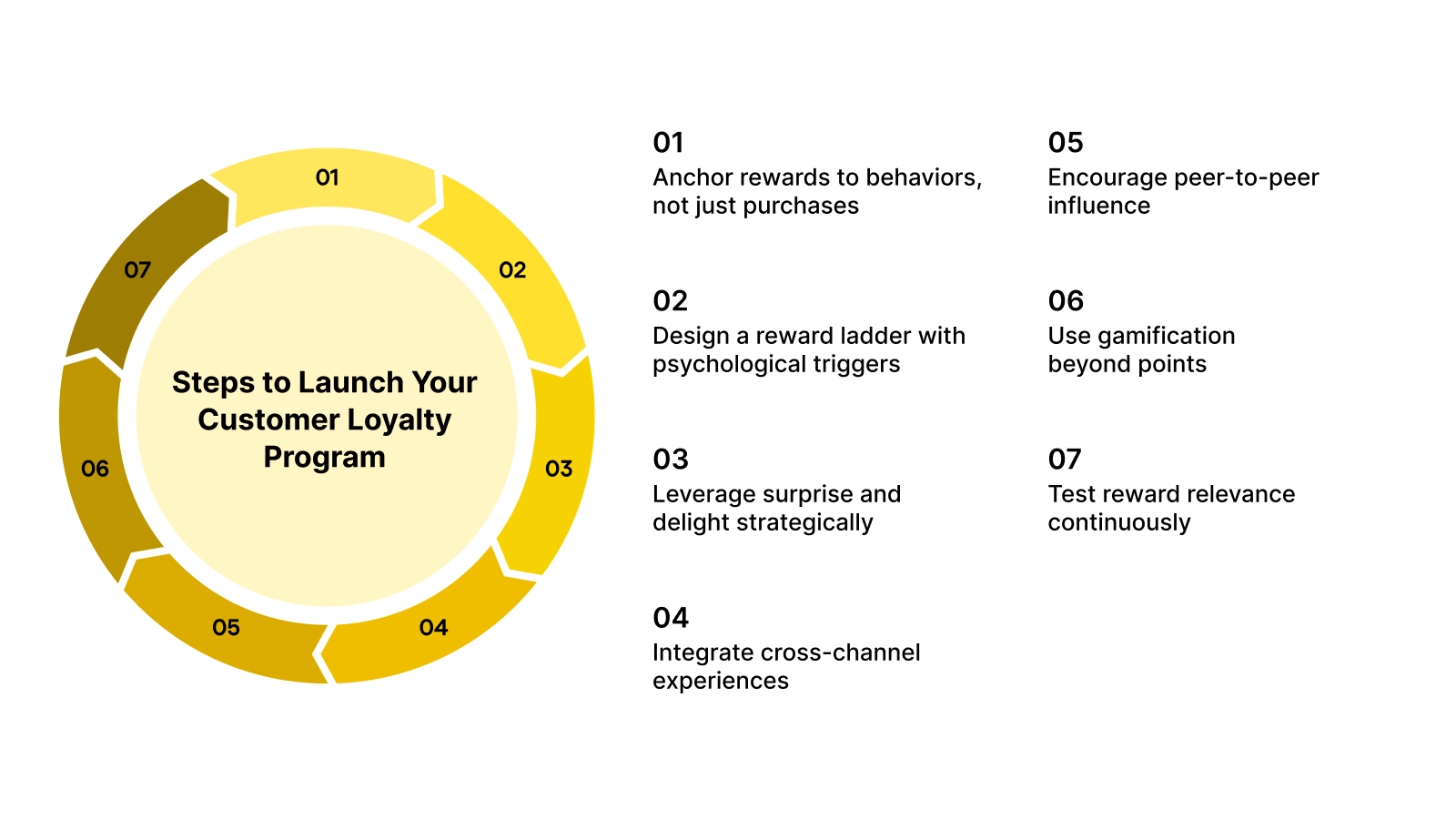
- Anchor rewards to behaviors, not just purchases: Reward customers for meaningful actions like sharing your brand story, participating in polls, or attending virtual events. This drives engagement beyond transactions.
- Design a reward ladder with psychological triggers: Structure milestones that feel achievable yet aspirational. Small wins build momentum, while higher-tier rewards create a sense of accomplishment and exclusivity.
- Use surprise and delight strategically: Introduce random, unexpected rewards to loyal customers. Unpredictable benefits increase emotional attachment and make members feel recognized.
- Integrate cross-channel experiences: Ensure loyalty interactions span email, app, social media, and in-store. Seamless omnichannel rewards create convenience and reinforce your program’s value.
- Encourage peer-to-peer influence: Include social or referral-based rewards that amplify your program organically. Customers trust recommendations from friends more than brand messaging.
- Use gamification beyond points: Add challenges, badges, or seasonal quests to create excitement. Gamified engagement increases time spent interacting with your brand and strengthens retention.
- Test reward relevance continuously: Use data to adapt rewards to different segments. What motivates one group may not resonate with another, so personalization is key for sustained participation.
When you apply these steps, your loyalty program becomes a growth engine that encourages repeat engagement, strengthens relationships, and maximizes long-term value.
And if you want to make managing all this simple while keeping your program highly effective, platforms like Nector let you automate rewards, tiers, and personalization so you can focus on building real loyalty.
Let Nector simplify setup, automation, and scaling → Start a Demo.
Now that you know how to set up a rewards program for customers, it is time to look at some rookie mistakes owners make so you can avoid them in advance.
7 Common Mistakes You Should Avoid While Building Your Customer Loyalty Program
Even the best-intentioned loyalty programs can fall short if brands overlook critical pitfalls. Avoid these common mistakes to ensure your program drives engagement, retention, and revenue:
- Overcomplicating the rules – Complex earning and redemption structures confuse customers. Programs should be intuitive; if members can’t explain it in one sentence, they won’t participate.
- Focusing only on discounts – Treating loyalty purely as a price-based reward undermines emotional connection. Programs that offer experiences, recognition, or exclusivity outperform simple cashback or points schemes.
- Neglecting personalization – One-size-fits-all rewards fail to resonate. Ignoring member preferences, behavior, and purchase history can reduce engagement and even drive churn.
- Under-communicating the program – Even strong programs fail if members forget they exist. Lack of reminders across email, app, or in-store touchpoints leads to low participation.
- Ignoring non-purchase engagement – Many programs reward only transactions. Failing to incentivize reviews, referrals, or social sharing leaves untapped engagement opportunities on the table.
- Failing to evolve – Customer needs change. Programs that remain static without testing new rewards, tiers, or engagement strategies lose relevance and decline in effectiveness.
- Measuring the wrong metrics – Tracking only enrollment or points issued ignores true ROI. Focus on metrics like repeat purchase rate, average order value, and member lifetime value to gauge success.
A strong loyalty program avoids these pitfalls by keeping rewards meaningful, participation simple, and engagement ongoing. When executed correctly, it becomes a growth engine rather than just a perks system.
Build a High-Converting Customer Loyalty Program with Nector
Manual loyalty program management often overwhelms e-commerce teams with operational complexity. Tracking points across different customer actions requires constant attention and resources.
Personalizing experiences for each member becomes nearly impossible to maintain at scale. These operational hurdles prevent your loyalty program from reaching its full potential.
Nector provides a complete platform for automating your customer loyalty strategy. Our system handles program setup, point tracking, and reward fulfillment automatically. You can launch a sophisticated loyalty program without technical complexity or manual effort. This approach transforms loyalty management from a burden into a competitive advantage.
Nector’s loyalty features deliver comprehensive program control:
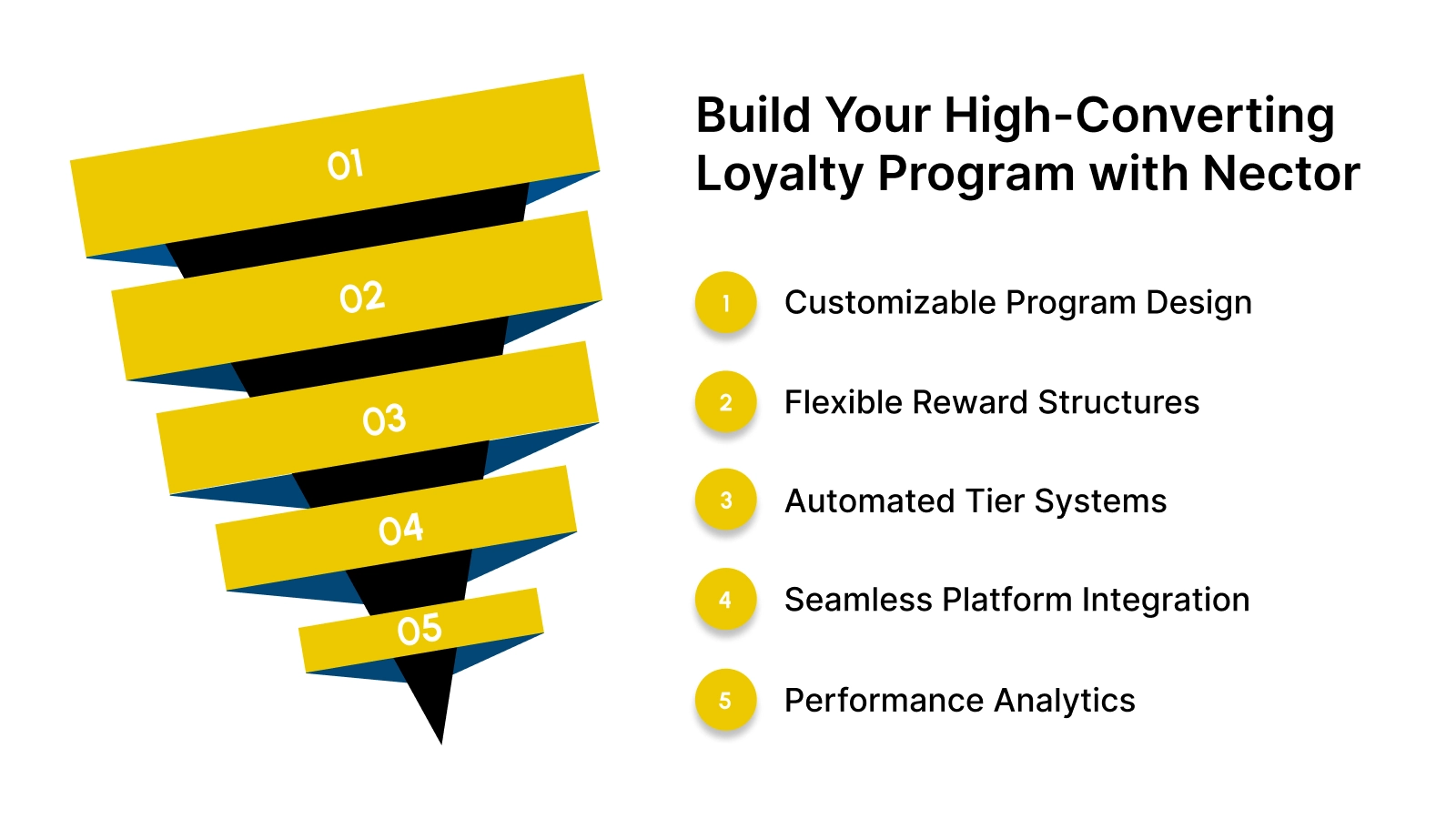
- Customizable Program Design: Create loyalty programs that align perfectly with your brand identity and specific business objectives.
- Flexible Reward Structures: Offer points, discounts, products, or exclusive access to reward customer loyalty.
- Automated Tier Systems: Implement VIP levels that automatically unlock special benefits for your best customers.
- Smooth Platform Integration: Connect Nector with your existing e-commerce store and marketing tools effortlessly.
- Performance Analytics: Track customer engagement and program effectiveness with detailed, actionable insights.
This comprehensive approach demonstrates a clear path from strategic planning to successful execution.
Wrapping Up
Effective customer loyalty and customer loyalty program strategies build lasting relationships beyond simple transactions. They systematically increase customer lifetime value and reduce acquisition costs. The right program structure aligns with your specific business goals and customer behavior.
Manual program management often creates operational complexity for e-commerce teams. Nector automates program setup, tracking, and reward fulfillment in one platform. This eliminates the technical barriers to running a sophisticated loyalty system.
Start building your high-converting loyalty program with Nector today. Create meaningful customer relationships that drive sustainable growth for your brand. Book a demo.
Frequently asked questions
What makes a customer loyalty program successful in 2026?
A successful loyalty program combines personalization, emotional engagement, gamification, and data-driven rewards. Brands win when customers feel valued, are rewarded instantly, and are continuously motivated to return without relying solely on discounts.
How often should a brand update its loyalty program?
Brands should refine loyalty programs quarterly based on customer behavior trends, reward performance, and engagement data. Small iterative updates improve program relevance, retention, and long-term participation without overwhelming users.
Do loyalty programs work for low-frequency purchase categories?
Yes. Low-frequency brands benefit by rewarding non-purchase actions like referrals, content engagement, reviews, and community participation. These touchpoints build emotional loyalty and maintain brand presence between long purchase cycles.
How can small businesses compete with big brands using loyalty programs?
Small businesses can compete by offering personalized rewards, community-focused engagement, and simple earning structures. Authentic interactions and tailored experiences often outperform large programs that feel generic or overly complex.
What is the biggest mistake brands make with loyalty programs?
The biggest mistake is rewarding only purchases. Customers engage more when programs incentivize multiple behaviors, create emotional value, and evolve with shifting preferences rather than remaining static or transactional.



.webp)