
%201.webp)
.avif)
.avif)
Email marketing and loyalty programs often run side by side, but rarely work together. Loyalty data lives in one system, email campaigns in another, resulting in generic messages that ignore what customers have already earned, unlocked, or worked toward.
That disconnect shows up in performance.
Personalized emails deliver higher open rates (44.3%) and lower bounce rates (2.26%) than non-personalized campaigns, which average 39.13% opens and 2.50% bounce rates.
Loyalty data is one of the strongest personalization inputs e-commerce teams have, yet it is often unused in email. When loyalty signals are activated through email, they drive faster repeat purchases and stronger retention.
This blog breaks down how loyalty apps and email marketing work better as one system, the workflows that improve performance, and how to set the integration up without adding operational complexity.
At a glance:
- Loyalty generates intent, and email delivers action. Points earned, redemptions, and tier progress are high-quality buying signals, but they only drive repeat purchases when activated through timely email communication.
- Disconnected loyalty and email lead to missed moments. When systems don’t talk, customers forget rewards, milestones go unacknowledged, and email campaigns stay generic despite strong loyalty engagement.
- Loyalty–email integration improves timing, not volume. Triggered emails based on loyalty events outperform calendar-based campaigns by reaching customers when motivation to act is highest.
- Integrated workflows increase redemption and repeat purchases without heavy discounts. Showing earned value through email reduces reliance on blanket promotions while protecting margins.
- Retention improves when loyalty behavior, not purchase history, drives email flows. Segmentation based on points, rewards, tiers, and inactivity surfaces churn risk earlier and enables more relevant re-engagement.
Why Loyalty and Email Can’t Operate in Silos Anymore
Loyalty programs and email marketing serve different roles, but they influence the same outcome: repeat purchases. When they operate in isolation, valuable signals get lost and retention efforts become generic instead of timely.
Loyalty Generates Intent Signals
Every loyalty interaction tells you something about intent. Points earned signal purchase momentum. Redemptions show readiness to buy again. Tier progress reflects long-term engagement. These are high-quality signals because they come from real behavior, not assumptions.
When this data stays locked inside a loyalty app, it never informs how or when you communicate with customers.
Email Is the Delivery Channel
Email is where most retention messaging actually happens. It’s how customers are reminded of value, nudged to return, and shown what to do next. Without loyalty data feeding into email workflows, campaigns rely on blunt triggers like “last purchase date” or “order count,” which miss the context loyalty provides.
What Breaks When They’re Disconnected
When loyalty and email don’t talk to each other, common problems show up quickly:
- Customers earn points but are never reminded to redeem them
- Loyalty milestones pass silently with no acknowledgment
- Tier progress feels invisible, reducing motivation to continue
- Email campaigns stay generic because they lack behavioral context
This disconnect leads to missed moments. A customer earns enough points for a reward but receives a standard promotion instead. Another is close to unlocking a tier benefit, but no email reinforces that progress.
Over time, loyalty feels passive, email feels irrelevant, and repeat purchase intent fades.
Also read: Essential Email Marketing Flows for E-commerce Success
How Loyalty Apps Email Marketing Integration Improves Retention
When loyalty data feeds directly into your email workflows, retention stops being reactive and starts becoming intentional. Instead of sending broad campaigns, you’re responding to real customer behavior with relevant, timely communication.
Here’s what changes when loyalty and email work together.
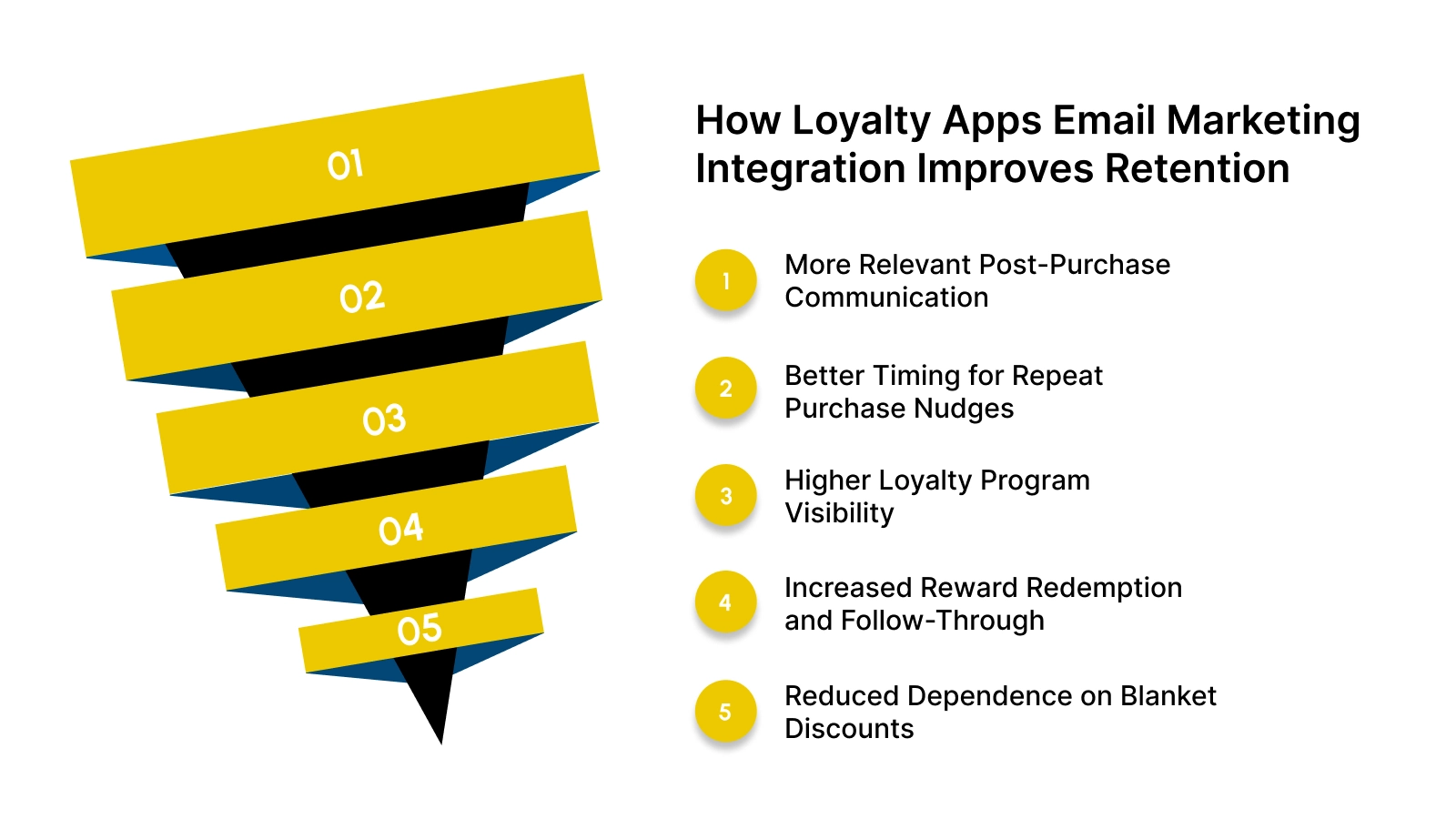
1. More Relevant Post-Purchase Communication
Emails triggered by loyalty activity feel personal because they reflect what the customer has already done. Reward reminders, point updates, and milestone nudges reinforce value after a purchase instead of pushing another generic promotion.
2. Better Timing for Repeat Purchase Nudges
Loyalty signals help emails arrive when customers are most likely to act. A redemption reminder or progress update sent at the right moment performs far better than calendar-based campaigns that ignore buying intent.
3. Higher Loyalty Program Visibility
Most loyalty programs fail because customers forget they exist. Email keeps loyalty visible beyond widgets and dashboards, reminding customers of points, tiers, and rewards without requiring them to seek that information out.
4. Increased Reward Redemption and Follow-Through
When customers are clearly shown what they’ve earned and how to use it, rewards stop sitting unused. Redemption-driven emails guide customers back to the store with a clear next step, improving repeat purchase rates.
5. Reduced Dependence on Blanket Discounts
Integrated loyalty and email workflows allow you to lead with earned value instead of constant price cuts. This protects margins while still giving customers a reason to return.
Nector connects your loyalty data to the email tools you already use, like Klaviyo, HubSpot, or Mailchimp. Points, tiers, and rewards can then show up in the emails customers actually read, not just inside a loyalty widget.

9 Workflows You Can Power With Loyalty Apps Email Marketing Integration
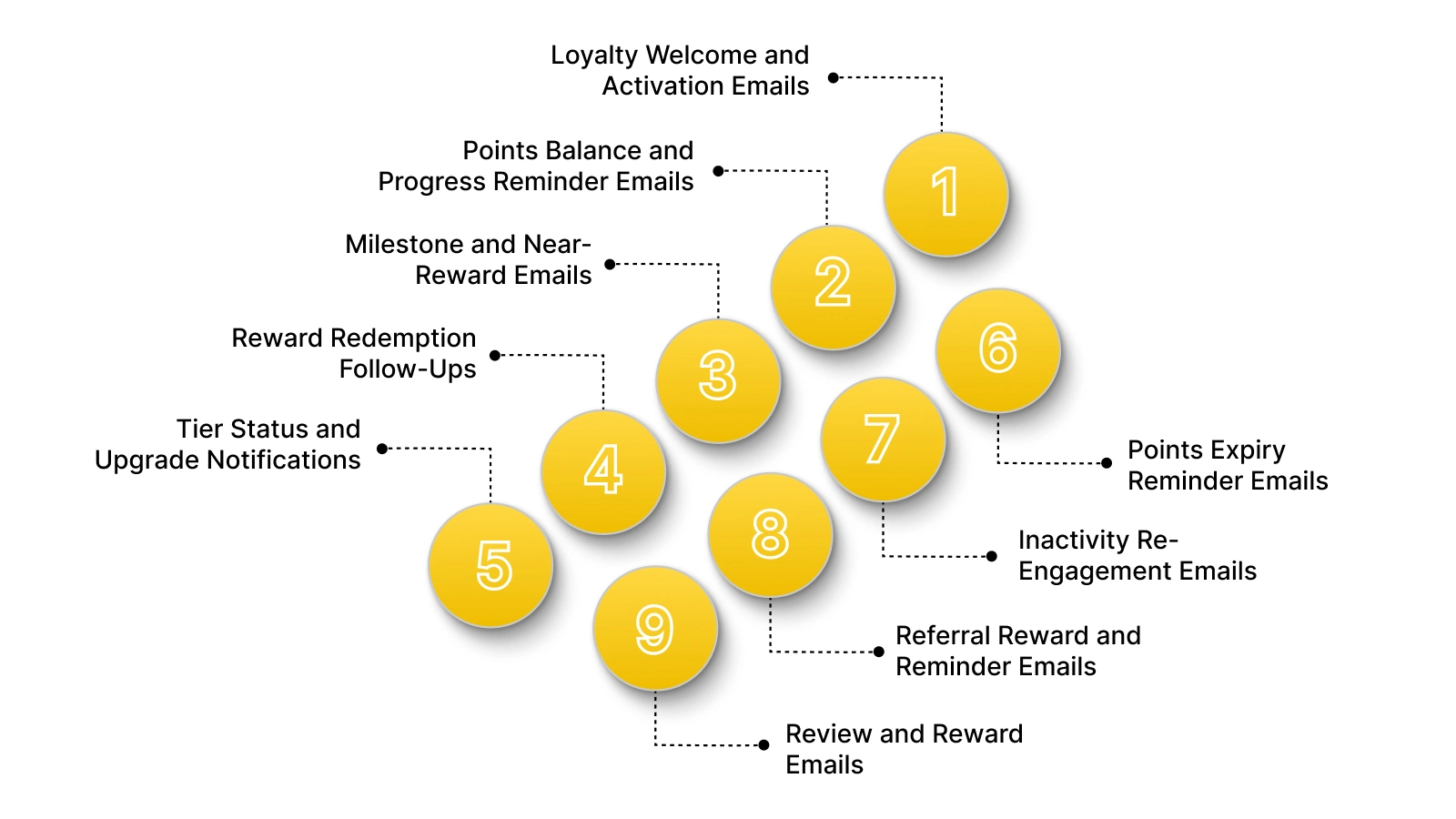
When loyalty data flows into your email platform, you can move beyond generic campaigns and trigger emails based on real engagement. These workflows help reinforce value, guide the next purchase, and keep loyalty top of mind without increasing send volume.
Below are high-impact email types made possible by loyalty app and email marketing integration.
1. Loyalty Welcome and Activation Emails
Triggered when a customer joins the loyalty program, these emails explain how the program works, how points are earned, and what the first reward looks like. They reduce early inactivity by setting clear expectations and highlighting immediate value.
Best used when: You want to reduce early loyalty drop-off after signup and make the value clear from day one.
Example: “Welcome to our rewards program. You’ve already earned 100 points on your first purchase. Earn points on every order and redeem them for rewards you’ll actually use.”
2. Points Balance and Progress Reminder Emails
Triggered after a purchase or loyalty action, these emails remind customers how many points they’ve earned and how close they are to a reward. They work because they turn abstract points into visible progress.
Best used when: You want to reinforce momentum immediately after a purchase instead of pushing another promotion.
Example: “Thanks for your order. You now have 350 points. Just 150 more and you can unlock your next reward.”
3. Milestone and Near-Reward Emails
When customers approach a reward threshold or tier upgrade, milestone emails highlight what’s within reach. This creates momentum and nudges customers to complete the next purchase to unlock value.
Best used when: Customers are close to unlocking value and need a small nudge to return.
Example: “You’re one order away from unlocking your next reward. Complete your purchase, and it’s yours.”
4. Reward Redemption Follow-Ups
After a customer redeems a reward, follow-up emails reinforce what they’ve unlocked and guide them toward their next order. This helps close the loop between redemption and repeat purchase.
Best used when: You want to ensure redemptions lead to another order, not a dead end.
Example: “Your reward has been applied to your account. Use it on your next purchase before it expires.”
5. Tier Status and Upgrade Notifications
Tier-based emails inform customers when they enter a new tier or show what benefits they’re close to unlocking. Clear tier communication keeps loyalty progression visible and reduces stagnation.
Best used when: You want to sustain long-term engagement and prevent tier stagnation.
Example: “You’ve unlocked Gold status. Enjoy exclusive benefits on every order as part of your new tier.”
6. Points Expiry Reminder Emails
When points are nearing expiration, reminder emails create urgency without relying on discounts. They prompt customers to redeem earned value before it’s lost, increasing both redemption rates and repeat purchases.
Best used when: You want to prompt redemption and repeat purchases by reminding customers that earned rewards will expire if not used within a clear timeframe.
Example: “You have points expiring in 7 days. Redeem them now and don’t let your rewards go unused.”
7. Inactivity Re-Engagement Emails
Loyalty inactivity signals can trigger re-engagement emails that remind customers of unused points, available rewards, or pending milestones. These emails feel relevant because they’re tied to loyalty behavior, not guesswork.
Best used when: A loyalty member has stopped engaging but hasn’t fully churned, making them more receptive to reminders of value they’ve already earned.
Example: “You still have rewards waiting for you. Pick up where you left off and use your points on your next order.”
8. Referral Reward and Reminder Emails
Referral-based emails notify customers when referrals are successful or remind them to redeem earned rewards. This turns advocacy into a repeat purchase driver instead of a one-time action.
Best used when: A referral has just converted, or a referrer has unredeemed rewards waiting.
Example: “Your friend just placed their first order. Your referral reward is now available to use.”
9. Review and Reward Emails
Post-delivery emails that reward reviews with loyalty points encourage participation while reinforcing trust. These emails strengthen engagement without relying on discounts.
Best used when: The customer has had enough time to experience the product and is most likely to leave thoughtful feedback in exchange for a clear reward.
Example: “Tell us what you think about your order. Earn loyalty points when you leave a quick review.”
Now that you’ve seen what’s possible, here’s how to set up loyalty and email integration in a way that actually works.
How to Set Up Loyalty Apps Email Marketing Integration (Step-by-Step)
Integrating loyalty apps with email marketing doesn’t require complex automation or heavy engineering. What matters is setting up the right signals, mapping them to meaningful communication, and reviewing performance regularly.
Here’s a simple, practical way to do it.
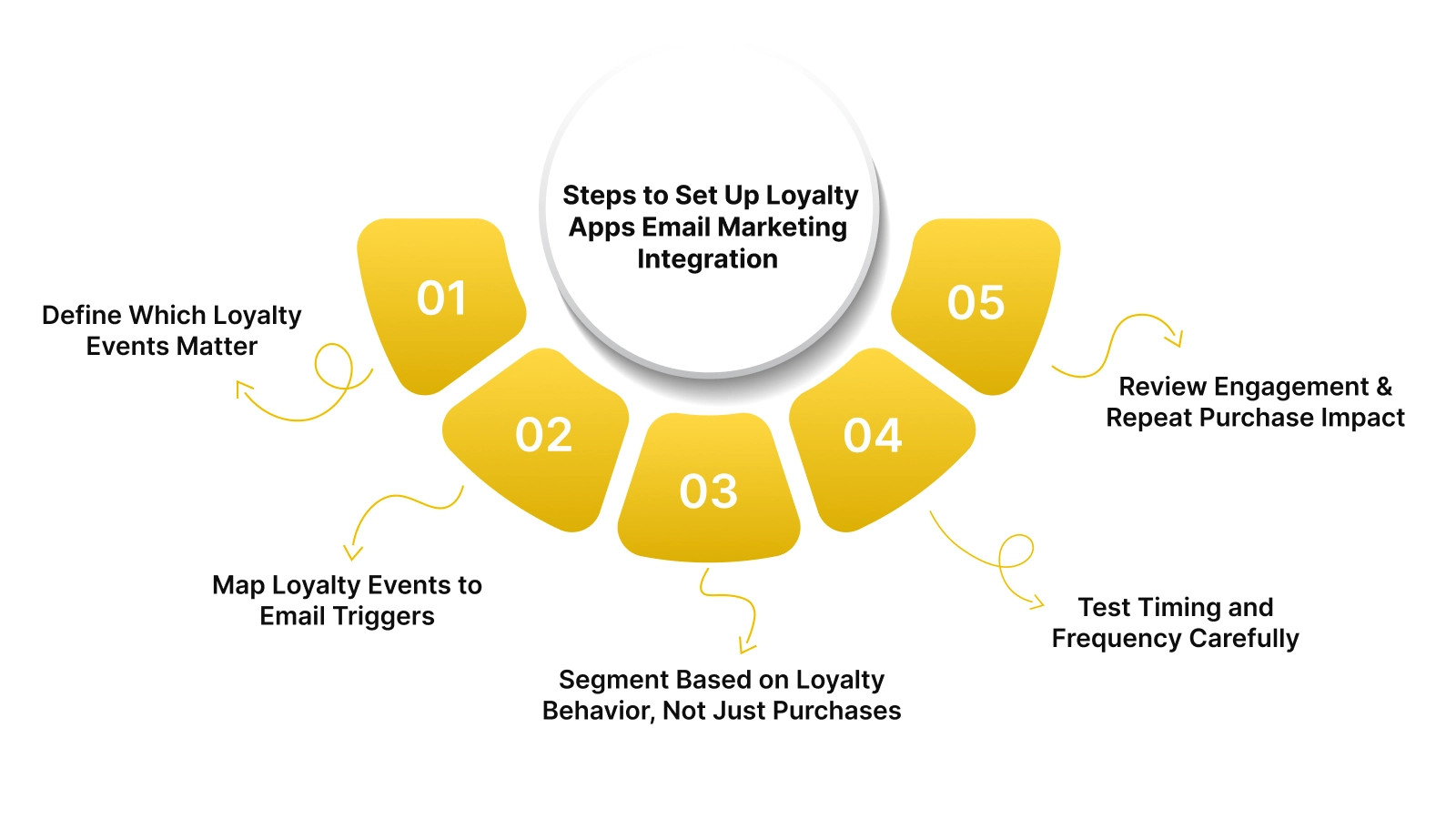
1. Define Which Loyalty Events Matter
Start by identifying loyalty actions that signal real intent. Not every in
teraction needs an email. Focus on events that indicate progress, urgency, or disengagement.
Events worth tracking include:
- Points earned after a purchase: Signals active engagement and momentum that can be reinforced with progress or reminder emails.
- Near-reward or milestone thresholds: Indicates customers are close to unlocking value and are primed for a return purchase nudge.
- Reward redemptions: Shows high intent and creates an opportunity to guide the next order.
- Loyalty inactivity over a defined period: Highlights early disengagement that can be addressed before full churn sets in.
This keeps email workflows tied to meaningful behavior rather than noise.
2. Map Loyalty Events to Email Triggers
Once key events are defined, map each one to a specific email workflow. Loyalty-driven emails should be triggered automatically and tied to a clear next action.
Common event-to-email mappings include:
- Near-reward events: Trigger milestone reminder emails that highlight what the customer is close to unlocking and what action completes it.
- Reward redemptions: Trigger follow-up purchase emails that guide customers toward their next order.
- Tier upgrades: Trigger status and benefit notifications that reinforce recognition and encourage continued engagement.
This ensures emails respond to customer behavior in real time.
3. Segment Based on Loyalty Behavior, Not Just Purchases
Purchase history alone doesn’t capture loyalty engagement. Segment customers based on how they interact with your loyalty program.
Useful loyalty-based segments include:
- Active earners who haven’t redeemed: Customers accumulating points but not converting them into rewards, often due to unclear value or high thresholds.
- Members with unused or expiring points: Customers with earned value at risk of being lost, making them strong candidates for redemption reminders.
- Tiered members with stalled progression: Customers stuck in the same tier who may need clearer progression or achievable milestones.
- Recently inactive loyalty members: Members who have stopped earning or redeeming points but may still be responsive to re-engagement prompts.
Behavior-based segmentation makes emails more relevant and effective.
4. Test Timing and Frequency Carefully
The impact of loyalty-triggered emails depends heavily on when and how often they are sent. Test different timing windows and spacing to avoid over-messaging.
Key timing questions to test:
- How soon after a loyalty event is the email sent? This tests immediate versus delayed sends to see when customers are most likely to engage and act.
- Whether immediate or delayed reminders perform better. Compares performance across short delays to find the optimal balance between urgency and relevance.
- How many loyalty-triggered emails do customers receive per month? This monitors frequency to reinforce value without causing fatigue or disengagement.
Small adjustments here can significantly affect engagement.
5. Review Engagement and Repeat Purchase Impact
Finally, evaluate performance based on retention outcomes, not just email metrics. Loyalty, email integration should improve engagement and buying behavior over time.
Metrics worth reviewing include:
- Reward redemption following emails: Indicates whether loyalty-triggered emails successfully prompt customers to use earned rewards.
- Time to next purchase: Shows how effectively emails shorten the gap between loyalty engagement and repeat buying.
- Changes in loyalty engagement trends: Highlights whether email-driven interventions are improving earning, redemption, or progression over time.
Use these insights to refine triggers, messaging, and frequency as customer behavior evolves.
Also read: Top 10 Brand Loyalty Tools for Post-Purchase Experience
What Breaks When Loyalty and Email Aren’t Aligned
Even strong loyalty programs underperform when email integration is handled poorly. The mistakes below are common, subtle, and often responsible for loyalty-driven emails failing to move retention metrics.
- Treating loyalty as just another email property: Passing loyalty data into an email tool as a static field strips it of context. Loyalty signals are dynamic and should drive behavior-based triggers, not just personalization tokens.
- Sending static campaigns instead of trigger-based flows: Batch loyalty emails ignore timing and intent. When emails aren’t tied to specific loyalty events, they arrive disconnected from customer behavior and lose impact.
- Over-rewarding through email discounts instead of loyalty value: Using discounts in place of earned rewards weakens the loyalty program. Customers begin to wait for promotions instead of engaging with points, tiers, or progression.
- Not aligning redemption with purchase intent: Reward redemptions that lack a clear next step often end the journey. Without guiding customers back to purchase, redeemed value fails to translate into repeat revenue.
Most of these issues don’t come from strategy gaps. They come from tools that don’t surface loyalty signals clearly or make them easy to act on in email. Solving this consistently requires a loyalty system designed to integrate deeply with email workflows.
How Nector Powers Loyalty-Driven Email Marketing
Nector is built to make loyalty data immediately usable inside your email and messaging tools. Instead of treating loyalty as a passive add-on, Nector turns points, tiers, rewards, and milestones into live engagement signals that can power personalized email and WhatsApp workflows across your marketing stack.
By syncing loyalty events in real time, Nector helps teams move from generic campaigns to behavior-led retention communication.
What this looks like in practice:
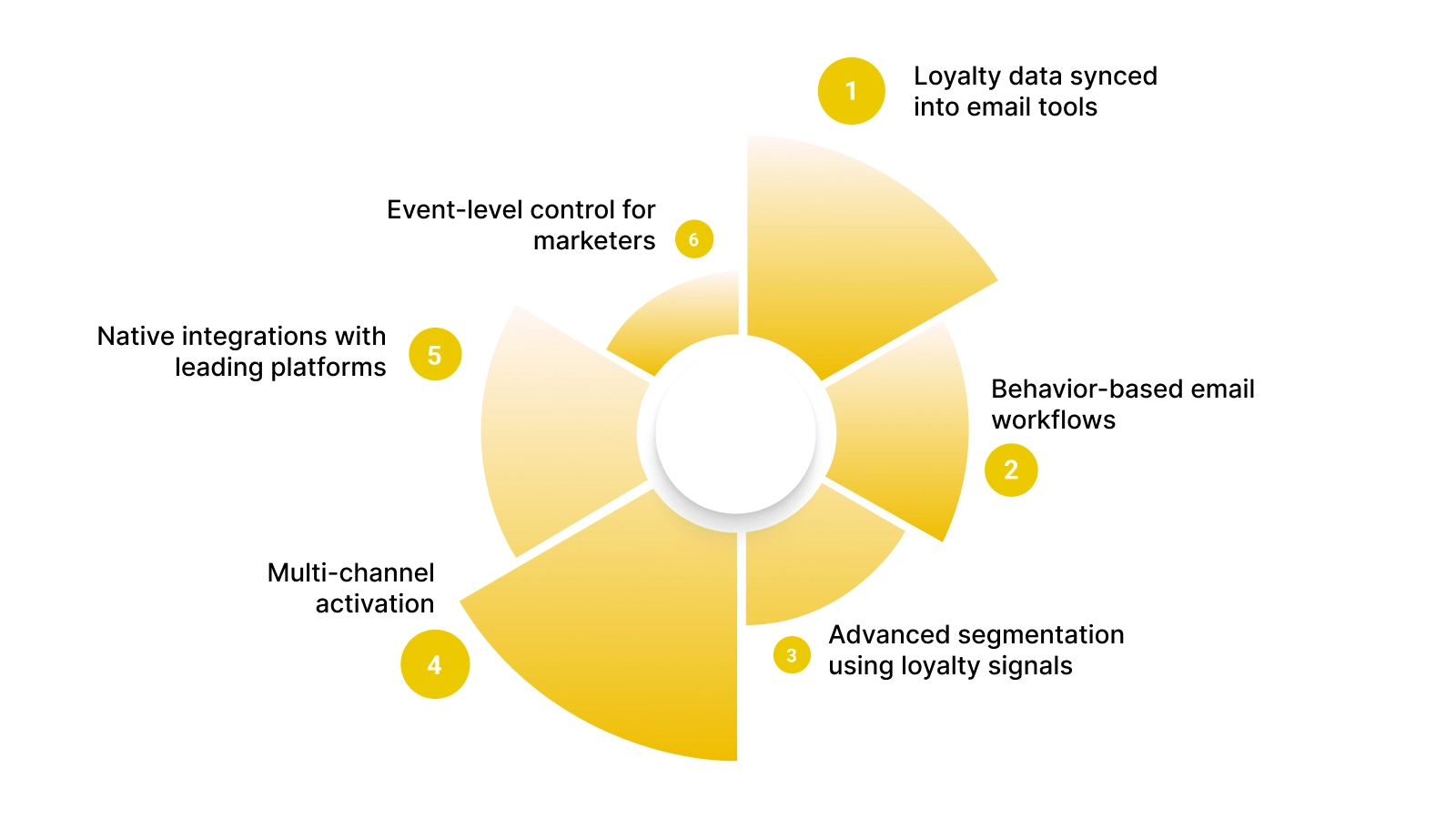
- Loyalty data synced into email tools: Points earned, tier status, reward eligibility, and milestones are available as usable attributes and triggers.
- Behavior-based email workflows: Trigger emails based on loyalty actions like near-reward thresholds, redemptions, inactivity, or tier upgrades.
- Advanced segmentation using loyalty signals: Segment customers by points balance, tier level, earning activity, or redemption behavior instead of relying only on purchase history.
- Multi-channel activation: Use the same loyalty signals across email and WhatsApp to reinforce value at the right moments.
- Native integrations with leading platforms: Works seamlessly with tools like HubSpot, Klaviyo, Mailchimp, Omnisend, MoEngage, Netcore, CleverTap, WebEngage, Contlo, Growlytics, and more.
- Event-level control for marketers: Loyalty events can be sent directly into your engagement platform, making it easy to test, refine, and scale workflows without engineering dependency.
When loyalty signals are activated through email and messaging, they stop being background data and start shaping buying behavior. Nector makes it easier to operationalize these signals across your existing tools without adding manual complexity.
Sign up for Nector to see how loyalty-driven email workflows can be set up in practice.
Final Thoughts
Loyalty apps and email marketing work best when they operate as one system, not parallel channels. Loyalty generates the intent signals, and email is how those signals are activated at the right moment.
When they’re disconnected, value gets lost. When they’re integrated, repeat purchases become easier to drive and easier to predict.
The difference comes down to execution.
Triggering emails from real loyalty behavior, aligning rewards with purchase intent, and avoiding discount-led shortcuts are what turn loyalty from a feature into a retention engine.
Nector is designed to make this execution practical, not theoretical, by turning loyalty behavior into usable email triggers across your marketing tools. Book a demo to see how it works with your current setup.
FAQs
What is loyalty apps email marketing integration?
Loyalty apps email marketing integration connects loyalty data like points, tiers, and rewards with your email platform so campaigns and workflows can be triggered based on real customer behavior, not just purchases.
Why should loyalty data be used in email marketing?
Loyalty data reveals intent, progress, and engagement. Using it in email helps brands send more relevant messages that drive repeat purchases instead of relying on generic promotions.
What types of emails can be sent using loyalty integration?
You can send loyalty welcome emails, points balance updates, near-reward reminders, tier notifications, reward redemption follow-ups, referral confirmations, review requests, and inactivity re-engagement emails.
How is this different from regular email segmentation?
Regular segmentation relies on static attributes like purchase history. Loyalty-based integration uses live signals such as earning, redemption, inactivity, and tier movement to trigger timely, behavior-led emails.
Do loyalty–email integrations replace discounts?
They reduce dependence on discounts by highlighting earned value like points, rewards, and status. This helps protect margins while still giving customers a clear reason to return.





Start Building Customer Retention That Lasts