

.avif)
.avif)
Ecommerce conversion is no longer just about getting more traffic to your store. With acquisition costs rising and competition increasing, the real challenge is making sure the visitors you already have actually move forward and buy.
Globally, the average ecommerce conversion rate sits around 2.95%, which means the vast majority of shoppers still leave without purchasing.
Most conversion issues don’t come from a single broken page. They come from small points of friction across the journey, unclear value propositions, slow checkouts, hidden costs, or weak post-purchase follow-through.
Fixing these gaps requires more than isolated tweaks.
This guide breaks down ecommerce conversion best practices that matter today, from reducing friction and building trust to optimizing checkout and post-purchase experiences.
At a glance:
- Ecommerce conversion is a journey, not a single event. True conversion performance depends on how well intent is protected across micro-conversions like add-to-cart, checkout completion, and post-purchase engagement, not just first orders.
- Conversion rate shows the outcome, micro-conversions show the problem. Metrics like add-to-cart rate, checkout completion, and time to first purchase reveal exactly where customers hesitate and where optimization actually matters.
- Checkout friction kills confirmed intent. Forced accounts, slow load times, limited payment options, and excess form fields block customers who have already decided to buy, making checkout speed and familiarity critical.
- Post-purchase moments drive the next conversion. Reinforcing value earned, setting clear expectations, and guiding the next action after the first order shortens the gap to repeat purchase and improves conversion quality.
- Sustainable conversion growth comes from alignment with retention. Optimizing for first purchases alone leads to discount dependence, while conversion flows designed around repeat buying improve revenue per visitor and long-term margins.
What Ecommerce Conversion Really Means Today
Ecommerce conversion is often reduced to a single number: how many visitors place an order. That definition is outdated. Conversion today reflects how smoothly customers move through the entire buying journey, not just whether they complete their first purchase.
Conversion includes a series of intent signals, often referred to as micro-conversions, such as:
- Add to cart: Shows product-level interest and pricing acceptance
- Checkout completion: Indicates reduced friction and payment confidence
- Account creation: Signals long-term intent and openness to re-engagement
Each of these actions reveals where customers hesitate or drop off.
Optimizing only product pages or ad performance ignores this broader picture. A high-converting PDP means little if customers abandon checkout or fail to return after their first order. Sustainable conversion improvement comes from optimizing the full path, from first click to completed purchase and beyond, so intent is protected at every step.
How to Measure Ecommerce Conversion
Conversion rate is the starting point for measuring ecommerce performance. It shows how effectively your store turns visitors into buyers. While it doesn’t explain why customers convert or drop off, it gives you a clear baseline to improve from.
How Ecommerce Conversion Rate Is Calculated
The basic formula is simple:
Conversion Rate = (Number of Orders ÷ Number of Sessions) × 100
This measures the percentage of visitors who complete a purchase during a given period.
Example
If your store receives 10,000 sessions in a month and generates 250 orders, your conversion rate is:
250 ÷ 10,000 × 100 = 2.5%
This means 2.5 out of every 100 visitors complete a purchase.
It’s important to note that the conversion rate shows the outcome, not the journey. It doesn’t tell you whether customers dropped off at the product page, abandoned checkout, or hesitated after their first purchase. That’s where tracking micro-conversions like add-to-cart rate, checkout completion, and repeat purchase behavior becomes essential.
Understanding conversion rate gives you the baseline. Optimizing it requires breaking the journey down into smaller signals, which is where effective conversion best practices come into play.
Also read: Ecommerce Conversion Rate Benchmarks in 2025-26
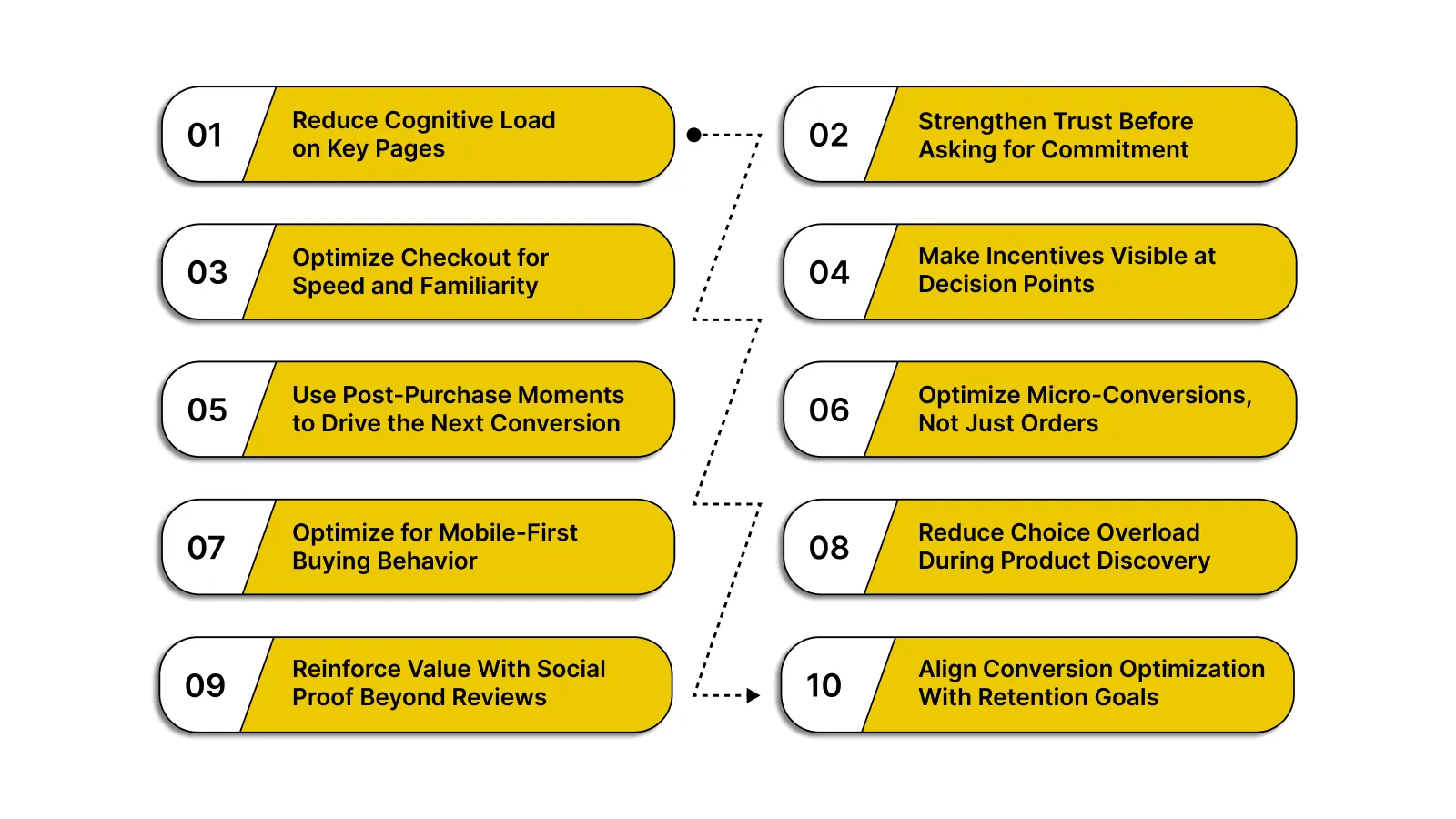
10 Best Practices to Improve Ecommerce Conversion
Improving ecommerce conversion isn’t about chasing quick wins or copying isolated tactics. It’s about identifying where customers hesitate and removing friction at the moments that matter most.
The best practices below focus on protecting intent across the buying journey, from product discovery to checkout and beyond.
1. Reduce Cognitive Load on Key Pages
Customers hesitate when they have to evaluate too many options or figure out what to do next. Every extra decision increases mental effort, which slows momentum and increases drop-offs, especially on product and cart pages.
How to apply this:
- One primary CTA per page: Guide customers toward a single clear action instead of competing buttons that split attention.
- Clear value proposition above the fold: Explain who the product is for and why it’s worth buying before customers scroll or compare.
- Limit on-page distractions: Remove banners, pop-ups, or links that interrupt the decision flow during high-intent moments.
Result: Customers move forward faster with less hesitation, increasing progression from product view to cart.
2. Strengthen Trust Before Asking for Commitment
Customers don’t abandon carts because they dislike the product. They abandon because they’re unsure. Concerns about quality, delivery timelines, or return policies often surface right before checkout.
How to apply this:
- Visible reviews near CTAs: Place social proof close to the “Add to Cart” or “Buy Now” button to reinforce confidence at the decision point.
- Clear shipping and return information: Set expectations early so customers don’t have to search for reassurance later.
- Consistent brand signals: Ensure product imagery, copy, and design feel coherent and credible across the journey.
Result: Lower hesitation and fewer trust-related drop-offs during checkout.
3. Optimize Checkout for Speed and Familiarity
Once customers reach checkout, they’ve already decided to buy. At this stage, friction doesn’t change intent, it blocks it. Checkout should feel quick, predictable, and familiar.
How to apply this:
- Guest checkout by default: Let customers complete purchases without committing to an account.
- Multiple payment options: Support the methods customers already trust to avoid last-minute exits.
- Minimal form fields: Remove non-essential inputs that slow completion or cause frustration.
Result: Higher checkout completion rates and reduced abandonment at the most critical step.
4. Make Incentives Visible at Decision Points
Incentives influence conversion only when they’re visible at the exact moment a customer is deciding whether to proceed. Rewards that are hidden, delayed, or unclear don’t change behavior and often go unnoticed entirely.
How to apply this:
- Show benefits on PDPs and cart: Clearly highlight what customers gain by purchasing now, such as points, rewards, or future benefits.
- Reinforce incentives at checkout: Remind customers of the value they’re about to earn when intent is highest, and hesitation is lowest.
- Tie incentives to actions: Explain exactly what triggers the reward so customers understand the connection between action and benefit.
Result: Higher motivation to complete purchases without increasing reliance on heavy or repeated discounts.
5. Use Post-Purchase Moments to Drive the Next Conversion
The first purchase creates trust, but the post-purchase experience determines whether that trust turns into a repeat order. This stage is often underused, despite being one of the highest-intent moments in the customer journey.
How to apply this:
- Clear confirmation and next steps: Set expectations around delivery, support, and what happens next to reduce uncertainty.
- Reinforce value earned: Highlight rewards, progress, or benefits gained from the order to create momentum.
- Prompt the next action: Guide customers toward reviews, referrals, or a follow-up purchase while engagement is still high.
Result: A shorter gap between the first and second purchase and stronger repeat conversion rates.
Nector helps brands reinforce value after checkout by surfacing rewards, points, and progress across thank-you pages and follow-up messages, giving customers a clear reason to come back.

6. Measure and Optimize Micro-Conversions, Not Just Orders
Orders are the final outcome, but they don’t explain where customers struggle. Micro-conversions reveal how intent builds and where it breaks down across the journey.
How to apply this:
- Track add-to-cart and checkout rates: Identify specific stages where customers drop off.
- Segment by device and traffic source: Conversion behavior often differs significantly by context.
- Test changes in isolation: Adjust one element at a time to understand what actually improves performance.
Result: More focused optimization efforts and consistent, sustainable conversion improvements.
7. Optimize for Mobile-First Buying Behavior
A large share of ecommerce traffic comes from mobile, but many stores still design for desktop first. Small mobile frictions compound quickly and lead to silent conversion loss.
How to apply this:
- Simplify mobile layouts: Reduce clutter and prioritize essential information above the fold.
- Ensure tap-friendly interactions: Buttons, CTAs, and form fields should be easy to tap without zooming.
- Minimize mobile load time: Compress images and remove unnecessary scripts that slow down pages.
Result: Higher conversion rates on mobile traffic and fewer drop-offs caused by usability issues.
8. Reduce Choice Overload During Product Discovery
Too many options can stall decision-making. When customers feel overwhelmed, they delay purchases or leave to “decide later,” which often means not returning.
How to apply this:
- Guide customers with recommendations: Use best-sellers, “most loved,” or curated collections.
- Limit visible variants initially: Show key options first and expand only when needed.
- Use filters thoughtfully: Make it easy to narrow choices without forcing complex decisions.
Result: Faster product selection and higher progression from browsing to add-to-cart.
9. Reinforce Value With Social Proof Beyond Reviews
Reviews matter, but they’re not the only trust signal customers look for. Seeing how others buy, use, or repurchase your products reinforces confidence.
How to apply this:
- Highlight popularity signals: Show “X people bought this recently” or similar indicators.
- Surface user-generated content: Display real customer photos or usage examples where possible.
- Show repeat behavior subtly: Signals like “frequently reordered” reinforce product reliability.
Result: Stronger confidence at decision points and improved conversion without additional incentives.
10. Align Conversion Optimization With Retention Goals
Conversion improvements shouldn’t come at the cost of long-term value. Optimizing only for the first purchase can increase short-term sales while hurting repeat behavior.
How to apply this:
- Avoid aggressive one-time discounts: Focus on incentives that encourage return visits.
- Capture signals for future engagement: Use account creation, rewards, or preferences thoughtfully.
- Design conversion flows with repeat buying in mind: Reinforce what customers gain by staying engaged.
Result: Higher-quality conversions that lead to stronger retention and long-term revenue.
These best practices work because they directly impact how customers move through your store. Here’s why optimizing conversion rates matters beyond short-term wins.
Why Ecommerce Conversion Rate Optimization Matters
Conversion Rate Optimization (CRO) isn’t about squeezing more orders out of the same pages. It’s about making sure the intent you’ve already paid for doesn’t get wasted. As acquisition costs rise, improving conversion becomes one of the most reliable ways to grow without increasing spend.
1. It Compounds Revenue From Existing Demand
Every visitor who lands on your store already represents paid or earned intent. CRO ensures that this intent is converted more efficiently instead of being lost to friction, confusion, or hesitation. Even small improvements at high-traffic touchpoints compound into meaningful revenue gains over time.
2. It Reduces the Cost of Growth
When conversion rates improve, you don’t need to scale traffic at the same pace to grow revenue. This reduces dependency on paid acquisition and makes growth less volatile, especially during periods of rising CPMs and lower ad efficiency.
3. It Improves the First-to-Second Purchase Transition
Most ecommerce drop-off happens after the first order. CRO helps reduce this gap by improving post-purchase clarity, reinforcing trust, and removing friction from repeat buying. Faster repeat purchases directly increase customer lifetime value without additional acquisition spend.
4. It Protects Margins by Reducing Discount Dependence
Poor conversion often leads brands to rely on discounts to force purchases. CRO addresses the underlying issues instead, such as unclear value propositions, weak trust signals, or poor checkout experiences. This allows teams to improve results without eroding margins.
5. It Makes Growth Bottlenecks Visible and Actionable
CRO forces teams to look closely at where customers hesitate or abandon, whether that’s at product discovery, checkout, or post-purchase engagement. These insights help prioritize fixes that have the highest impact instead of guessing where problems exist.
When conversion improves across key touchpoints, growth becomes more predictable. Instead of chasing traffic spikes, teams build systems that consistently turn interest into revenue.
Also read: 5 Stages of the eCommerce Conversion Funnel (With Tracking Methods)
Additional Metrics to Track Alongside Conversion Rate
Conversion rate shows what happened, but it rarely explains why. To understand where intent is building or breaking, these supporting metrics give the context that conversion rate alone can’t.

1. Add-to-Cart Rate
This metric shows how many visitors move from browsing to intent. A low add-to-cart rate usually signals issues with pricing clarity, product presentation, or perceived value.
Tracking this helps you diagnose whether problems start at discovery or later in the funnel.
2. Cart-to-Checkout Rate
Cart views indicate interest, but checkout initiation reflects seriousness. Drops here often point to unexpected costs, shipping friction, or trust concerns.
Monitoring this metric highlights whether hesitation appears before customers even attempt payment.
3. Checkout Completion Rate
This measures how many customers who start checkout actually finish it. It’s one of the most sensitive indicators of friction.
Low completion rates often stem from forced account creation, limited payment options, or overly complex forms.
4. Time to First Purchase
This shows how long it takes a new visitor to convert. Longer times can indicate uncertainty, comparison behavior, or unclear value propositions.
Reducing this metric often improves overall conversion efficiency and lowers reliance on remarketing.
5. First-to-Second Purchase Conversion Rate
This metric reveals whether initial conversions lead to repeat behavior. It’s critical for understanding conversion quality, not just quantity.
A strong first-purchase conversion paired with weak repeat conversion usually signals post-purchase gaps.
6. Average Order Value (AOV)
While not a conversion metric by itself, AOV shows whether customers feel confident enough to buy more per order.
Tracking AOV alongside conversion rate helps ensure optimization isn’t driving low-value transactions.
7. Revenue Per Visitor (RPV)
RPV combines conversion rate and order value into a single metric. It reflects how efficiently traffic turns into revenue.
This is especially useful when testing changes that affect both conversion and basket size.
No single metric tells the full story. Conversion rate explains outcomes, while these metrics explain behavior. When tracked together, they reveal where to focus optimization efforts and which changes actually improve buying momentum.
How Nector Helps Ecommerce Brands Improve Conversion and Retention
Nector is a loyalty, rewards, referral, and reviews platform designed to help ecommerce brands boost customer retention and repeat purchases while making loyalty a seamless part of the shopping experience. Trusted by over 1,000+ brands, Nector helps stores turn first-time buyers into loyal repeat customers with minimal setup and deep customization.
Key Features:
- Boost repeat sales with loyalty and rewards: Nector’s gamified loyalty programs increase repeat purchases and engagement by rewarding customers for meaningful actions.
- Seamless loyalty, referral, and review stack: Everything from points and referral rewards to review incentives works together to increase trust and repeat purchasing.
- Effortless point redemption: Customers can redeem points via widgets, reward pages, or at checkout, making rewards tangible and conversion-friendly.
- Automated engagement tools: Trigger emails and prompts based on customer behavior to reduce drop-offs and drive repeat activity.
- Analytics that drive growth: Nector provides insights into loyalty program performance, helping teams identify conversion and retention opportunities.
- Integrations with supporting platforms: Sync loyalty data with CRM, email marketing, WhatsApp, and checkout tools to make rewards actionable across your stack.
- Fully customizable experience: Tailor rewards, rules, and user flows to match your brand’s look and value proposition.
Nector’s blend of loyalty mechanics, referral incentives, and automated engagement tools helps ecommerce brands not only convert more visitors into customers but also encourage those customers to come back and buy again. Sign up to get started.
Wrapping Up
Ecommerce conversion best practices work best when they’re applied across the full customer journey, not just at the point of purchase. Improving conversion today means reducing friction, building trust, reinforcing value at the right moments, and using post-purchase experiences to drive the next action. When these elements work together, conversion stops being a one-time win and starts compounding over time.
The brands that see consistent results focus on systems, not hacks. They track the right metrics, optimize micro-conversions, and design experiences that make it easier for customers to buy again.
If you want to improve conversion beyond the first order and turn more buyers into repeat customers, Nector helps you do that through loyalty, referrals, and reward visibility built directly into the shopping experience.
Book a demo to see how Nector can support your conversion and retention strategy.
FAQs
How can I improve my ecommerce conversion rate?
You can improve conversion by simplifying navigation, strengthening trust signals, optimizing checkout, making incentives visible, and tracking micro-conversions to identify where customers drop off.
Why is conversion rate optimization important for ecommerce?
Conversion rate optimization helps brands generate more revenue from existing traffic, reduce dependence on paid ads, and improve profitability without increasing acquisition spend.
What metrics should I track besides conversion rate?
Alongside conversion rate, track add-to-cart rate, checkout completion rate, average order value, time to first purchase, and first-to-second purchase conversion to understand buyer behavior.
How does mobile optimization affect ecommerce conversions?
Mobile optimization directly impacts conversions because small usability issues on mobile can cause significant drop-offs. Fast load times, clear CTAs, and simplified layouts are critical for mobile buyers.







Start Building Customer Retention That Lasts