

.avif)
.avif)
Customer retention is now a profit driver, not a marketing metric. Bain & Company reports that improving retention by just 5% can increase profits by 25% to 95%, yet most enterprises fail to realize this gain because their loyalty systems do not integrate properly.
This is where enterprise loyalty integration breaks.
This guide is for brands operating across multiple systems, regions, or channels. If your loyalty program relies on delayed syncs, manual workarounds, or disconnected tools, the issue is not loyalty strategy; it is integration.
Ahead, we break down the architecture, integration checklist, common failure points, and what effective enterprise loyalty looks like in 2026.
In a Nutshell:
- Integration over incentives: Loyalty fails at the system level, not the reward level.
- Real-time matters: Points, tiers, and redemptions must sync instantly across channels.
- Architecture choice is critical: Native, API-first, and headless models fit different enterprise needs.
- Checkout visibility drives adoption: If rewards don’t appear at checkout, they don’t get used.
- Loyalty is infrastructure: In 2026, it powers retention, personalization, and revenue reporting.
What Is Enterprise Loyalty Integration?
Enterprise loyalty integration is the process of connecting a loyalty program with an enterprise’s core systems: commerce, POS, CRM/CDP, marketing automation, and analytics. So rewards, customer data, and actions stay consistent everywhere.
It ensures customers can earn, redeem, and progress in real time, regardless of channel or location. Done right, loyalty becomes a shared data layer, not a disconnected tool.
How enterprise loyalty differs from SMB loyalty:
Example:
A customer earns points online. They redeem those points in-store the same day. Their tier updates instantly, triggering a CRM workflow that sends a personalized offer, without manual syncs or delays.
What sounds simple in theory becomes fragile at scale, and in 2026, enterprise loyalty integration is breaking more often than ever.
Why Enterprise Loyalty Integration Breaks (And Why 2026 Made It Worse)
On paper, enterprise loyalty looks straightforward. Earn points. Redeem rewards. Recognize loyal customers. In reality, this is where most enterprise teams hit friction—not because they lack intent, but because loyalty has to sit across systems that were never designed to talk to each other.
Here’s why enterprise loyalty integration breaks in the real world.
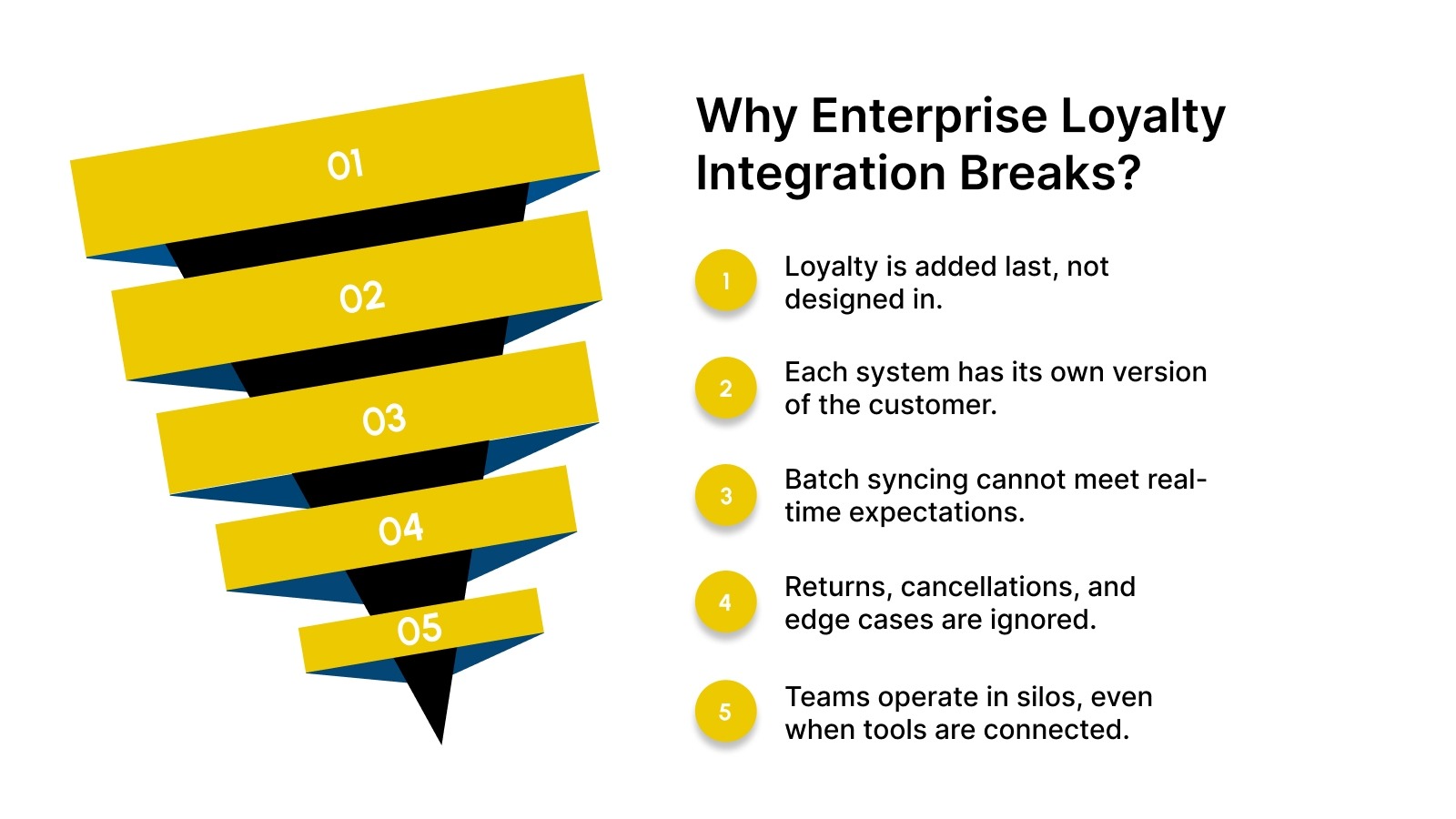
- Loyalty is added last, not designed in.
Most stacks were built around commerce, CRM, and analytics first. Loyalty gets bolted on later. That means it inherits every data gap, sync delay, and workaround already in place.
- Each system has its own version of the customer.
Ecommerce tracks emails. POS relies on phone numbers. CRM prefers internal IDs. Loyalty ends up guessing who the customer really is; and mistakes here show up as missing points, duplicate accounts, and frustrated support tickets.
- Batch syncing cannot meet real-time expectations.
Customers expect instant balances and redemptions. Enterprises still rely on delayed jobs and nightly syncs. The result? Rewards feel unreliable, and trust erodes quickly.
- Returns, cancellations, and edge cases are ignored.
Points are issued instantly, but reversals lag behind. Over time, balances become inflated, reporting becomes unreliable, and finance starts asking uncomfortable questions.
- Teams operate in silos, even when tools are connected.
CX teams manage loyalty rules. CRM teams run campaigns. Ecommerce owns checkout. When loyalty data does not flow cleanly between them, no one has the full picture, and optimization stalls.
What changes in 2026?
These problems are not easing up. They are accelerating.
In 2026, customers will expect instant, cross-channel loyalty recognition as a baseline, not a differentiator. Loyalty signals will increasingly power real-time personalization, not just rewards.
Enterprise teams will be pressured to prove incremental retention revenue, not vanity engagement metrics. And stacks will continue to grow more complex, not less.
The gap between loyalty programs that “exist” and those that actually work will widen fast.
Also Read: Enhance Customer Loyalty with Klaviyo Integration in 2025-26
To fix this, enterprises need to stop treating loyalty as a standalone program and start treating it as infrastructure.
The Enterprise Loyalty Integration Stack (What Must Connect)
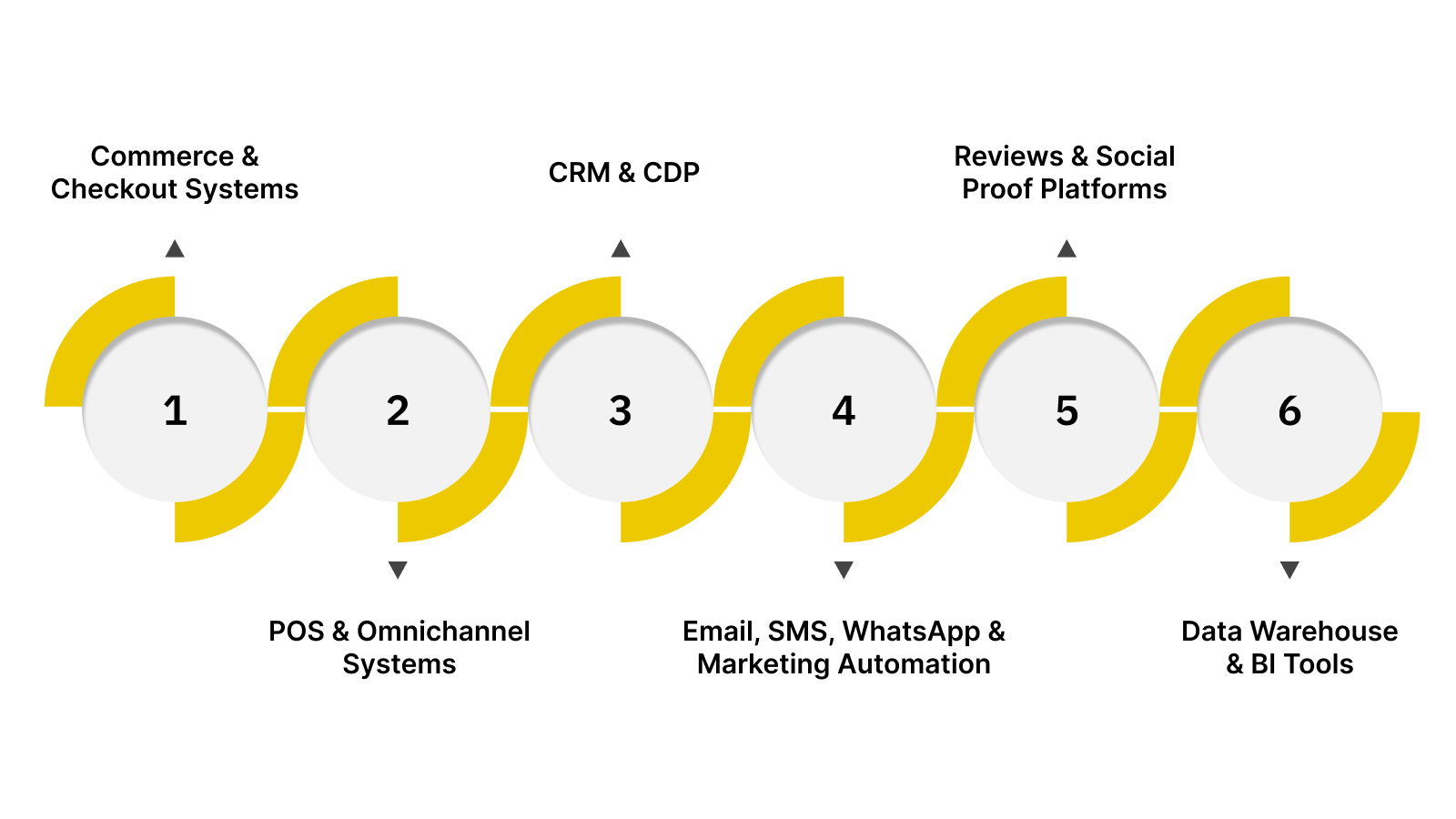
If loyalty is meant to influence retention, revenue, and customer experience, it cannot live in isolation. At the enterprise level, loyalty only works when it is deeply connected to the systems that already run your business.
This is the section most enterprise teams bookmark, because when even one layer is missing or loosely integrated, loyalty adoption drops fast.
Below is the minimum stack an enterprise loyalty program must connect to in 2026 to work reliably at scale.
Commerce & Checkout Systems
This is where loyalty becomes real for customers. If earning and redeeming points feels frictionless at checkout, adoption follows naturally.
- Points are earned on purchases, sign-ups, and key actions.
- Rewards and discounts are applied directly during checkout, not after.
- Customers can see the value of their points before they pay.
- Miss this layer, and loyalty stays invisible to most buyers.
Checkout-level integration is often the difference between a loyalty program that exists and one customers actually use.
When loyalty is integrated correctly, rewards appear directly at checkout, allowing customers to see and redeem points instantly, a flow supported by Nector to drive real usage.
POS & Omnichannel Systems
For omnichannel brands, loyalty must travel with the customer, not stop at the storefront.
- Customers earn and redeem rewards in-store and online without confusion.
- Points adjust correctly for returns, cancellations, and exchanges.
- Balances remain accurate across locations and regions.
- Store teams do not need manual overrides or workarounds.
When POS is disconnected, loyalty breaks trust first, and finance notices soon after.
Also Read: 9 Omnichannel Retention Strategies: How to Keep Customers Engaged Everywhere
CRM & CDP
This is where loyalty stops being a reward system and becomes a growth signal.
- Loyalty actions flow into customer profiles as behavioral data.
- Tiers, balances, and milestones inform segmentation.
- Campaigns are triggered based on loyalty status, not guesswork.
- High-value and at-risk customers are identified faster.
Without CRM or CDP integration, loyalty data stays trapped and underused.
Email, SMS, WhatsApp & Marketing Automation
Loyalty only works when customers are reminded why it matters, at the right moment.
- Expiry alerts nudge customers before rewards go unused.
- Tier progress updates motivate the next purchase.
- Referral and reward confirmations reinforce positive behavior.
- Win-back campaigns use loyalty context, not generic discounts.
Automation turns loyalty from a static program into an ongoing conversation.
Reviews & Social Proof Platforms
Trust fuels repeat purchases, and reviews are where trust compounds.
- Customers are rewarded for verified reviews, not spam.
- Different rewards can be applied to text vs. photo reviews.
- Review requests are automated post-purchase.
- Positive feedback feeds both conversion and retention loops.
When reviews connect to loyalty, social proof stops being passive and starts driving growth.
Data Warehouse & BI Tools
This is where leadership decides whether loyalty is working or wasting money.
- Loyalty-driven revenue is measured incrementally.
- Retention cohorts reveal long-term impact, not short-term spikes.
- Redemption economics stay transparent.
- CX, growth, and finance teams share the same numbers.
- If loyalty data never reaches your warehouse, ROI debates never end.
Also Read: 10 Best Customer Loyalty Software Platforms in 2026
3 Enterprise Loyalty Integration Architectures Used in 2026
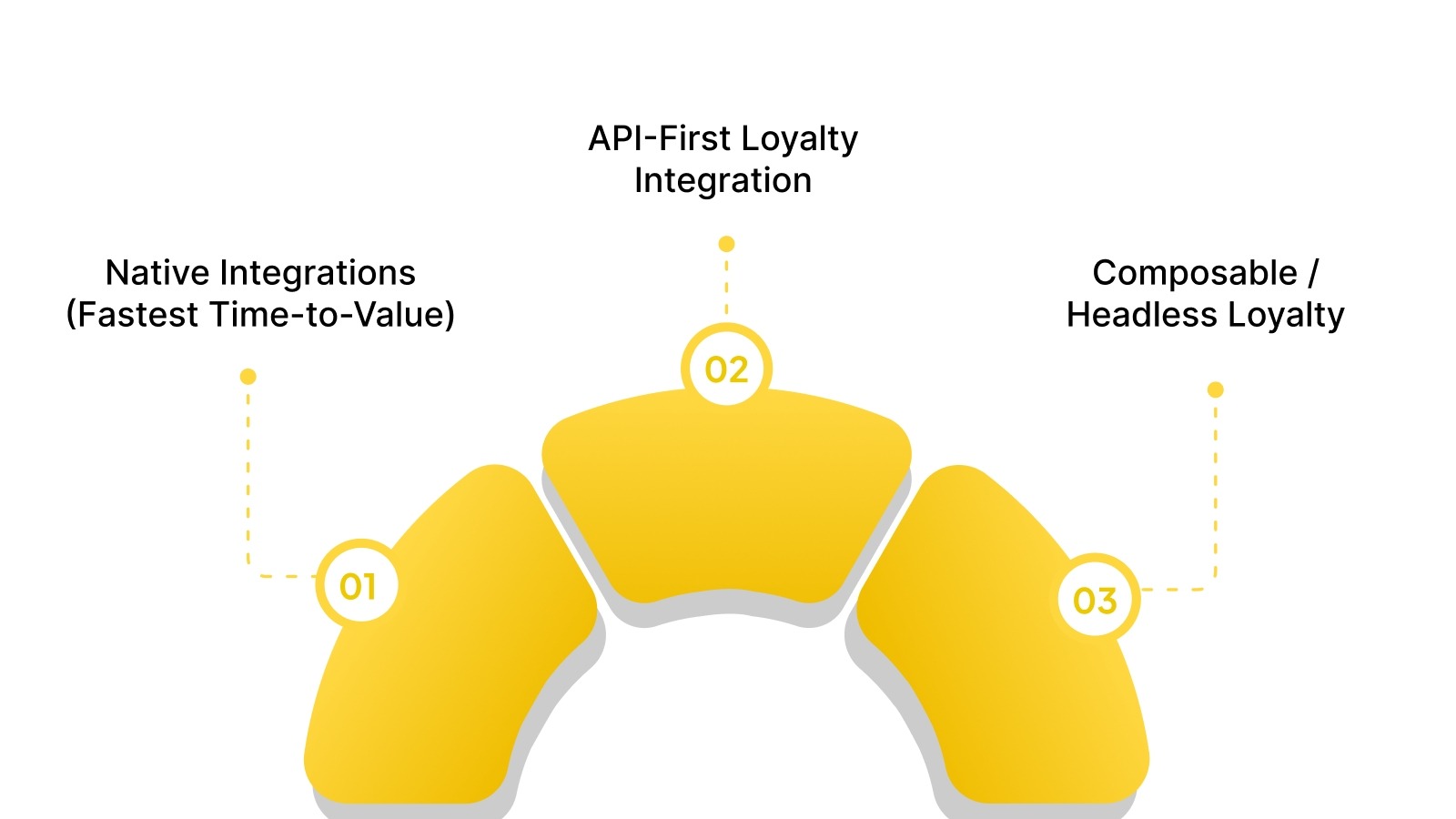
There is no single “best” way to integrate loyalty at the enterprise level. What works depends on how complex your stack is, how fast you need to move, and how much control your teams require.
In 2026, enterprise brands typically choose one of three loyalty integration architectures, each with clear strengths and trade-offs.
The key is selecting the model that fits your reality today, without limiting where you need to go next.
1. Native Integrations (Fastest Time-to-Value)
Native integrations are pre-built connections between a loyalty platform and commonly used enterprise tools. They are designed to reduce setup time and operational overhead.
How it works: Loyalty connects directly to your commerce, CRM, and marketing tools through maintained connectors.
When this works:
- Your stack is relatively standardized
- Speed to launch matters more than deep customization
- You want predictable behavior with minimal engineering effort
Where it breaks at scale:
- Limited flexibility for custom flows
- Slower to adapt to new channels or regional variations
- Dependency on vendor update cycles for changes
This model favors efficiency, but can feel restrictive as complexity grows.
2. API-First Loyalty Integration
API-first loyalty treats integration as a continuous data exchange rather than a fixed connection. Loyalty events move in real time across systems.
How it works: Loyalty actions are triggered and synced through APIs and webhooks.
Real-time events:
- Earn, redeem, tier changes, referrals, and reversals update instantly
- Customer-facing experiences stay consistent across touchpoints
Flexibility across channels:
- Works across web, mobile, POS, and emerging surfaces
- Supports region-specific logic without rebuilding the core
Why enterprises prefer this model:
- Greater control without full reinvention
- Easier to evolve as the stack changes
- Balanced ownership between product and engineering teams
This is the most common choice for enterprises scaling fast. API-first loyalty platforms like Nector are designed to sync earn, redeem, and tier events in real time, without locking teams into rigid workflows.
3. Composable / Headless Loyalty
Composable loyalty removes the UI from the equation and positions loyalty as an engine inside your architecture.
How it works: Loyalty logic runs independently while experiences are built by your frontend and data layers.
Loyalty as an engine, not a UI:
- Full control over earning, redemption, and tier logic
- Loyalty data feeds personalization, pricing, and CX systems
Best for complex stacks and global brands:
- Multi-brand, multi-region operations
- Heavy customization and governance requirements
- Teams with strong data and engineering maturity
This model maximizes flexibility, but requires clear ownership and alignment.
Each architecture serves a different stage of enterprise maturity. The right choice is not about sophistication, it is about fit, scalability, and how much change your organization is prepared to absorb.
Quick Checklist: Which Enterprise Loyalty Integration Model Fits You?
- Go with Native Integrations if speed matters most, your stack is standardized, and you want minimal engineering effort.
- Choose API-First Loyalty Integration if real-time updates, cross-channel flexibility, and scalable personalization are non-negotiable.
- Opt for Composable / Headless Loyalty if you run multiple brands or regions and need full control over logic, data, and customer experiences.
Sanity check before deciding:
If loyalty data must be real-time, feed CRM automation, and scale across channels, native integrations alone will not be enough.
Once the right loyalty programs are chosen, the next challenge is rolling them out in a way that drives CLV without overwhelming teams or breaking existing systems.
A Practical 30–60–90 Day Enterprise Rollout Plan
Enterprise loyalty succeeds when it is rolled out in phases. Trying to integrate everything at once slows teams down and increases risk. This 30–60–90 day plan keeps momentum high while ensuring loyalty is stable, measurable, and ready to scale.
Days 1–30: Foundation
The goal in the first month is to make loyalty reliable before making it visible.
- Define core loyalty rules: earning logic, redemption values, tiers, and expiry.
- Establish customer identity rules across systems.
- Connect core platforms: ecommerce, CRM/CDP, and marketing automation.
- Launch basic earn actions such as sign-up, purchase, and birthday rewards.
- Validate data flow and point accuracy before promoting the program.
At the end of this phase, loyalty should work quietly but correctly.
Days 31–60: Omnichannel & Automation
With a stable foundation, the focus shifts to adoption and engagement.
- Integrate POS for in-store earning, redemption, and returns.
- Introduce tier visuals and progress indicators to motivate repeat purchases.
- Launch referral programs with clear, trackable rewards.
- Automate review requests and reward verified feedback.
- Enable triggered communications like reward confirmations and expiry alerts.
This is where customers start noticing and using loyalty. At this stage, teams typically rely on a loyalty platform that can automate referrals, reviews, tier logic, and event-based messaging without manual effort.
Platforms like Nector are built to support this phase without adding operational load.
Days 61–90: Optimization & Scale
The final phase turns loyalty into a performance lever for the business.
- Segment customers using loyalty behavior and tier status.
- Launch win-back workflows for inactive or at-risk customers.
- Fine-tune earn and redemption rules based on early performance data.
- Roll out executive dashboards covering retention, redemption, and revenue impact.
- Align CX, growth, and finance teams on shared loyalty KPIs.
By day 90, loyalty is no longer a program. It is infrastructure.
This is where the right integration approach needs a platform that can actually support it.
How Nector Supports Enterprise Loyalty Integration
Enterprise loyalty usually breaks because teams try to stitch too many tools together. One system tracks points. Another handles CRM. Another sends messages. Over time, data drifts, rewards lag, and no one fully trusts the program. Nector is built to remove that friction by making loyalty work as one connected layer across your stack.
Nector’s enterprise loyalty setup works like this:
What you get in one place
- Loyalty programs that sync across ecommerce, POS, and customer profiles
- Real-time loyalty events that power CRM segmentation and automation
- Referral and review workflows that run automatically after purchases
- Tier progress and reward visibility that customers actually understand
- Analytics that show retention impact, redemption behavior, and loyalty-driven revenue
- Integrations with ecommerce, CRM, messaging, and analytics tools from a single dashboard
Conclusion
Enterprise loyalty does not break at the idea level. It breaks at the integration layer. When loyalty cannot move in real time across channels, systems, and teams, it stops influencing behavior and starts losing relevance.
In 2026, loyalty is becoming infrastructure. It is expected to power personalization, retention, and revenue decisions, not sit on the side as a standalone program. That shift rewards platforms built to integrate cleanly and scale without friction.
Nector is designed for this reality. It fits into modern enterprise stacks, keeps loyalty data consistent, and reduces operational load for teams managing complex systems.
If enterprise loyalty integration is on your roadmap, the foundation matters more than the features. Book a demo to see how Nector supports loyalty that actually works at scale.
FAQs
How long does enterprise loyalty integration take to show real impact?
Most enterprises achieve technical stability within 60–90 days. Meaningful retention gains appear once customers start redeeming rewards consistently, not just enrolling.
Why do customers join loyalty programs but rarely redeem rewards?
This usually signals integration gaps. Delayed balances, unclear redemption at checkout, or inconsistent experiences cause disengagement. Redemption issues are often system problems, not incentive problems.
Can enterprise loyalty integration work with an existing CRM or CDP?
Yes. Enterprise loyalty integration is designed to feed loyalty events into your current CRM or CDP, enhancing segmentation and automation without replacing core systems.
How do enterprises control loyalty fraud without hurting experience?
By using rule-based automation and controlled reward timing instead of manual reviews. This limits abuse while keeping the customer journey smooth.
What is the most common planning mistake enterprises make?
Treating loyalty as a campaign rather than infrastructure. Without early alignment across ecommerce, POS, CRM, and analytics, integration breaks down at scale.

Related Blogs
.webp)

%201.webp)

Start Building Customer Retention That Lasts