

.avif)
.avif)
You track repeat purchases and cohorts closely, yet revenue from existing customers still feels flat. Customers return, but many buy only during discounts, spend less over time, or never increase their order value. At the same time, acquisition costs keep rising, and true lifetime value remains out of reach.
While average ecommerce retention hovers at just 30%, top performers hit 62%, and 65% of revenue comes from repeat buyers. This gap explains why traditional metrics miss the mark.
Net Revenue Retention (NRR) shifts the focus from who comes back to how much value they generate over time. It shows whether your existing customers are actually contributing to growth.
In this guide, we will break down NRR vs customer retention, the key differences between them, and practical ways to improve both without adding operational complexity.
Key Takeaways
- Retention alone is misleading: E-commerce retention averages ~30%, but even high retention doesn’t ensure revenue growth.
- Repeat customers drive revenue: ~65% of revenue comes from existing customers, making them the core growth lever.
- NRR is the real growth signal: NRR >100% means your existing customers are increasing revenue; <100% means you’re losing value despite retention.
- Revenue ≠ repeat behavior: Customers can return frequently but still reduce AOV or buy only on discounts, hurting NRR.
- Best-performing brands combine both: Strong retention (up to ~62%) + high NRR is what separates stable stores from scalable ones.
What Is Customer Retention?
Customer retention measures how well your business keeps customers coming back over time. In e-commerce, this shows up as repeat purchases and returning users.
For example, if 100 customers buy from you and 40 return, your retention rate reflects how many stayed. At its core, retention answers a simple question: are customers coming back?
It indicates whether your product and experience deliver consistent value. However, it doesn’t explain why customers return. They may come back due to discounts, convenience, or habit, which is why retention is a starting point, not a complete measure of growth.
How to Calculate Customer Retention Rate
Customer Retention Rate = ((Customers at End − New Customers Acquired) ÷ Customers at Start) × 100
Example:
- Start: 100 customers
- End: 120 customers
- New customers: 40
Retention = ((120 − 40) ÷ 100) × 100 = 80%
Read further: Customer Retention Rate Formula: Calculation Steps + 6 Ways to Improve
What Is Net Revenue Retention (NRR)?
Net Revenue Retention (NRR) measures how much revenue you retain and grow from your existing customers over time.
Unlike customer retention, which focuses on whether customers return, NRR looks at how their spending changes. It accounts for increases in revenue from upsells and cross-sells, as well as losses from churn or reduced spending.
In simple terms, NRR answers one key question: Are your existing customers becoming more valuable over time?
As a benchmark, an NRR above 100% means your current customers are generating more revenue than before, indicating growth without relying on new acquisition. An NRR below 100% suggests that revenue loss from churn or lower spending is outweighing any gains.
Because of this, NRR is a critical metric for understanding whether your business is truly growing, especially in models driven by repeat purchases or ongoing customer relationships.
How to Calculate Net Revenue Retention (NRR)
NRR is calculated using the following formula:
NRR = (Starting Revenue + Expansion Revenue − Churned Revenue − Downgrade Revenue) ÷ Starting Revenue × 100
Example:
- Starting revenue: ₹1,00,000
- Expansion revenue: ₹20,000
- Churned revenue: ₹10,000
- Downgrade revenue: ₹5,000
NRR = (1,00,000 + 20,000 − 10,000 − 5,000) ÷ 1,00,000 × 100 = 105%
This means your existing customers generated 5% more revenue than before.
Also Read: How to Calculate and Reduce Ecommerce Churn Rate?

NRR vs Customer Retention: Key Differences
.webp)
At a surface level, both metrics focus on existing customers. But they answer very different questions about your business.
Customer retention tells you whether customers are coming back. NRR tells you whether those customers are generating more revenue over time.
This distinction becomes clearer when you look at how each metric behaves in real scenarios.
1. Customers vs Revenue
Customer retention measures how many customers continue to buy from you over a given period.
NRR measures how much revenue you retain and grow from those same customers, including increases from higher spending and losses from churn or reduced purchases.
In practice, this creates a gap.
A brand may retain a large percentage of customers, but if those customers:
- Spend less over time
- Purchase only during discounts
- Do not explore higher-value products
Then revenue does not grow.
Retention will look strong, but NRR will reveal whether your customer base is actually becoming more valuable.
2. Behavioral vs Financial Metric
Customer retention is a behavioral metric. It shows whether customers are returning and engaging with your brand again.
NRR is a financial metric. It reflects how customer behavior translates into revenue growth or decline.
This difference matters when evaluating performance. You might have high retention, which suggests customer satisfaction. But if revenue from those customers is not increasing, your business is not scaling.
NRR connects customer activity directly to financial outcomes, making it more relevant for growth decisions.
3. Does It Include Expansion?
Customer retention treats all returning customers equally.
It does not differentiate between:
- A customer who spends $500 repeatedly
- A customer who grows from $500 to $3,000 purchases
Both are counted the same.
NRR captures this difference by including:
- Upsells
- Cross-sells
- Increased purchase frequency
This makes NRR a better indicator of how customer relationships evolve over time.
4. Growth Insight
Customer retention helps you understand stability. It tells you whether your customer base is holding steady.
NRR provides insight into growth. It shows whether your existing customers can drive revenue expansion without relying on new acquisitions.
For example:
- If customers return but spend the same amount, your business remains stable
- If customers return and spend more, your business grows
This is why NRR is often used as a measure of sustainable growth.
5. Benchmark Differences
Retention metrics vary widely depending on industry, product type, and purchase frequency. A “good” retention rate in one category may not apply to another.
NRR is more standardized:
- Around 100% means you are maintaining revenue from existing customers
- Above 100% means your existing customers are driving growth
- Below 100% means revenue is declining
This makes NRR easier to interpret when assessing business performance.
Most brands already track retention. The harder part is influencing what happens after, getting customers to come back, spend more, and move beyond one-time purchases.
That usually doesn’t happen on its own. It needs a structured approach to loyalty, referrals, and post-purchase engagement. Nector helps you build that layer, so retention translates into real revenue growth. If you want to see how this would work for your brand, book a demo.
Now that the differences are clear, the next question is: should you track both?
Why High Retention Alone Still Leads to Flat Revenue
Many e-commerce brands focus heavily on retention and assume that if customers are coming back, the business is growing. In reality, that’s not always true.
Customers may return, but:
- They buy only during discounts
- Their average order value declines over time
- They don’t explore higher-value products
For example, a customer who previously spent $100 per order might now spend $60, even if they continue purchasing. Your retention rate stays stable, but your revenue quietly drops.
This creates a false sense of performance.
Retention shows that customers are staying, but it does not show whether they are becoming more valuable.
That’s where NRR becomes critical. It highlights whether your existing customer base is actually contributing to growth or simply maintaining activity.
For e-commerce brands, real growth happens when customers not only return, but also increase their spending over time.
Why You Need Both Retention and NRR to Scale Revenue
Many brands focus only on retention and miss a critical insight: retained customers don’t always mean growing revenue.
Here’s a common scenario:
- Customers return only during discounts
- Average order value declines
- Revenue stagnates despite good retention
Retention looks healthy, but the business isn’t scaling.
NRR solves this by showing whether your customers are:
- spending more over time
- upgrading their purchases
- increasing their value to your business
Together:
- retention = “Are they staying?”
- NRR = “Are they becoming more valuable?”
Both are essential for sustainable growth.
Also Read: Customer Churn vs Retention: Key Differences Explained
When to Track Retention vs NRR (Based on Your Growth Stage)
What you track depends on your goal. Retention helps you understand behavior and churn, while NRR shows if revenue from existing customers is actually growing.
Use Customer Retention When:
- You’re analyzing repeat purchase behavior
- You want to understand churn
- You’re improving customer experience
- you’re early-stage and focused on product-market fit
Retention is especially useful for founder-led e-commerce stores trying to validate demand.
Use NRR When:
- You want to measure revenue growth from existing customers
- You’re scaling and need predictable growth
- You have upsells, bundles, or repeat purchase cycles
- You want to reduce dependency on acquisition
NRR becomes more important as your business matures.
To act on these metrics, you need more than tracking, you need to influence them. Nector helps you boost both retention and NRR by rewarding repeat purchases and high-value behaviors, turning one-time buyers into loyal customers without relying on discounts. Book a demo to learn how.
How to Improve Customer Retention Without Killing Margins
Improving customer retention is less about pushing more offers and more about fixing gaps across the customer journey. In most e-commerce businesses, the drop-off doesn’t happen because customers didn’t like the product. It happens because the experience after the first purchase doesn’t give them a strong reason to return.
A strong retention strategy focuses on reducing friction and staying relevant after checkout.
1. Improve the Post-Purchase Experience
The post-purchase phase plays a critical role in whether a customer returns. Customers expect clear communication, timely updates, and easy access to support. When these expectations are met consistently, trust builds naturally.
Simple actions like sending proactive order updates, ensuring smooth delivery, and following up after the purchase can significantly improve how customers perceive your brand. A reliable experience reduces uncertainty and makes customers more comfortable buying again.
2. Personalize Engagement Based on Behavior
Customers are less likely to engage with generic communication. If every message looks the same, it quickly gets ignored.
Using behavioral data allows you to make your communication more relevant. This could include recommending products based on past purchases, reminding customers about items they may need to replenish, or tailoring offers based on their browsing patterns. When customers feel understood, they are more likely to return and engage.
3. Stay Consistently Present Across Channels
Retention is built through consistent and meaningful communication over time. If customers only hear from you during sales or promotions, your brand becomes easy to forget.
Maintaining regular touchpoints through email, WhatsApp, or SMS helps keep your brand top of mind. These touchpoints should add value, whether through useful updates, product education, or reminders, rather than just pushing discounts.
4. Incentivize Repeat Purchases Without Over-Discounting
Customers often need a clear reason to come back, especially in competitive categories. However, relying heavily on discounts can reduce margins and condition customers to wait for offers.
Structured incentives such as loyalty rewards, early access, or exclusive benefits create a more sustainable reason to return. These incentives encourage repeat behavior while maintaining the perceived value of your products.
This approach works best when rewards are tied to customer behavior rather than just transactions.
For example, skincare brand Vilvah implemented an omnichannel loyalty program with Nector that rewarded purchases and engagement across online, app, and offline channels instead of relying on constant discounting.
As a result, 18% of their total orders came from loyalty members while maintaining healthy margins. Their structured rewards system also led to a 25% increase in online AOV and a 93% increase in offline AOV, with strong redemption rates, indicating that customers respond better to value-driven incentives than to repeated price cuts.

How to Increase NRR by Growing Customer Value
Improving NRR requires a different approach than retention. While retention focuses on bringing customers back, NRR focuses on increasing the value generated from those customers over time. This means looking beyond repeat purchases and focusing on how customer relationships evolve.
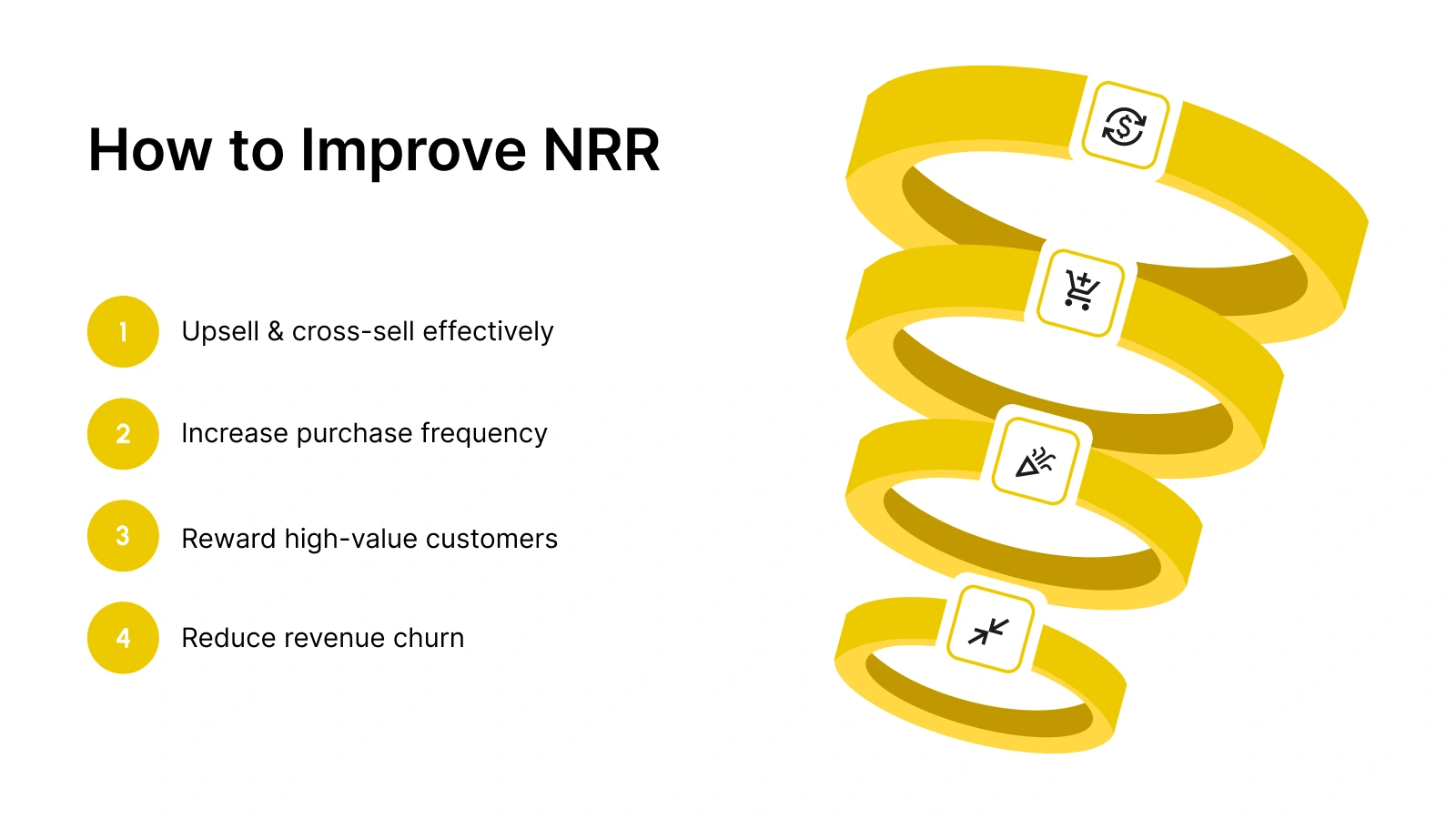
1. Drive Upsells and Cross-Sells Strategically
Increasing revenue from existing customers often starts with encouraging them to explore more of your product range. This can be done through well-timed recommendations, bundles, or complementary product suggestions.
Instead of pushing random products, the focus should be on relevance. When customers see value in upgrading or adding to their purchase, they are more likely to spend more without feeling pressured.
2. Increase Purchase Frequency
Another key lever for improving NRR is reducing the time between purchases. The more frequently customers return, the higher their overall value.
This can be achieved through replenishment reminders, subscription models, or timely nudges based on usage patterns. When you align communication with when customers are most likely to need the product again, repeat purchases become more predictable.
3. Focus on High-Value Customer Segments
Not all customers contribute equally to revenue growth. A small percentage of customers often drives a large portion of revenue.
Identifying these high-value customers and giving them differentiated experiences can significantly improve NRR. This could include exclusive rewards, faster earning rates, or early access to new products. These strategies encourage continued engagement and higher spending over time.
4. Reduce Revenue Churn Before It Happens
Revenue loss doesn’t always come from customers leaving completely. In many cases, customers simply reduce how much they spend.
Tracking early signals, such as reduced purchase frequency or lower order value can help you identify at-risk customers. Re-engaging them at the right time prevents revenue decline and helps maintain overall growth.
Turn Repeat Customers Into Revenue Growth Engines with Nector
Most e-commerce brands don’t struggle with acquiring customers. They struggle with turning those customers into consistent, high-value buyers.
You may already see the patterns. Customers come back, but only during discounts. Repeat purchases don’t translate into higher order value. Referrals and reviews remain underutilized. Over time, retention looks stable, but revenue growth slows down.
The problem isn’t effort. It’s execution across too many disconnected tools.
Nector helps you turn retention into a structured system that drives both repeat purchases and revenue growth.
With Nector, you can:
Points and Tiered Loyalty Programs
Create customizable reward systems that encourage customers to return more frequently and spend more over time. Progress bars, milestones, and tier upgrades make the value visible and motivating.
Referral Programs That Drive Acquisition
Turn your existing customers into a scalable acquisition channel by rewarding referrals across WhatsApp, SMS, and email, with built-in tracking and control.
Automated Review Collection
Incentivize customers to leave reviews and user-generated content, helping you build trust and improve conversion rates without manual follow-ups.
Behavior-Based Engagement
Trigger personalized communication based on customer actions, whether it’s a repeat purchase, milestone achievement, or inactivity, ensuring your brand stays relevant across the journey.
Real-Time Analytics and Insights
Track redemption rates, customer engagement, and revenue impact from a single dashboard, allowing you to continuously optimize your loyalty strategy.
Instead of running separate campaigns for retention, referrals, and engagement, Nector brings everything into one system. This ensures your customers not only return, but also increase their value over time, helping you improve both customer retention and NRR in a scalable way.
Conclusion
A lot of e-commerce growth looks good until you zoom in. Orders are coming in, but they’re mostly from new customers. The same people rarely come back, and when they do, they don’t spend much more than the first time. So every month starts from scratch, with more money going into acquisition just to maintain the same numbers.
That’s where the gap is. Retention without increasing customer value doesn’t move the business forward; it just slows down the decline.
What you actually want is a setup where customers come back because there’s a reason to, spend more because it makes sense to, and stick around long enough to matter. That only happens when post-purchase isn’t an afterthought, but something intentionally designed.
Nector helps you put that structure in place, so repeat purchases, referrals, and engagement aren’t left to chance, but become a consistent part of how your revenue grows. If you want to see how this would work for your brand, you can book a demo and walk through it with the team.
FAQs
What is the difference between NRR and customer retention?
Customer retention measures how many customers stay, while NRR measures how much revenue you retain and grow from those customers.
What is a good NRR benchmark?
An NRR above 100% is considered strong, as it means revenue from existing customers is growing.
Can you have high retention but low NRR?
Yes. Customers may return but spend less, leading to stable retention but declining revenue.
Why is NRR important for growth?
NRR shows whether your business can grow revenue without acquiring new customers.
Is NRR relevant for e-commerce?
Yes, especially for brands with repeat purchases, subscriptions, or upsell opportunities.

Related Blogs


%201%20(2).webp)
Start Building Customer Retention That Lasts